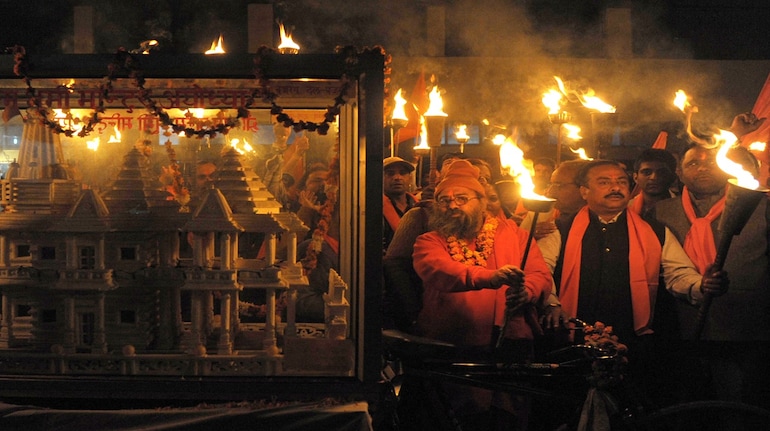
The Ayodhya dispute had already seen several decades of litigation by the late 1970s, since the appearance of idols inside the Babri Masjid in 1949, an episode recorded in Faizabad district administrative records, criminal case filings of 1949-50, and later summarized in the Government of India’s 1993 White Paper on Ayodhya. During the 1960s and 1970s, the structure remained locked, although Hindu worship was allowed from outside the grill, recorded in civil suit documents and district court correspondences.
Till the early 1980s, the dispute had been confined essentially to the courts in Faizabad and sporadic local demonstrations. There was no national mobilisation on the issue, nor did any political party put Ayodhya at the heart of an electoral programme.
The VHP enters the Ayodhya question (early 1980s)
The Vishva Hindu Parishad, established in 1964, was the first major national organisation to take Ayodhya as the centrepiece of its agenda. Archival material reveals that the resolutions of the VHP's 1983 national meeting show that the construction of a Ram temple at Ayodhya was formally taken up by the organisation as its prime objective.
Throughout the early 1980s, the VHP organised state-level committees, conferences of religious leaders, and distributed pamphlets, posters, and religious literature. Press reports during the time and VHP internal circulars speak about mass Ramayana recitation programmes, regional gatherings of sadhus, and processions that journeyed through towns and villages. These were the first efforts to move Ayodhya from a courtroom issue to a cultural-religious campaign with national reach.
The 1984 Dharma Sansad and coordinated national demands
VHP organized a major Dharma Sansad of religious heads in 1984, which was documented in VHP records as well as reported widely across the national press of that time. The gathering demanded "liberation" of Ayodhya along with Kashi and Mathura, marking the first articulation of Ayodhya within a larger Hindu religious framework.
The Sansad called for:
• Release of the locked site
• Construction of a Ram temple at the birthplace
• Nationwide campaigns to increase awareness of Ayodhya
That same year, VHP launched the Ram Janaki Rath Yatra from Sitamarhi to Ayodhya, as described in Yatra brochures and contemporary newspaper reports, collecting offerings, signatures, and support across states. This represents one of the earliest mass-contact programmes of the temple campaign.
The political context: Shah Bano, Mandal and shifting alignments
A number of national developments in the 1980s contributed to an atmosphere in which religious identity became an axis of political mobilization.
1. The Shah Bano case (1985-86)
The Supreme Court judgement and the legislation that followed, the Muslim Women (Protection of Rights on Divorce) Act, 1986, led to a controversy that witnessed debates on minority rights and secularism. Press editorials and debates in Parliament from that period reflect how the controversy inadvertently linked up with Ayodhya-the parties were mobilising public opinion on religious issues.
2. The Mandal Commission debates
While implementation came in 1990, discussions through the 1980s on caste reservations reconfigured political alliances. Reports of the Second Backward Classes Commission and political analyses of the time show how new identity lines were forming—lines that the temple movement later drew upon.
The 1986 opening of the site
The turning point happened on February 1, 1986, when District Judge K.M. Pandey ordered the opening of the gates to allow Hindu devotees access to the idols. This order is documented in Faizabad District Court records and summarised in later judicial reviews, such as the Allahabad High Court's 2010 judgment.
The unlocking received wide coverage in national newspapers and elicited immediate reactions in both communities. The Muslim organisations protested strongly, while Hindu groups viewed it as a legal affirmation of their claim. This was the moment widely cited in political analyses as when Ayodhya entered mainstream national discourse.
The BMAC is formed (1986)
In response, the Muslim leadership established the Babri Masjid Action Committee (BMAC), according to its constituent resolutions and press statements. State-level committees, public meetings and coordinated legal strategies followed, which marked the institutionalisation of Muslim mobilization.
For the first time, the dispute involved national bodies representing both communities, rather than only local litigants.
Change in the BJP: Palampur 1989
Although founded in 1980, the BJP initially stressed a Gandhian socialism. According to party records, the turning point came at the 1989 Palampur National Executive, where the BJP explicitly supported the building of a Ram temple.
It aligned the party with the VHP's cultural-religious mobilization and provided a clear political platform for the temple demand.
VHP’s Shila Pujan and Shilanyas (1989)
In 1989, the VHP undertook the Shila Pujan campaign of collecting consecrated bricks from across India. Newspaper accounts and VHP documentation report that millions participated, donating bricks inscribed with “Shri Ram.”
The government allowed a Shilanyas (the laying of the foundation) ceremony outside the immediate confines of the disputed structure on 9 November 1989. Thousands attended and the event received widespread media coverage—establishing Ayodhya as a symbol with nationwide emotional traction.
Yatras and mass congregations
The VHP and other allied organizations undertook:
• Ram-Janaki Yatras
• Kalash Yatras
• Ekatmata Yatras
Press reports, movement pamphlets, and police records describe how these yatras moved across states, touching both major cities and rural belts. They synchronised with festivals and fairs, embedding Ayodhya into everyday religious life.
Media and cultural amplification
The 1980s witnessed a boom in mass communication. Doordarshan’s Ramayan (1987–88), among the most-watched serials in Indian television history, amplified public familiarity with the Ram story. While it was not a part of political movements, its impact on cultural imagination has been widely noted in media studies.
Pamphlets, audio cassettes, and posters circulated in high volumes, making Ayodhya a household conversation irrespective of region or language.
The 1989 general election: A shifting political landscape
While in the 1989 Lok Sabha elections, the BJP increased its seats from 2 to 85-a transformation noted in Election Commission of India data. Analysts frequently identify the party's alignment with the temple issue as a central factor shaping voter sentiment. With the Janata Dal government depending partly on BJP support, the temple movement gained further political visibility.
Conclusion: How the 1980s reshaped Indian politics
From a localized conflict, the Ram Janmabhoomi movement transformed into a national religious-political movement by the close of the decade of the 1980s. The articulation of several forces can be shown from sources such as VHP resolutions, BMAC statements, court records, press archives, broadcast data of Doordarshan, and Election Commission reports:
• Organisational commitment by the VHP
• Legal turning points like the 1986 unlocking
• Institutionalised Muslim mobilisation
• BJP's formal adoption of the temple demand
• Yatras and mass ceremonies
• Cultural dissemination of Ram narratives
Put together, these factors made Ayodhya a defining issue of modern Indian politics. The momentum built through the 1980s laid the ground for the dramatic developments of the early 1990s-the Rath Yatra of 1990 and the demolition of 1992-events whose implications continue to shape India's political contours.
Discover the latest Business News, Sensex, and Nifty updates. Obtain Personal Finance insights, tax queries, and expert opinions on Moneycontrol or download the Moneycontrol App to stay updated!
Find the best of Al News in one place, specially curated for you every weekend.
Stay on top of the latest tech trends and biggest startup news.