In the immediate aftermath of India’s high-precision strikes under Operation Sindoor, which targeted nine terror hubs deep within Pakistan and Pakistan-occupied Kashmir, Islamabad attempted to mount an attempted counteroffensive aimed at hitting multiple Indian cities.
On Thursday, the defence ministry said the Pakistani military tried last night to target Awantipura, Srinagar, Jammu, Pathankot, Amritsar, Kapurthala, Jalandhar, Ludhiana, Adampur, Bhatinda, Chandigarh, Nal, Phalodi, Uttarlai, and Bhuj but these attempts were foiled and a Pakistani air defence system was destroyed in Lahore.
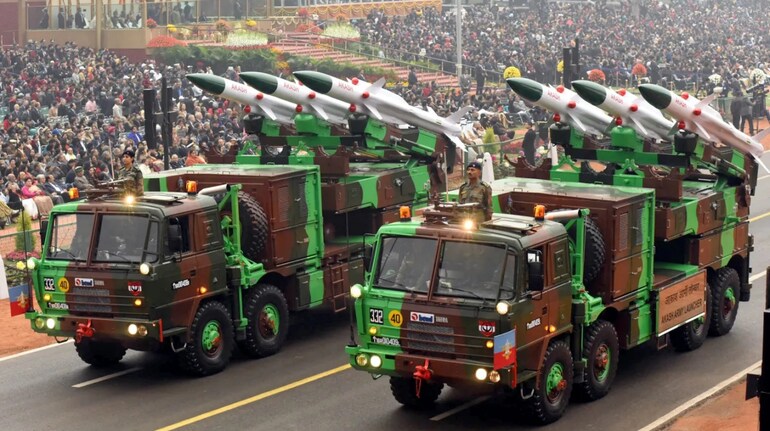
The swift and coordinated deployment of India’s indigenous Akash surface-to-air missile system — along with the Indian Air Force's S-400 Triumf, often dubbed India’s “Sudarshan Chakra” — helped intercept and neutralize incoming threats, preventing what could have been a catastrophic escalation.
Akash: India’s Indigenous Air Guardian
Developed by the Defence Research and Development Organisation (DRDO), Akash is a medium-range mobile surface-to-air missile defence system developed by the Defence Research and Development Organisation (DRDO) and the missiles produced by Bharat Dynamics Limited.
The missile system can target aircraft up to 45 km away, at altitudes up to 18,000 m. It has the capability to neutralize aerial targets like fighter jets, cruise missiles and air-to-surface missiles as well as ballistic missiles.
An Akash battery comprises a single Rajendra 3D passive electronically scanned array radar and four launchers with three missiles each, all of which are interlinked. Each battery can track up to 64 targets and attack up to 12 of them.
The Role of S-400: India’s Strategic Umbrella
While Akash provided tactical, short-to-medium range air defence, the S-400 Triumf system—with a range of up to 400 km—offered long-range protection. Deployed strategically by the Indian Armed Forces, the S-400 systems tracked Pakistan's long-range missile threats and high-flying aircraft.
Key Features of S-400:
According to sources quoted by News18, India used the Akashteer system, recently deployed along the western front, to create an advanced digital shield over the Line of Control and the international border.
The system integrated inputs from all radar sources — including ground-based radars and airborne early warning systems — and generated a live web of real-time data to precisely track aerial threats. This network enabled Indian forces to intercept and neutralise every missile launched from across the border that night, preventing damage to any intended targets.
Discover the latest Business News, Sensex, and Nifty updates. Obtain Personal Finance insights, tax queries, and expert opinions on Moneycontrol or download the Moneycontrol App to stay updated!
Find the best of Al News in one place, specially curated for you every weekend.
Stay on top of the latest tech trends and biggest startup news.