







The Indian Air Force (IAF) secured decisive air superiority over much of Pakistan during Operation Sindoor, carrying out deep-penetration strikes that severely degraded Pakistan’s air combat capability and pushed Islamabad to seek a ceasefire within days, according to a detailed assessment by a Switzerland-based military think tank.
The 47-page report, Operation Sindoor: The India-Pakistan Air War (7-10 May 2025), authored by military analyst Adrien Fontanellaz, was published last week by the Centre d’Histoire et de Prospective Militaires (CHPM), an independent military history and strategic studies institution based in Pully, Switzerland.
The study concludes that Pakistan was effectively “coerced” into agreeing to a ceasefire after losing the ability to meaningfully contest Indian air operations during the four-day conflict from May 7 to May 10, 2025.
India's air dominance and deep strikes
By the final phase of the engagement, the IAF had gained near-total freedom of action, enabling long-range precision strikes deep inside Pakistani territory. In contrast, the Pakistan Air Force (PAF) had lost the capacity to mount effective counter-attacks, the report says.
By the morning of May 10, Indian forces were striking targets well inside Pakistan using long-range munitions, including BrahMos and SCALP-EG cruise missiles. Pakistani air operations, meanwhile, were increasingly constrained by the degradation of forward surveillance radars and the threat posed by India’s S-400 air defence systems, particularly to PAF airborne early warning and control (AEW&C) aircraft.
Opening strikes and Pakistan’s response
According to the report, the conflict began on the night of May 7, when the IAF launched two coordinated strike packages involving Rafale and Mirage-2000 fighter jets. The targets included the headquarters of Jaish-e-Mohammed in Bahawalpur and Lashkar-e-Taiba in Muridke.
One Indian strike formation reportedly penetrated Pakistani airspace at low altitude before executing a pop-up attack intended to draw out Pakistani interceptors. Pakistan responded by scrambling more than 30 fighter aircraft and launching PL-15 long-range air-to-air missiles, with Indian Rafales identified as priority targets.
Disputed aircraft loss claims
In 2025, Pakistan claimed it had shot down six Indian aircraft during the fighting. The Swiss assessment, however, states that publicly available visual evidence supports the loss of only three Indian aircraft: one Rafale, one Mirage-2000, and a third fighter assessed as either a MiG-29 or a Su-30MKI.
India has rejected Pakistan’s claims regarding aircraft losses.
The recovery of multiple PL-15 missile casings on Indian territory suggests that several IAF pilots successfully evaded incoming missiles, the report adds.
Drone and missile offensive blunted
Beginning May 7, Pakistan launched a large-scale drone and missile offensive aimed at Indian military targets. The first wave involved more than 300 drones, followed by a second wave of around 600 drones, alongside artillery rockets, ballistic missiles and air-launched munitions.
Targets included Indian Army positions, air bases, logistics hubs and air-defence systems. The objective, the report says, was to force Indian radars to activate so they could be identified and neutralised.
Nonetheless, India’s layered air-defence network, supported by jamming, spoofing and sensor fusion, intercepted the majority of incoming threats. More than half of the drones were reportedly destroyed by anti-aircraft guns alone.
The study credits the integration of the IAF’s Integrated Air Command and Control System (IACCS) with the Army’s Akashteer network, which allowed Indian forces to switch radars on only briefly, denying Pakistan the ability to accurately map Indian air-defence positions. Despite repeated attempts, Pakistan failed to establish India’s electronic order of battle.
Failed attacks on Indian air bases
Pakistan’s largest assault came on the night of May 9-10, focusing on Indian air bases and nearby S-400 batteries at Adampur, Srinagar and in the Kutch region. Despite extensive use of drones, electronic jamming and fighter aircraft, the attacks failed to breach Indian defences. Pakistani claims of damage to S-400 systems were not supported by verifiable evidence, the report states.
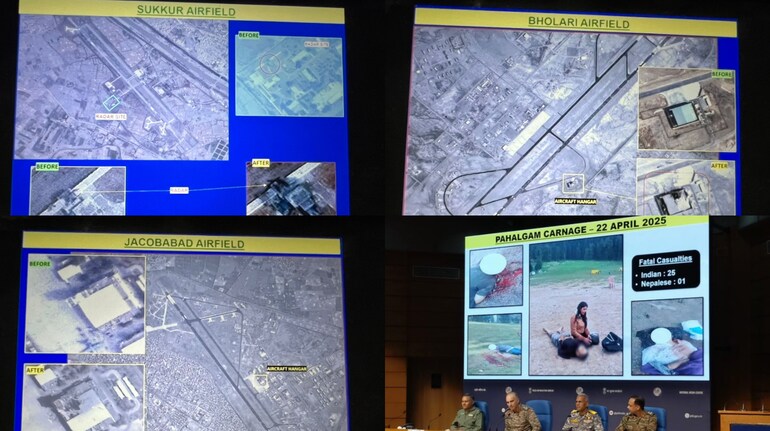
India responded between 2 am and 5 am on May 10 with long-range missile strikes launched from within Indian airspace, targeting Pakistani air bases, radar installations and surface-to-air missile sites. A second wave at around 10 am expanded the target set to include manned aircraft on the ground. Several Pakistani air bases were rendered inoperative, with runways cratered and hangars destroyed.
Damage assessment and ceasefire
Citing the IAF’s internal assessment, the report further notes that Indian strikes destroyed four to five fighter aircraft, one AEW&C aircraft, one transport aircraft, multiple drones, several radar installations, command centres and at least one surface-to-air missile battery. Pakistan acknowledged casualties at one air base but disputed the overall scale of the damage.
By midday on May 10, Pakistani military authorities sought a ceasefire, which India accepted.
Strategic conclusions
The report concludes that India met both its political and military objectives by delivering punitive strikes against terror infrastructure, neutralising Pakistan’s air response and preventing escalation beyond defined limits.
Unlike many contemporary conflicts that evolve into prolonged engagements, the confrontation ended swiftly, with India retaining operational dominance throughout. New Delhi, the analysis says, controlled both the tempo and the ceiling of escalation, demonstrating credible deep-strike capability while avoiding any breach of nuclear thresholds.
About the study
Founded in 1969, CHPM describes itself as a neutral forum for professional military research and lessons-learned analysis. The report underwent institutional review by a committee that included Paris-based strategic analyst Joseph Henrotin, retired Swiss Air Force major general and former chief of staff Claude Meier, and nuclear doctrine and arms control specialist Arthur Lüsenti.
Discover the latest Business News, Sensex, and Nifty updates. Obtain Personal Finance insights, tax queries, and expert opinions on Moneycontrol or download the Moneycontrol App to stay updated!
Find the best of Al News in one place, specially curated for you every weekend.
Stay on top of the latest tech trends and biggest startup news.










