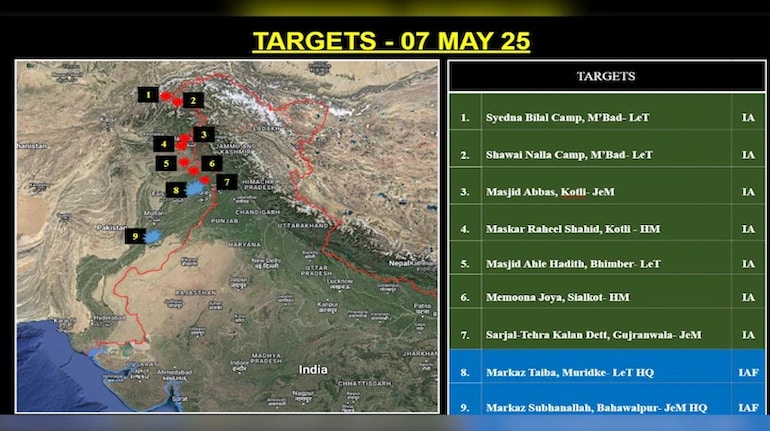
Three months after India’s precision strikes on terror camps in Pakistan and Pakistan-occupied Kashmir (PoK), new visuals and insights into Operation Sindoor have been shared by the Indian Air Force. The retaliatory strikes followed the Pahalgam terror attack in Jammu and Kashmir that claimed 26 lives.
Speaking at the NDTV Defence Summit, Vice Chief of Air Staff Air Marshal Narmdeshwar Tiwari revealed that fewer than 50 weapons were used to push Pakistan to agree to a ceasefire.
“From the options on the table, we had multiple target sets. Eventually, we narrowed them down to nine,” he said. “The key takeaway is that with less than 50 weapons, we were able to end the conflict. That’s the crucial point I want everyone to remember.”
He said that starting a war is easy, but ending one is not. “That was always a key consideration. Our forces were fully mobilised and prepared for any scenario that might have escalated,” Tiwari added.
The Air Marshal credited India’s Integrated Air Command and Control System (IACCS) for the operation’s success, calling it the backbone of both offensive and defensive moves. The system, he said, allowed India to absorb initial shocks and deliver a “hard-hitting reply” that compelled Pakistan to de-escalate.
He further explained that the government’s directives were clear: the response had to be visible, the message strong enough to deter future attacks, and the armed forces were to operate with complete freedom, even in case the situation escalated into a full-scale war.
“One major advantage was the operational freedom given to us. It shortened our decision cycles significantly. As events unfolded, we were able to act in real time,” Tiwari said.
After four days of missile strikes, drone incursions, and artillery exchanges along the Line of Control (LoC), both countries agreed to cease all military actions on land, air, and sea from the evening of May 10. However, hours later, Indian forces reported Pakistani drones entering Indian airspace in Jammu and Kashmir, including Srinagar, and even parts of Gujarat.
India accused Pakistan of violating the ceasefire, warning of an “adequate and appropriate response.” Foreign Secretary Vikram Misri stressed that New Delhi takes these violations “very, very seriously.”
On the morning of May 10, IAF jets launched BrahMos-A air-launched cruise missiles targeting key Pakistan Air Force (PAF) bases. The first confirmed hits were at Chaklala near Rawalpindi and Sargodha in Punjab province, both strategic for the Pakistan military. Later assessments confirmed additional strikes on Jacobabad, Bholari, and Skardu in PoK.
By that afternoon, after Indian forces neutralised several Pakistani tactical moves, Pakistan’s Director General of Military Operations (DGMO), Major General Kashif Abdullah, called his Indian counterpart, Lieutenant General Rajiv Ghai, at 3:35 pm IST, a detail later confirmed by Foreign Secretary Misri.
Discover the latest Business News, Sensex, and Nifty updates. Obtain Personal Finance insights, tax queries, and expert opinions on Moneycontrol or download the Moneycontrol App to stay updated!





Find the best of Al News in one place, specially curated for you every weekend.
Stay on top of the latest tech trends and biggest startup news.