






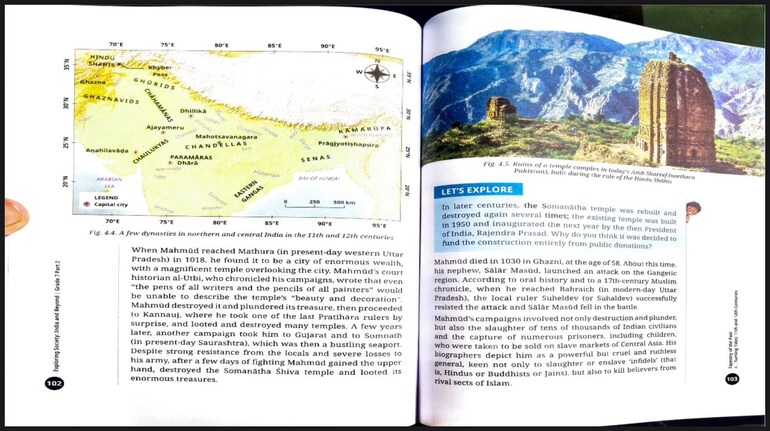
A new NCERT class 7 social science textbook released on Friday carries a much longer and sharper section on the Ghaznavid invasions, placing stronger emphasis on Mahmud of Ghazni’s destruction, plunder and the spread of his version of Islam than earlier editions.
The six-page section titled The Ghaznavid Invasions opens with a boxed “word of caution”, similar to the note used before the Delhi Sultanate chapter in the class 8 book. “Our approach is that it is better to face them and analyse them to understand what made such developments possible and, hopefully, help avoid their recurrence in future. In addition, we should not forget that while past events cannot be erased or denied, it would be wrong to hold anyone responsible for them today,” the note read, as reported by Indian Express.
Earlier, NCERT had dropped portions on Gujarat riots and violence after the demolition of Babri Masjid. In an interview with the Indian Express, director DP Saklani in 2024 had defended the move saying, children should not be taught about riots in schools as the goal should be to create "positive citizens" and not violent and "depressed individuals".
Part 1 of the new textbook was released earlier this year, and this updated volume will be used in the current academic session.
The older class 7 history book had only one short paragraph on Mahmud of Ghazni, mentioning his 17 raids into the subcontinent and his targeting of wealthy temples. The new edition replaces that with a detailed account of his military campaigns, including the plunder of Mathura, Kannauj and the destruction of the Somnath temple in Gujarat.
The book narrates Mahmud’s 17 India campaigns, his defeats of Jayapala and Jayapala’s son, and highlights his use of fast cavalry attacks and mounted archers. Students are told how the Somnath temple fell after days of fighting and how Mahmud returned to Ghazni with enormous wealth. The chapter also notes that the present Somnath temple, rebuilt in 1950 and inaugurated by President Rajendra Prasad, was funded entirely through public donations. Students are asked to reflect on why that choice may have been made.
The expanded section describes Mahmud as a powerful but ruthless general whose campaigns involved the killing of tens of thousands of civilians and the capture of children who were later sold in Central Asian slave markets. It cites his biographers and chroniclers such as Al-Utbi, who wrote that Mahmud destroyed temples, carried away children and cattle as booty and built mosques in place of sacred structures. The book also quotes Al-Biruni’s account of the destruction of the Somnath Shivalinga and the removal of its fragments to Ghazni.
None of these details were present in the earlier textbook.
After the Ghaznavid section, the chapter Turning Tides: 11th and 12th Centuries moves to Muhammad Ghuri, Qutb-ud-din Aibak and Bakhtiyar Khilji. For the first time in a class 7 NCERT book, there is a full account of Khilji’s campaigns in eastern India and the destruction of the great Buddhist centres of Nalanda and Vikramashila. The book describes large-scale killings of monks and the looting of wealth, and refers to accounts that say Nalanda’s library burned for months. It adds that historians broadly agree that the razing of these institutions sped up the decline of Buddhism in India.
The revised chapter also introduces students to the Arab invasion of Sindh by Muhammad bin Qasim. It quotes a 13th-century Persian record that described his campaign as a religious duty and recounts the killing of King Dahar. The book explains how the term “infidel” was used in medieval Islam and notes that the Arab conquest of Sindh had a limited long-term political or religious impact compared with Arab conquests elsewhere.
The chapter closes by noting that large parts of north India and all of south India remained outside the reach of Turkic invaders, and that local rulers sometimes united against them.
NCERT Director Dinesh Saklani said the new content is self-explanatory. The textbooks follow the National Education Policy 2020 and the National Curriculum Framework 2023. Earlier, class 7 social science was split across three books.
*With agency inputs
Discover the latest Business News, Sensex, and Nifty updates. Obtain Personal Finance insights, tax queries, and expert opinions on Moneycontrol or download the Moneycontrol App to stay updated!
Find the best of Al News in one place, specially curated for you every weekend.
Stay on top of the latest tech trends and biggest startup news.









