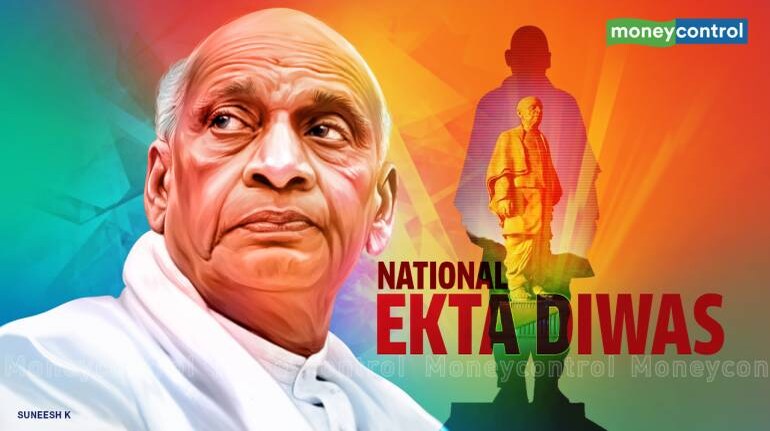
Sardar Vallabhbhai Patel would have been 148 years old this October 31. The day is now celebrated as Rashtriya Ekta Divas or National Unity Day, to honour his monumental achievement of integrating more than 550 princely states into the Union of India. In recent years, decades after his passing, he has also become the subject of some political controversy with both the BJP and the Congress claiming to own his legacy.
I grew up hearing from my father, who had been a young refugee during the 1947 Partition, that things would have been much better for India if Sardar Vallabhbhai Patel had been the prime minister instead of Jawaharlal Nehru. This thought has been a constant undercurrent in Indian political discourse. But it was rarely voiced loudly till Narendra Modi established himself as the unchallenged leader of Gujarat and began building the Statue of Unity, the world’s tallest statue.
Obviously, it is impossible to prove that India would have followed a different trajectory had Patel been prime minister. After all, he passed away less than a year after India became a republic. Yet, the truth—and not many people know this—is that in the days leading up to Independence, Patel had been the Congress workers’ near-unanimous choice for prime minister. Except Mahatma Gandhi’s.
By early 1946, it was clear that Independence was close. The British Raj would invite the president of the Indian National Congress to form the interim government and this person would eventually be prime minister. Gandhiji made his view public—he wanted Nehru.
But technically, only the Pradesh Congress Committees (PCC) could nominate and elect the Congress president. When the votes were counted, it was found that, despite Gandhiji’s backing, Nehru had not received a single nomination. Twelve of the 15 PCCs had nominated Patel and the other three had abstained.
Gandhiji then stepped in and asked his fellow Gujarati to withdraw in favour of Nehru. We have been taught in our history textbooks that Nehru was the unanimous choice as prime minister. This is a total fabrication. The reason for this distortion of history is of course the construction of the Nehru cult.
In fact, this was the third time that Gandhiji had stepped in at the last minute to deprive Patel of the leadership of the Congress, each time for Nehru. He had done it earlier in 1929 and 1937. Among leaders who publicly disagreed, either immediately or years later, with Gandhiji’s choice of India’s first prime minister were Rajendra Prasad, Maulana Azad and C. Rajagopalachari.
In his autobiography India Wins Freedom, Azad, hardly a Hindutvavadi, wrote: “(Supporting Nehru for Congress president in 1946) was perhaps the greatest blunder of my political life... (It was a great mistake that) I did not support Sardar Patel… I can never forgive myself when I think that if I had not committed these mistakes, perhaps the history of the last ten years would have been different.”
But Patel was a loyal soldier who had always accepted the decisions of the leader he revered. He had been one of India’s leading barristers, but had renounced wealth and the high life without a second thought to follow Gandhiji into the freedom movement. For him, a lofty position was inconsequential compared with Independence and India’s interests. Patel gave up his legitimate claim rather than risk dividing the Congress and India.
Yet, loyal soldier Patel would defy Gandhiji and Nehru when it came to protecting the nation. Barely two months after Independence, Pakistani tribesmen and soldiers disguised as tribesmen invaded Kashmir. Patel forced the Maharaja to sign the Instrument of Accession to India as a condition for the Indian Army to move in. But as Field Marshall Sam Manekshaw recalled decades later in an interview, Nehru still dithered.
In an early morning meeting with Lord Mountbatten, Nehru and Patel, Manekshaw, then a colonel, told them bluntly that unless India flew in troops within the next few hours, Srinagar would be lost. As Manekshaw remembered, “As usual Nehru talked about the United Nations, Russia, Africa, God Almighty, everybody, until Sardar Patel lost his temper. He said, ‘Jawaharlal, do you want Kashmir, or do you want to give it away?’ (Nehru) said, ‘Of course, I want Kashmir.’ Then (Patel) said, ‘Please give your orders.’ And before Nehru could say anything, Sardar Patel turned to me and said, ‘You have got your orders.’ I walked out, and we started flying in troops at about 11 o'clock or 12 o'clock.” Srinagar was saved.
In 1947, the princely states accounted for 40 percent of India’s land area and 23 percent of its population. Using every technique of persuasion possible, Patel integrated them into the Indian Union. Where negotiations did not work, he used military force.
When the Nizam of Hyderabad, the largest princely state, refused to accede to India, Mountbatten and Nehru worked hard to achieve a peaceful solution, but the Nizam rejected all deals. A year went by. In September 1948, Nehru was on a tour of Europe. Patel, in his capacity as acting prime minister, ordered the Indian Army into Hyderabad. The state became part of the Indian Union.
To put it in simple terms, Patel practically created our nation’s current map.
From what we know of the man and his ideals, he would have been bemused by the tug-of-war between the BJP and the Congress over his legacy. On one side are politicians and historians who argue that Patel’s contribution to the freedom movement and modern India have been deliberately downplayed to maintain the halo around Nehru and his family. Now, in its battle against the dynasty, the BJP wants to rehabilitate Patel and even appropriate him in its pantheon.
On the other side are those who point out that it was Patel, as home minister, who banned the RSS after Mahatma Gandhi’s assassination. This is met with the argument that it was Patel again who lifted the ban 18 months later after the government failed to establish any link between the RSS and the assassination in court.
What seems evident, however, from his speeches, writings and political positions is that Patel’s view of secularism differed from Nehru’s. This is really the crux of the matter.
For Nehru, secularism, to a significant extent, was about the protection of the rights and faith of minorities while bringing the majority faith under a modern legislative and legal system. Patel saw secularism as everyone enjoying the same rights under the Constitution—that minorities should not be seen as only people in need of state benevolence; they should have equal duties as anyone else in crafting India’s story of religious harmony.
As home minister, he was the man who had to handle the post-Partition exodus across the borders and the horrifying violence. A few incidents from those days give us a sense of his brand of secularism.
In Delhi, he visited the dargah of Nizamuddin Auliyah where hundreds of fear-stricken Muslims had taken shelter and made certain that they would be safe. He convinced Sikh leaders in Amritsar to let convoys of Muslim refugees pass into Pakistan without any bloodshed.
Soon after, a sniper’s bullet whizzed past him as he was touring a Muslim-controlled area in Delhi. Told by a police officer that it was impossible to silence the snipers without blowing up the building, he said, “Blow it up.”
He was a prime mover in the reconstruction of the Somnath temple which had been demolished by Mahmud of Ghazni. But he was also clear that the temple would be rebuilt with public contributions, not government funds.
More than anything else, the Sardar was a disciplined soldier for his nation, uninterested in either pelf or power. For him, there was no higher cause than that of India.
Would our nation have been different if he had been our first prime minister, or had lived for another five or ten years? This is “what if?” speculation that is not very useful to the average Indian. The controversy over which political party represents his values more today is much less important than the sheer fact that a massive majority of Indians do not know what he stood for and what we owe to him. It is not their fault, but it is still a shame.
Discover the latest Business News, Sensex, and Nifty updates. Obtain Personal Finance insights, tax queries, and expert opinions on Moneycontrol or download the Moneycontrol App to stay updated!

Find the best of Al News in one place, specially curated for you every weekend.
Stay on top of the latest tech trends and biggest startup news.