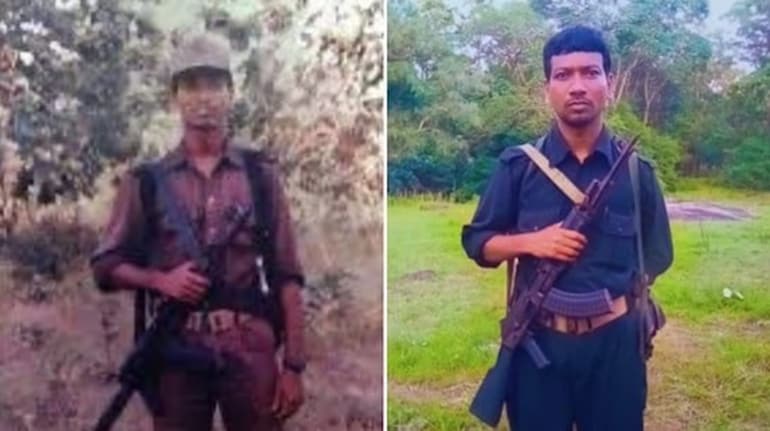
The violent protest in Delhi over air quality last week took a startling turn when a group of demonstrators shouted "Madvi Hidma amar rahe!" slogans hailing the recently killed CPI (Maoist) commander. The footage, now widely circulated, triggered outrage across political circles, prompting the Delhi Police to arrest several protesters and launch an investigation into possible extremist links.
But behind the national controversy lies the story of one of India's most dreaded and elusive Maoist commanders, of a man security forces had hunted for over a decade, and whose death in an encounter in Andhra Pradesh marks one of the most significant blows to Left-Wing Extremism in years.
Ghost-like figure in Maoist hierarchy
Madvi Hidma, believed to be around 40, hailed from a remote village in Sukma district of Chhattisgarh. He rose through Maoist ranks from a foot soldier to the head of the People's Liberation Guerrilla Army's (PLGA) Battalion 1, the outfit's most elite and lethal strike unit.
According to The Indian Express, Hidma was the youngest member of the Maoists' Central Committee, and over the years became the most feared face of the insurgency. Over the years, Hidma had earned a notorious reputation as a commander known for planning ambushes with meticulous precision, exploiting terrain, and striking with overwhelming force.
Security agencies often described him as a "ghost" who was rarely photographed, almost never seen by villagers, constantly shifting locations in the forests that span Chhattisgarh, Telangana, and Andhra Pradesh.
India's most wanted Maoist
Hidma's battalion was linked to some of the deadliest Maoist attacks of the last 15 years. According to security agencies, Hidma is suspected to have masterminded as many as 26 deadly attacks targeting political leaders and security personnel alike. Hidma carried a reward of over Rs 40 lakh from multiple states and the National Investigation Agency.
Hidma is believed to have played a central role in some of the deadliest Maoist operations in Chhattisgarh, including the 2013 Darbha Valley massacre in which 27 people, including senior Congress leaders Mahendra Karma and Nand Kumar Patel, were killed after Maoists ambushed a political convoy. He was also linked to the 2017 Burkapal ambush, one of the worst attacks on the CRPF in recent years that left 25 personnel dead, as well as the 2021 Sukma-Bijapur encounter where 22 security personnel were killed and weapons looted.
Beyond these headline-making strikes, Hidma was associated with a series of operations across Dantewada, Sukma and Bijapur that cumulatively claimed dozens of lives and helped entrench Maoist influence in the region.
A high-value killing
On November 9, 2024, Hidma was killed during a joint operation by Andhra Pradesh's elite Greyhounds, Telangana police, and CRPF commandos in the Karriguttalu forest area in AP's Alluri Sitharama Raju district.
The Times of India reported that forces tracked his movement for weeks before intercepting him with a small group of Maoists. His body was later identified through multiple sources, though Maoists have not publicly confirmed his death in consistency with their long-running practice.
Security officials, nevertheless, have described the killing as the biggest counter-Maoist breakthrough since 2011, when Kishenji, another top commander, was eliminated.
Hidma's name at Delhi protests
At the Delhi air-pollution protest that turned violent at Jantar Mantar, several participants were heard shouting slogans of "Madvi Hidma amar rahe!" This immediately alarmed security agencies, as the slogan is commonly raised by Maoist cadres and sympathisers in Bastar after a major commander is killed.
Delhi Police registered cases under sections relating to unlawful assembly and assault, while central agencies began examining whether the protest had been infiltrated by extremist elements or whether the slogans were raised in ignorance by protesters unaware of Hidma's history.
Opposition parties accused authorities of "sensationalising" the incident, but officials told NDTV that any glorification of a Maoist commander involved in mass killings must be taken seriously.
Weakening Maoist resilience
For years, Hidma represented what security agencies termed "the Maoist advantage" that was characterized by intimate knowledge of the terrain, loyal local networks, deep ideological indoctrination and decentralised autonomy on the battlefield.
His death, experts say, removes a crucial tactical brain behind Maoist operations in central India as Hidma was identified among the last surviving top-tier commanders capable of planning high-casualty ambushes.
Yet, his mention in Delhi, hundreds of kilometres from the forests where he operated, has reopened questions about dormant urban Maoist networks, the spread of Maoist influence beyond Bastar, the ideological pull of insurgent figures and the political weaponisation of "urban Naxal" narratives.
The end of conflict?
Even though the killing of Madvi Hidma is a major tactical victory, forces acknowledge that the Maoist movement remains capable of sporadic violence, especially in remote tri-junction forest regions.
But the elimination of Hidma, and the controversy around his name in Delhi, underscores the paradox of India's Maoist conflict. While the insurgency weakens militarily, the Delhi incident reveals the next frontier for India's fight against Maoism -- one that continues to ignite political and ideological battles far beyond the forests.
Discover the latest Business News, Sensex, and Nifty updates. Obtain Personal Finance insights, tax queries, and expert opinions on Moneycontrol or download the Moneycontrol App to stay updated!
Find the best of Al News in one place, specially curated for you every weekend.
Stay on top of the latest tech trends and biggest startup news.