






The Indian Meteorological Department (IMD) on Tuesday projected above normal rainfall amounting to 108 per cent of the long-period average in June.
It said that India, during the entire monsoon season, may receive 106 per cent of the long-period average rainfall of 87 cm.
Secretary in the Ministry of Earth Sciences M Ravichandran said that the monsoon core zone is expected to get above-normal rainfall this season. The monsoon core zone includes parts of Madhya Pradesh, Chhattisgarh, Maharashtra, Odisha, and nearby areas.
Additionally, IMD Director General Mrutyunjay Mohapatra said that Northwest India is likely to receive normal rainfall, while the Northeast may see below-normal rain. Central and south peninsular India are expected to record above-normal rainfall.
The southwest monsoon arrived in Kerala on May 24 this year, eight days earlier than its usual onset date of June 1. IMD declares the onset of the southwest monsoon over Kerala any time after May 10, based on a set of scientific criteria revised in 2016.
This assessment is based on a combination of three primary meteorological indicators: 1) Rainfall: at least 60% of 14 stations in Kerala and nearby regions must record ≥2.5 mm of rain for two consecutive days.
2) Wind Patterns: Consistent westerly winds up to 600 hPa, with speeds of 15–20 knots (27–37 km/h) at 925 hPa.
3) Outgoing Longwave Radiation (OLR): Must fall below 200 W/m², indicating active convection and cloud cover.
The IMD may also consider the satellite imagery to identify the position of the maximum cloud zone along the west coast and water vapour imagery to monitor the extent of moisture incursion into the region.
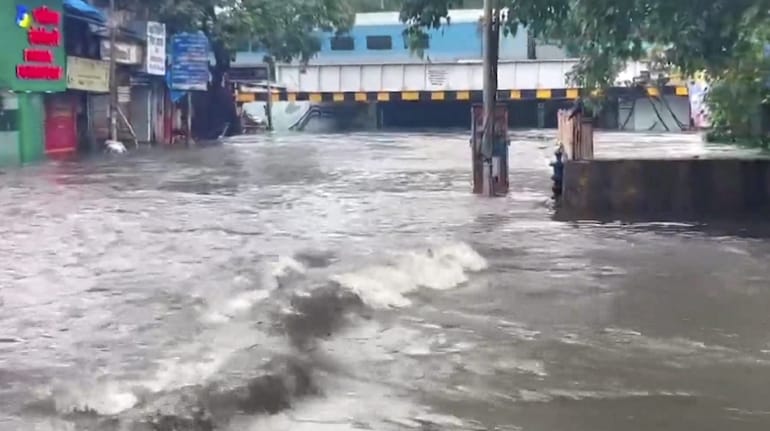
Meanwhile, the southwest monsoon battered Mumbai on Monday as the city recorded its earliest onset ever. The city also broke its 100-year-old record for rainfall received in May, which has now reached 295mm.
However, IMD did not call this a cloudburst and said was an 'intense rain spell'. A cloudburst is typically defined as extremely intense rainfall over a small area, usually 100 mm or more in one hour, which often leads to flash floods, landslides, and severe water logging.
The 'intense rain spell' exposed the unpreparedness in the financial capital as waterlogging was seen in areas which had never been flooded earlier, including the newly opened underground Acharya Atre Chowk Metro station.
Suburban train services, especially Harbour line, were hit by waterlogging while over 50 Central Railway services and 18 Western Railway services were cancelled.
Discover the latest Business News, Sensex, and Nifty updates. Obtain Personal Finance insights, tax queries, and expert opinions on Moneycontrol or download the Moneycontrol App to stay updated!
Find the best of Al News in one place, specially curated for you every weekend.
Stay on top of the latest tech trends and biggest startup news.









