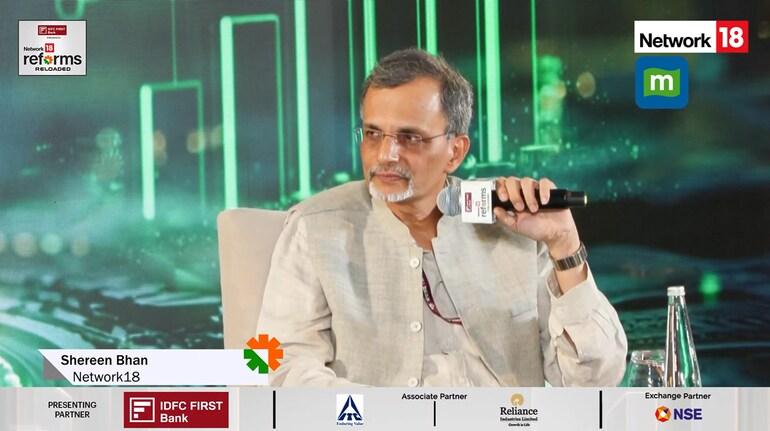
Speaking at the Network18 Reforms Reloaded 2025 summit in Delhi, Chief Economic Advisor Anantha Nageswaran said the landmark GST 2.0 reform will provide a strong push to domestic demand and strengthen growth momentum. He noted that India’s GDP is likely to trend toward the upper end of the 6.3–6.8% range projected in the Economic Survey, with the second-quarter numbers expected to come closer to the 7% mark.
Here is the full transcript:
Shereen Bhan: Well, thank you very much, ladies and gentlemen. We continue the dialogue and the conversations here at the Reforms Reloaded platform. And it is my pleasure and privilege to welcome here the Chief Economic Advisor, Mr. Anantha Nageswaran. Thank you very much, sir, for joining us here this afternoon.
Let's start with GST as well as the impact that the government hopes this GST cut will provide as an impetus to the economy. What is your own expectation? Do you believe that you now feel confident enough to review upwards your growth projections for the economy? Or do you believe that the band that you had articulated in the Economic Survey still holds?
Anantha Nageswaran: I think the GST 2.0 is a very significant landmark reform. I am very confident that, under the circumstances, it will provide a very significant boost to domestic demand. Because if you look at the total amount of taxes that is estimated to be foregone, it is exactly the amount of savings that the households are making. Coming on top of the direct tax relief or concessions made in the budget. And then, if you sort of take in the multiplier effect, it will definitely add quite a bit to the GDP numbers.
While I should actually be looking at revising my numbers upward, given my cautious nature, I will simply say that I am more comfortable now that the final number, which we have given a range of 6.3 to 6.8% in real terms, I am more comfortable now in saying that we will be tending towards the upper end of this range rather than the lower end of this range, considering what is happening on the external front. So that is the extent to which I am prepared to sound more relaxed and confident at this point. But once the second quarter number comes, we will revisit the estimates.
Shereen Bhan: We will take the higher end of that band that you had laid out in the Economic Survey. But if we could just understand the stimulus provided by both the income tax cuts as well as the GST benefits. The Prime Minister gave a number of Rs 2.5 lakh crore when he addressed the nation yesterday. What is the estimate that you are working with? Because I am sure that will go into the budget math as well.
Anantha Nageswaran: I think his numbers are quite appropriate, taking into account both the direct and the indirect taxes. Because, especially focusing on the indirect tax cut — GST 2.0 — it is a combination of three components. One is the reduction in rates from many categories going from 18 to 5 and the 12 becoming 5, etc. That is one major chunk. The second chunk is the withdrawal of the compensations.
These two are very positive to the households. The small minus is the one where a few categories where the rate goes from 28 to 40. So the final tax savings is the first two components minus the third component. And that number will be upwards of Rs 1 lakh crore. And then, if you really assume a marginal propensity to consume, as they call it — MPC in economics jargon — which basically means depending on how much households consume, then it leads to further income growth. So, two, three rounds of multiplier effect.
Then the total impact on the economy will be even more than Rs 2.5 lakh crore. So I think what the Honorable Prime Minister said was purely the static estimate of the tax saved for the households. But the impact on the economy can be bigger. But of course, we know that there are other uncertainties and other factors which may dilute some of this translation of the savings into aggregate demand or GDP growth, as we call it. But the total impact is of this order of magnitude between the direct tax relief and the indirect tax relief put together.
Shereen Bhan: I will come to the uncertainties that you alluded to in just a second. But I just want to continue with the GST conversation and talk about the impact on states and state finances. Because many states came out and said that they were concerned about the revenue impact that they would have to face. As you look at how things are panning out, and we have just seen the CAG numbers also come in as far as state revenues are concerned, what is your own indication, considering the fact that there is no longer any compensation cess?
Anantha Nageswaran: In fact, former RBI Governor Shri Rangarajan and Mr. Shanmugam, former Finance Secretary of the Tamil Nadu Government, wrote an article before the GST Council met about three weeks ago as to how well states have done with GST. And they particularly pointed out that the producing states, which were concerned about GST impacting them adversely, actually have ended up doing much better. So that is one.
The second point I would like to make is, the revenue neutral rate, which was around 15% when GST came into being, actually has been coming down even before this happened. So, by last year, it was down to 11% something. Every time the revenue neutral rate or the effective GST rate came down, the annual average collection actually kept going higher and higher. So you already have a track record where the reduction in the GST rate — effective GST rate — did not result in a decline in GST revenues.
But revenues were having a step-up function every year. And this happened even in 2019, before the elections sometime in February, March, or April, I don't remember the exact month, when the GST significant reliefs were announced, there was a concern that it would lead to a decline in revenue. But immediately after the elections, the monthly numbers picked up within no time.
So, these two examples, I think, give us encouragement that the volume growth will make up for the static calculation that, as the rate drops, the revenue collections will drop, because the volumes will go up. And the last point I want to make is, last year I wrote a paper co-authored with the Joint Secretary in the GST Council. We both wrote saying that whenever UPI transactions pick up, they have a very high correlation with GST revenues. And UPI transactions are going at 20 to 30% per annum, year on year, every month. So the rise in UPI transactions is actually a very good harbinger of GST revenues continuing to rise. And with the rate cut, the volume effect will dominate.
So we shouldn't be overly concerned because the track record is there. Rate reductions have led to more formalization rather than less formalization. And that means more revenues.
Shereen Bhan: That means more revenues?
Anantha Nageswaran: More transactions.
Shereen Bhan: More transactions, and hence more transactions. And hence you believe states have little reason to be concerned at this point in time. Which brings me to the question about the government's own fiscal map. We are, of course, getting into the budget-making exercise. Do you believe that this will have any impact as far as the government's own fiscal map is concerned?
Anantha Nageswaran: I think we are confident that the final number will be 4.4% of GDP, which is the gross fiscal deficit. We have had good non-tax revenue growth. And overall revenue growth is on track in comparison to last year's numbers. And we feel that the festival season will last all the way until the end of the year because of successive Diwali festivals spilling over towards Christmas and New Year, etc. So we are confident that the fiscal map will hold up very well for the current financial year.
Shereen Bhan: The Q2 numbers should be out shortly at the end of this month.
Anantha Nageswaran: Of the GST numbers, you mean?
Shereen Bhan: No, GDP.
Anantha Nageswaran: GDP for the second quarter will come only in November.
Shereen Bhan: Yes, November. That's right.
Anantha Nageswaran: It comes only at the end of November.
Shereen Bhan: Correct. But what's the expectation there on the back of the data available so far?
Anantha Nageswaran: I don't want to jinx the GDP number. But from whatever we have seen in the first two months of July and August, the second quarter numbers look very encouraging. We may be getting closer to the 7 handle even for the second quarter. Notwithstanding the tariff that came into effect from August 3rd week onwards, the fiscal second quarter growth numbers are looking quite promising based on the high-frequency indicators we track. But of course, that is still only about one and a half to two months of data. So we have to wait and see how September fares, etc. But we are quietly hopeful that the second quarter has maintained the momentum that we saw in the first quarter.
Shereen Bhan: And so closer to the 7% mark is what you are hoping for, on the back of the information you have?
Anantha Nageswaran: I would say I am hoping for rather than predicting it. I am not predicting it.
Shereen Bhan: Fair point.
Anantha Nageswaran: I am simply saying, based on the trends I have seen, it is the number that I hope for.
Shereen Bhan: We will take that. Sir, you talked about the tariff impact. What is the expectation if this were to continue? The hope is that we will be able to arrive at a middle path and there will be a conclusion to the trade negotiations that are underway. We do not know whether that will result in 25% of the additional tariffs being done away with. But if 50% continues for the foreseeable future, what will the impact be on the economy?
Anantha Nageswaran: I think it will have an impact. For this year, maybe, obviously, it will be slightly muted because half the year went away before the tariffs kicked in. And we also achieved 50% of our annual merchandise export to the US by August. So this year the impact will be diluted or compensated for by the GST cut, etc. So it will be very difficult to give you a net effect.
We have to make some simplifying assumptions. If the GST rate reductions were not there, based on what we knew by the end of August or something, we could have said this year's impact will be about 0.4 to 0.5% of GDP reduction. And next year it might be... I am saying reduction from what, you might ask? Reduction from the trend growth rate of 6.5%. That is what we would have said. And next year it would have been closer to 1%. But again, now that the GST rate reductions have happened, it might actually be a lower impact than what I just now mentioned.
Shereen Bhan: Since we are talking about the impact of the tariffs, and that is on goods so far, but what we have seen over the weekend is the first indication of the Trump administration now trying to go after services. H1B is the first move that is coming. Of course, there have been clarifications that the administration has put out, which have sort of provided some relief to what was expected as the worst-case scenario. What is your impression, assessment of the impact of this, especially when we talk about remittances, etc.?
Anantha Nageswaran: I think it is still very early days because, as you said, clarifications have been issued, and two-thirds of the annual visa issuances is pertaining to renewals. And that is not affected by this new announcement. And I think the fee also, if I am not mistaken...
Shereen Bhan: It’s one time.
Anantha Nageswaran: Not only that, I think it kicks in from 2026.
Shereen Bhan: Yes, from the next lotter, that is correct.
Anantha Nageswaran: This is 2026.
Shereen Bhan: ’26, correct.
Anantha Nageswaran: So, I think in that sense, the impact will not be immediate. And I think there will be, by the time the next lottery comes around, I am sure there is plenty of room for the American companies and the Indian companies to figure out ways to deal with this, etc. So, I think it is still... I mean, having seen the announcement only in the last couple of days or so, it is difficult to give you a quantified impact of what it would mean for remittances or for services sector export growth, etc. But again, considering the clarifications issued and that it is coming into effect from 2026, and there is much... These days, that is too long-term for us to comment on. I would not be anxious at this point about the impact.
Shereen Bhan: We have seen many changes between decisions that have been taken by the Trump administration and eventually what gets rolled out. But the momentum that seems to be building on going after services, the HIRE Act, of course, is almost akin to a private member's bill at this point in time, which talks about a 25% tax on outsourcing. But the possibility or the probability of that, does that seem to worry you, concern you now?
Anantha Nageswaran: No, I think we have already enough on our plate to think about. So, I do not want to add hypotheticals also to this list. And anyway, at the moment, it is a private member's initiative. It has to get through the Senate and then it has to get through the House and then it has to reach the President's desk. So, there is plenty of steps for that process, for that particular piece of legislation to make its way through the Congress and to the President's desk. So, let us wait for it to play out rather than sort of reacting preemptively.
Shereen Bhan: I completely agree with you. But the impact of all of this, especially as far as foreign direct investment is concerned, and that is something that we have been trying to attract — FDI across sectors into the country. Given the uncertainty, the volatility, the unpredictability, what sort of an impact do you believe this could have in the medium to long term on FDI?
Anantha Nageswaran: I think the operative words in your question is the medium to long term. In the medium to long term, I think there will be some via media found, and I do not think it will have an impact on the FDI numbers.
In the short run, yes, people will wait to see some sort of a resolution to this situation. And if anything, if the Indian system — by that I mean both the public and the private sector — if we are able to use these developments as opportunities for changing the business model on the part of the private sector or for the government to do what it is doing in terms of focusing on structural reforms like GST, deregulation, etc., they may actually end up as catalysts for higher FDI.
And if you look at the first quarter numbers, April to June, the gross FDI flows were $25 billion, so annual run rate of $100 billion at the moment compared to last year, which is $80 billion. So, I think the investment interest or whatever, I have seen people who have visited us from other countries or even from the United States themselves, the picture of attractiveness of India as an investment destination or a manufacturing destination as an alternative to the overall China-plus-one framework, I haven't seen any diminishing of that interest.
Shereen Bhan: Wait, even with the 50%?
Anantha Nageswaran: Even with the additional tariff, etc. That's why I said the operative part of your question was the medium to long term. The medium to long term plans or the attractiveness of India, in the conversations I have had in the last one month, it has been very unhesitating, very unambiguous in what they said. India remains a top investment destination for them.
Shereen Bhan: Well, that's good to hear. You talked about never missing a crisis as an opportunity to reform, and we are perhaps seeing that play out starting with the GST. The Economic Survey that you presented had a lot there in terms of what the government needs to do on deregulation, the ease of doing business, and so on and so forth.
We have got the government set up committees under the Cabinet Secretary to look at exactly that. What would you now prioritize in light of the measures already undertaken, but given the need of the hour today with the global uncertainty being the way that it is, what would you prioritize today in terms of next steps?
Anantha Nageswaran: I think the policy steps apart from the three important boosts we have given to domestic demand — direct taxes, indirect taxes, income tax simplification, etc. — now the other thing that we are focusing on is the deregulation part, because our goals are to boost private capital formation and get manufacturing share of GDP up and increase the share of small and medium enterprises in this. All these three goals are well served by deregulation, not just at the Union Government level, but also at the State Government level. So I think the next important policy agenda would be to get the deregulation committees to submit their reports and start acting on them immediately.
Apart from that, yes, there is emphasis on innovation, R&D, but that is more a private sector responsibility than a public sector responsibility. There, the government has done its bit by notifying the Arizona National Research Fund and the Research and Development Innovation Fund. They have to become active.
They have to have the governing structure in place and get to start funding research ideas and so on. The other important thing would be to get our energy transition and energy security in place. I think, in the budget, we announced that we will open up nuclear energy for the private sector and remove the civil nuclear liability provisions in the law, etc. That would be, in my opinion, an important area. And the third thing which we are doing already — again, it is a work in progress because UGC, for example, two years ago notified simplified norms for foreign universities to set up shop here. But in general education, both school and higher education, we have a lot of input-based requirements.
I think those sectors now need opening up for more competition, more innovation, focus on outcomes. I think just as we talk about external developments providing the impetus for change, the infusion of AI into the learning and teaching process will also trigger these reforms. So I would say, from a structural reform perspective, focusing on education and skilling will be more important now that we have taken care of the demand aspect, and then the deregulation, ease of doing business. The third important bit is the human resources. And that is where I would think we will be focusing on. We are doing that. We will just start to ramp it up further.
Shereen Bhan: Okay, ramp that up further. I want to go back to the demand issue that you just spoke of. You said that now that we have taken care of demand, what does that mean in terms of investments? What is the sense that you get in terms of a further pickup on private investments? You have, of course, been talking about the fact that we have been seeing green shoots emerge on the private investment side. But given capacity utilization across sectors, what is the indication on that front?
Anantha Nageswaran: So frankly, if you look at post-COVID trends, we have had four completed years of data. 21-22, very big ramp-up in private sector spending. Naturally, it was a sort of a bounce from the 20-21 contraction, and 22-23 wasn't bad, but obviously a bit lower. It was 23-24 that was disappointing, and 24-25 actually, from what I gather, I think those numbers are going to be good. So we will get to see it only in February next year, the breakdown, but I think the fact is, therefore, you would have had two very good years, one moderate year, one disappointing year post-COVID.
And that isn't a bad record because, considering the circumstances — you know, higher interest rates in the world in general, the Ukraine-Russia conflict and supply chain disruptions in semiconductor chips, etc. — the overall pace of capital formation in India, at around 30.4% of GDP, it's not something concerning, in my opinion. And the biggest contribution the government can make for investment growth are two. One is to provide a platform for demand to rise, which is what will lead to capacity build-up on the part of the private sector.
The second is the fiscal prudence and fiscal stability because that brings down the interest rates. And government's borrowing cost has dropped by about 250-300 basis points in the last 10 years, and that naturally brings down the private sector's borrowing cost. So basically, making your investments easier to finance and providing the underlying demand conditions, and third, by continuing to invest in ease of doing business, I think these are the three building blocks of boosting capital formation, and all of them are in place right now.
Shereen Bhan: Okay. All of them in place right now, and you expect a further pickup as far as capital formation is concerned.
Anantha Nageswaran: That's right.
Shereen Bhan: You know, since we're talking about industry, and I think, would it be fair for me to say that I've sensed some disappointment in your commentary on how industry has responded by way of wages, etc.? You've made those comments in public forums several times.
Anantha Nageswaran: Absolutely. I agree with you. I have made my comments, and I continue to make those comments whenever I have conversations with the industry. I think that's important because, from a medium-term perspective, there is no trade-off between how well we take care of our workers and how well we perform profitably. There is no trade-off. Trade-offs occur only in the short run, and yes, if you look at the track record of India's top 25 manufacturing companies or the entire private sector data, it is true that salaries and wages growth have substantially trailed profitability growth, and this will become even more acute when we are talking about inroads that AI would make in terms of job creation, not to mention job displacement, etc. And I think the medium-term social stability is an important consideration for businesses to be profitable as well. So there is no trade-off there. So that issue remains important along with what I mentioned earlier in terms of innovation, investment in R&D. These are also areas where the industry has its own role to play in catching up.
Shereen Bhan: Is that another area of disappointment that you believe Indian industry hasn't risen to the occasion, so to speak, as far as innovation and R&D is concerned?
Anantha Nageswaran: In fact, more than me, Mr. Naushad's folks have been writing about it quite extensively in the last couple of years. But again, I would qualify my observation. My disappointment is in part because if you look at how the Indian pharma industry responded to the TRIPS agreement in 1995, they ramped up their R&D spend quite considerably. So you have a template there. When their operating model was threatened, they did not take shortcuts; they actually ramped up their R&D spend, which is how they managed to retain their global market shares in generic drugs and so on. That's exactly the same thing we need to repeat.
Shereen Bhan: Is it, to take that conversation forward, is this then a similar inflection point for India's IT services sector?
Anantha Nageswaran: I think so. I think, as is the case with individuals, every crisis actually is the only way we will re-look and re-examine the business model, and whatever is happening in the last couple of days or three is a very good, I would say, we will look back two, three years from now and say there is actually a good thing that happened because we are now much stronger, more diversified and have a different operating model. I think that is what we will see three years later, although it may look very uncertain right now.
Shereen Bhan: Speaking of diversification, I mean, of course, we've got our challenges as far as the India-U.S. partnership is concerned currently, but we are trying to ink and forge free trade agreements, whether it's with the EU or other nations. This diversification, how do you see it playing out again in the medium to long term? Because, in the short term, it will still take time for these agreements to operationalise.
Anantha Nageswaran: I totally agree because even the agreement signed with the UK has to be ratified by the parliament. So I understand that. But naturally, this is what we can do and we should be doing, which we are doing, which is to sort of open up geographies for our exporters, and it will definitely have an impact. In fact, if anything, we should remember that most of these markets already have very low import duties in their markets. So all that India is getting is access to these markets because, as a country which imposes a higher duty, we are the ones who make more concessions in these negotiations than they make.
In general, their average MFN rate is much lower than ours. So, in that sense, Indian exporters will get an opportunity to compete in those markets. It doesn't mean that it's sort of a freeway for Indian exporters into these markets, that they are going to come in and immediately get their market share up. These agreements get our exporters a leg inside the door, inside the hall. And how we compete there depends on not only industry's investment in competitiveness, R&D, but also in how we, from the policy perspective, make the cost of manufacturing more affordable in the country. That requires not only deregulation, but also looking at our duty structure on input materials, intermediate materials, etc.
So that is also something that the policy will have to contribute to make the overall cost of production lower. That is how we will translate these free trade agreements into actual export growth numbers.
Shereen Bhan: Since we're talking about decisions that policymakers will have to make, the Prime Minister's comments yesterday in his address to the nation on Atma Nirbharta as well as Swadeshi — now, as far as Atma Nirbharta or self-reliance is concerned, we've seen the government act on several measures, including, for instance, in the defence sector, where there has been now a concerted attempt at indigenisation. But what do we understand Swadeshi to mean, and what will that result in in terms of policy changes, if any, if at all?
Anantha Nageswaran: I think what he meant — in fact, he has said it even in recent past also — as long as the money could be coming from anywhere, but as long as the good is made with the sweat of the Indian, then he calls it Swadeshi or India-made goods. So, in that sense, this signifies a certain openness to foreign direct investment. As long as it is manufactured here, then he calls it Swadeshi, which I think is an important statement to understand that it is not an anti-foreign investment position at all.
Now, with respect to buying Indian goods, yes, I think the important thing is to also make it easier, as I said, to manufacture those goods in India. And right now, for example, if you look at the kind of components, the categories of goods we import from China, predominantly it is intermediate goods and capital goods, which are necessary for our own industry to become self-reliant in manufacturing. So there are areas where we need to sequence our "Made in India." We need to make sure that, for our finished goods to be made in India, we need to have these supplies of intermediate goods and capital goods. Therefore, getting into the global value chain still is an important priority for "Make in India" to become a very viable long-term reality.
Shereen Bhan: Well, speaking of global supply chains, it was again the Economic Survey last year that talked about the need to re-engage with China. We've now seen the government, as well as the Chinese government, make steps to further the cause of economic re-engagement. There's a lot of talk around the possibility of Press Note 3 being up for review, for instance, to try and draw in investments from China. What do you think the way forward should be on this economic re-engagement with China?
Anantha Nageswaran: I think it will be somewhat difficult for me to comment on what should be the way forward because I think there are many more steps required for both the countries to take it to the next level, etc. But the important point is, we need to figure out a way to improve our own resilience in terms of supply chain, because right now it is skewed in favour of more imports, which is what I wrote about in the Economic Survey. That still remains the case. But in what manner and shape this will evolve in the coming months and years — because a lot of water has flowed under the bridge since I wrote this last July, in 2024 — how exactly it will move forward is still very difficult to visualise. But I think there will be some movement along these lines, I suppose.
Shereen Bhan: Speaking of movement, let me get your take on the movement of the rupee, and what you make of that, as well as the moves in the bond markets globally, as well as here in India, and the interest rate trajectory as well. I know the MPC is meeting, you won't comment on that, but at least as far as the rupee and the bond market is concerned.
Anantha Nageswaran: I am not too concerned about the rupee's current recent weakness or current levels per se. It's alright. Obviously, we have ample foreign exchange reserves, and we have very low external debt, so it's not that the rupee is vulnerable in any particular manner. It is just maybe the current demand for dollars or the reduction in inflows on the portfolio side may have contributed to this weakness. So, I am not worried about the wider interest.
Shereen Bhan: And does it actually also help offset some of the — at least as far as the export is concerned?
Anantha Nageswaran: To a limited extent, it's actually a good thing. Because if the Indian rupee is depreciating on the back of a depreciating dollar, it does impart a certain competitiveness in the near term, but of course, anything that is overdone will be a challenge, but that is not something we are facing right now.
The interest rates, yes, I think the 10-year bond yield went to 6.6, but we are now hovering around 6.5 or 6.45. I think there is still room for it to go down, and it will go down because right now maybe the market is concerned about second-half supply and RBI's monetary policy stance and what will be the fiscal deficit, etc. And, as I said, we are confident of maintaining the fiscal deficit. The second-half market borrowing will be unchanged, etc. And I think we will know what the Reserve Bank decides. So, I do believe that the Indian bond market is a pretty good opportunity for investors at the current 10-year yield levels.
The third point was about?
Shereen Bhan: Inflation.
Anantha Nageswaran: Oh, I think, frankly, if you ask me, until the end of next calendar year, by and large, I see pretty benign inflation trends. I know that I am speaking a little too far ahead because next year's monsoon will play an important part. But assuming that it is a normal monsoon, I think then we are looking at fairly benign inflation until the end of the next calendar year.
Shereen Bhan: Until the end of the next calendar year. So, what will that then mean as far as the business of inflation targeting is concerned? The RBI discussion paper is out. I don't know whether the government has sent in its feedback or not yet.
Anantha Nageswaran: No, I think we haven't responded officially, and I don't think it will serve any purpose by commenting on it in public at this point.
Shereen Bhan: But do you believe a status quo perhaps is warranted?
Anantha Nageswaran: I suppose, because on the face of it, as long as the central bankers have the flexibility and are willing to exercise it and not be doctrinaire about it, then I think the framework, as long as the framework doesn't become a sort of a constraint, then it's fine. Because sometimes, once a framework is in place, disrupting it also will send unconfusing signals to investors.
Shereen Bhan: So, a status quo even though you haven't officially sent in the feedback yet?
Anantha Nageswaran: I don't know about that. That is a question you need to ask the Secretary of Economic Affairs. It's not my prerogative. We did write about it in the Economic Survey last year in a conceptual manner, discussing the pros and cons of inflation targeting for a developing country like India. But having written that, I would also acknowledge the fact that once a framework is in place, you have to be very careful about disrupting it also.
Shereen Bhan: Well, fair enough. Let me end by asking you, you are, of course, going to be presenting the Economic Survey come February next year. And I would imagine that we will get some sort of an update from you on the measures already undertaken, especially on heads like deregulation. What could that potentially look like? How much ground has been covered?
Anantha Nageswaran: I think it will be unnecessarily spoiling whatever little fun people have in reading Economic Surveys. I don't think I call it a fun document.
Shereen Bhan: It's a voluminous document, for sure.
Anantha Nageswaran: Exactly. So, whatever little surprises there are, I don't want to spoil it by talking about it right away. But having written about deregulation, it's only natural for us to write about the progress that the government has made. Not just the government, but the governments around the country have made in the last one year. That will be something that we will cover in the Economic Survey.
Shereen Bhan: Well, we look forward to the next edition of the Economic Survey. Many, many thanks for joining us here on Reforms Reloaded. Ladies and gentlemen, a big round of applause for the Chief Economic Advisor, Anantha Nageswaran. Thank you very much for your time.
Anantha Nageswaran: Thank you.
Discover the latest Business News, Sensex, and Nifty updates. Obtain Personal Finance insights, tax queries, and expert opinions on Moneycontrol or download the Moneycontrol App to stay updated!
Find the best of Al News in one place, specially curated for you every weekend.
Stay on top of the latest tech trends and biggest startup news.