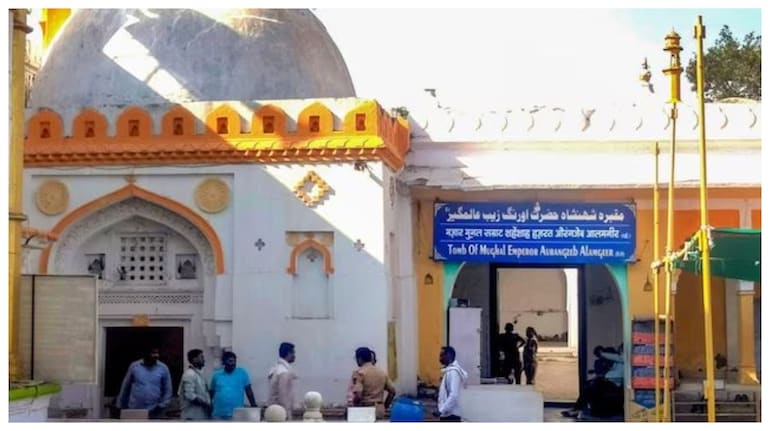
The recent violence in Nagpur -- sparked by calls to demolish Mughal emperor Aurangzeb’s tomb at Khuldabad in Maharashtra’s Sambhajinagar district -- has reignited debates surrounding the monument’s existence.
Protests by Hindu nationalist groups against Aurangzeb’s tomb led to violence in Nagpur on March 17 amid rumours that a religious text had been burnt. As tensions grew, the situation turned violent, leaving police officers injured and prompting authorities to enforce curfews in the affected regions.
Can Aurangzeb’s tomb be demolished by Maharashtra govt?
Although calls to demolish the Mughal emperor’s tomb are growing louder, the Maharashtra government lacks the legal power to proceed.
The site is safeguarded by the Ancient Monuments and Archaeological Sites and Remains Act (AMASR Act), 1958, and is under the control of the Archaeological Survey of India (ASI), making its removal legally unfeasible without central government consent.
Amid demands from right-wing organisations to demolish the tomb, the ASI has reportedly installed tin sheets on two sides of the 18th-century structure.
On the directive of the Chhatrapati Sambhajinagar district administration, ASI has put up tin sheets on two sides of Aurangzeb’s tomb, an official told PTI.
The tin sheets and wire fencing were put up on two sides of the structure on Wednesday night, a local official said.
A circular fence will also be installed around the tomb, an official said. "The green net covering two sides of the tomb was in bad shape, and the structure was visible to those visiting the nearby Khwaja Syed Zainuddin Chishti grave. So we have installed tin sheets," he told PTI.
How ASI protects important monuments/sites?
The ASI, operating under the Union Ministry of Culture, oversees the conservation and upkeep of selected historical monuments and archaeological sites which are declared of national importance.
The rich gamut of built heritage conserved and preserved by ASI includes prehistoric rock-shelters, Neolithic sites, megalithic burials, rock-cut caves, stupas, temples, churches, synagogues, mosques, tombs, palaces, forts, bathing Ghats, tanks, water reservoirs, bridges, pillars, inscriptions, excavated sites, among others.
The Union Ministry stated in a press release last December that the ASI is currently responsible for preserving 3,697 ancient monuments and archaeological sites.
Under the AMASR Act, no construction is allowed around a protected site. Section 19(1) of the Act states, “No person, including the owner or occupier of a protected area, shall construct any building within the protected area or carry on any mining, quarrying, excavating, blasting or any operation of a like nature in such area, or utilise such area or any part thereof in any other manner without the permission of the Central Government.”
Only the central government has the power to delist ASI-protected monuments.
Discover the latest Business News, Sensex, and Nifty updates. Obtain Personal Finance insights, tax queries, and expert opinions on Moneycontrol or download the Moneycontrol App to stay updated!
Find the best of Al News in one place, specially curated for you every weekend.
Stay on top of the latest tech trends and biggest startup news.