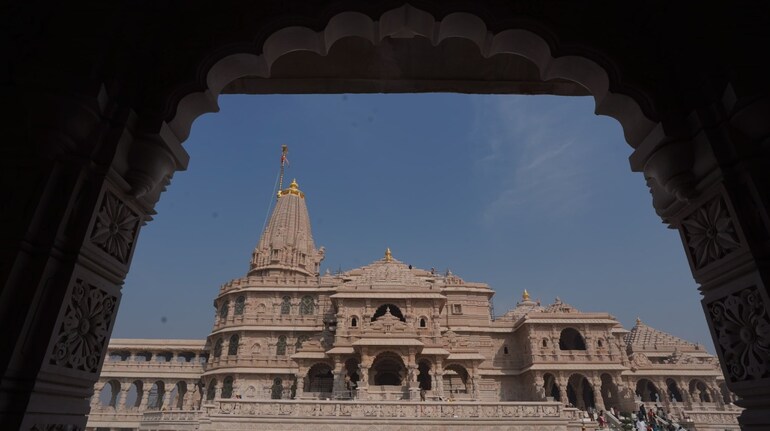
When the Supreme Court delivered its unanimous Ayodhya verdict in November 2019, it not only settled a legally fraught dispute but laid down a precise administrative roadmap. The judgment relied heavily on court-evaluated archaeological findings from the Archaeological Survey of India’s 2003 excavation, detailed references to revenue registers dating back to the nineteenth century, and documented patterns of uninterrupted worship at the site. Drawing from these records, the Court concluded that Ram Lalla, recognised as a juristic entity under Indian law, held title to the disputed land.
This judicial clarity became the foundation upon which the Ram Temple project was built over the next four years.
Forming the Ram Janmabhoomi Trust
On the strength of the Supreme Court’s direction that a “suitable trust” be created to manage and construct the temple, the Union Cabinet moved swiftly. Early in February 2020, the government issued a cabinet notification establishing the Shri Ram Janmabhoomi Teerth Kshetra, transferring possession of the land to this newly formed body.
Government records from the time describe a 15-member trust composed of religious leaders, administrators and legal experts, with the mandate to construct the temple, oversee long-term management, raise funds independently and preserve archaeological material associated with the site. Trust documents show that one of its first responsibilities was taking formal possession of the sanctum area identified in the Supreme Court judgment as the birthplace of Ram.
The Court’s own reasoning for identifying this precise spot came from a combination of ASI’s findings below the demolished structure, the documented presence of a pre-existing Hindu religious building, and records such as Faizabad revenue papers and European travel accounts that placed Hindu worship there across centuries.
Archaeology, soil and the engineering of a foundation
Much of the early phase of construction was governed by the archaeological legacy and geological realities of Ayodhya.
The archaeological layer
The 2003 ASI excavation, conducted under the supervision of the Allahabad High Court and later scrutinised in detail by the Supreme Court, described a large underlying stone structure with pillar bases, sculptural fragments and architectural features consistent with a Hindu religious complex. While the Court emphasised that archaeology cannot adjudicate faith, it nevertheless accepted the ASI’s conclusion that the Babri structure was not built on an empty plot but over a pre-existing temple-like building.
This archaeological backdrop influenced the trust’s early decisions on preservation and the eventual creation of a future museum to house unearthed artefacts, something later mentioned at trust briefings and reported widely in The Hindu and Frontline.
Engineering challenges
Ayodhya’s deep alluvial soil presented serious structural challenges. Engineers from Larsen & Toubro, working with scientists from the Central Building Research Institute, recommended a complete overhaul of the soil strata. Technical reports shared by these agencies in 2021 described a removal of weak soil, the laying of a massive engineered fill compacted layer by layer, and the creation of a granite raft to act as a seismic buffer.
This was crucial because the temple was to be constructed without steel or cement in its main structural body, relying entirely on heavy stone — a traditional choice consistent with Nagara temple architecture but one that demanded exceptional ground stability.
Designing the temple: traditional form, revised scale
The temple’s architectural vision rests with the Sompura family, whose earlier blueprint from the late 1980s had to be substantially reworked after the 2019 verdict. Interviews given by the chief architects to Indian Express and The Hindu described how the design evolved into a three-storey, all-stone structure with 360 carved pillars and a towering Nagara shikhara.
The sanctum was placed exactly above the point identified during litigation as the spot to which devotees had offered worship across the pre-colonial and colonial periods — an argument reinforced repeatedly in the Supreme Court’s legal reasoning. The Court had noted that Hindu worship at the outer courtyard and belief in the Janmabhoomi site had continued through centuries, surviving political transitions and even restricted access.
Reports from the trust indicate that artisans across Rajasthan and Gujarat began carving stones on a massive scale after 2020, with truckloads of finished blocks reaching Ayodhya by mid-2022.
Land consolidation and a transformed Ayodhya
Parallel to temple construction, the Uttar Pradesh government began a large-scale consolidation process to create a broader temple precinct. State records show that land was acquired around the main site to build pilgrim facilities, roads, a parikrama path and security apparatus.
A separate legal obligation arising from the Supreme Court judgment also proceeded: the allocation of five acres to the Sunni Waqf Board for construction of a mosque at Dhannipur. State allotment orders from 2020 formalised this arrangement. This fulfilled the Court’s direction that the Sunni Board be provided alternative land as restitution for the illegal demolition of the Babri Masjid in 1992, an event the Court described in unambiguous terms as a violation of the rule of law.
Preserving the archaeological record
As construction progressed, teams from the ASI and the trust worked to catalogue artefacts unearthed during foundation works. These included intricately carved stones, terracotta objects and remnants of pillar components. According to briefings shared with the media during 2021–23, these items are being conserved for an on-site museum envisioned as part of the greater Ayodhya development plan.
A nationwide fundraising exercise
The trust launched one of India’s largest donation campaigns in 2021. Press Information Bureau releases from that year noted contributions from more than five crore households. Importantly, the temple was constructed without government budgetary allocation, reflecting the Supreme Court’s directive that the trust must be autonomous. The campaign’s vast scale resembled earlier mass-participation movements but was executed through formalised receipts and banking channels, details of which were repeatedly reported in Indian Express.
Raising the superstructure and preparing the sanctum
By late 2022 and early 2023, the temple’s carved pillars and beams began rising above the plinth. Photographs and reports from the trust documented the completion of the temple’s mandapas, the outer structure and the surrounding parikrama.
The selection of the Ram Lalla idol was treated with exceptional scrutiny. Sculptor Arun Yogiraj’s black stone idol was eventually chosen after evaluations by religious scholars and artistic committees, a process that received coverage across major newspapers.
Consecration
The pran pratishtha ceremony of January 2024 marked the moment when Ram Lalla was moved from the temporary structure — where worship had continued since the idol’s unlawful placement inside the Babri structure in 1949 — to the new garbhagriha. During litigation, the Supreme Court had held that this 1949 act was illegal, though it also recognised the uninterrupted devotion to the deity over the decades.
The consecration created a legal and ritual finality that the Ayodhya dispute had lacked for generations.
What the temple’s construction represents
The completion of the Ram Temple between 2020 and 2024 cannot be separated from the logic of the Supreme Court’s 2019 verdict. The judgment relied on several pillars of evidence: the ASI’s excavation identifying a pre-existing temple-like structure beneath the mosque; historical travelogues, including those of the eighteenth-century Jesuit priest Joseph Tieffenthaler, that described Hindu worship at the site; colonial land and revenue documents indicating Hindu possession of the outer courtyard; and the legal principle that the demolition of 1992 required the Court to fashion a remedy consistent with restitution and constitutional order.
Public reporting in Indian Express, The Hindu, Frontline and other outlets through 2020-24 consistently highlighted how these judicially affirmed facts shaped each stage of construction — from foundational engineering to archaeological preservation and eventual consecration.
As a result, the Ram Temple stands not only as a religious monument but also as the physical outcome of a legal settlement grounded in documentary history, archaeological evidence and a Supreme Court-mandated administrative framework.
Discover the latest Business News, Sensex, and Nifty updates. Obtain Personal Finance insights, tax queries, and expert opinions on Moneycontrol or download the Moneycontrol App to stay updated!





Find the best of Al News in one place, specially curated for you every weekend.
Stay on top of the latest tech trends and biggest startup news.