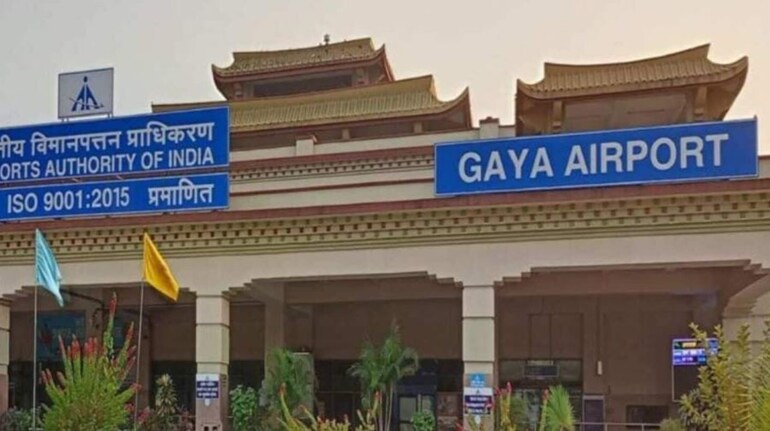
Bhim Singh, a Rajya Sabha member from Bihar, has raised concerns over 'GAY' being the International Air Transport Association (IATA) identifier code for Gaya international airport in the state.
The BJP MP sought a written response from the Ministry of Civil Aviation over the matter, asking whether the government intends to change the code name to a “more respectful and culturally appropriate” one.
In response, minister of state for civil aviation Murlidhar Mohol said the three-letter airport codes once assigned are considered permanent and are altered only under exceptional circumstances, usually involving air safety concerns.
The three-letter airport codes, also known as IATA location identifiers, are assigned by the International Air Transport Association (IATA) to facilitate identification of airports across various travel-related systems and processes.
These codes are generally assigned using the first three letters of the location's name where the airport is situated, Mohol said in a written reply in the Rajya Sabha.
He also mentioned that requests for changing the code of Gaya have been received in the past by the Ministry of Civil Aviation and Airports Authority of India.
"IATA location codes are primarily intended for commercial airline operations and are issued at the request of airline operators. Air India had earlier approached IATA seeking change of the existing airport code. However, IATA has conveyed that under the provisions of IATA Resolution 763, assigned three-letter codes are considered permanent and are altered only under exceptional circumstances, usually involving air safety concerns," Mohol said.
LGBTQ activists react
LGBTQ activists reacted strongly to the BJP member’s comments, arguing it reflects deep-rooted prejudice rather than legitimate cultural concerns.
That the term ‘GAY’ is being labelled as offensive, culturally inappropriate, or even unsafe reflects how deeply rooted the stigma against LGBTQIA+ people still is, Shanmathi Senthil Kumar, a counselling psychologist and diversity advocate told The Hindustan Times.
“Such framing reinforces harmful stereotypes and makes society even more difficult and exclusionary for queer individuals. This highlights the urgent need to centre and prioritise LGBTQIA+ voices in public discourse, so that narratives rooted in prejudice are not allowed to define what is deemed acceptable,” Kumar was quoted.
Rajesh Srinivas, another LGBTQ activist, shrugged off the need for any change. “The airport code does not require a change as there is nothing culturally inappropriate about it. The discomfort with the term stems from deeply ingrained prejudice,” he told the publication.
A look at some of the codes globally:
SUX (Sioux Gateway, USA), PEE (Perm, Russia), POO (Pocos De Caldas, Brazil), FAT (Fresno Yosemite, USA), LOL (Derby Field, USA), OMG (Omega, Namibia), FUN (Funafuti, Tuvalu), YUM (Yuma, Arizona), GAG (Gage, Oklahoma), CAT (Cascais Municipal, Portugal), DAD (Da Nang, Vietnam), WOW (Willow, Alaska), BOO (Bodo, Norway), SAD (Safford, USA).
Discover the latest Business News, Sensex, and Nifty updates. Obtain Personal Finance insights, tax queries, and expert opinions on Moneycontrol or download the Moneycontrol App to stay updated!
Find the best of Al News in one place, specially curated for you every weekend.
Stay on top of the latest tech trends and biggest startup news.