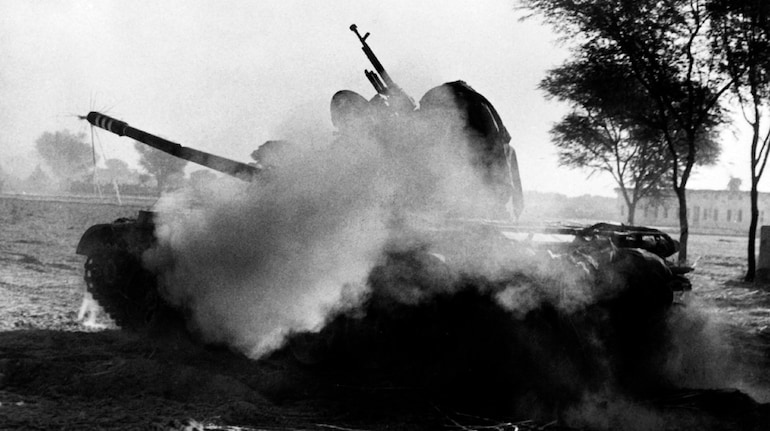
In December 1971, as Indian forces were surging towards victory in the east, some of the fiercest fighting of the war — the Battle of Chhamb — raged in the western sector of Jammu and Kashmir. The valley of Chhamb–Jaurian is located on the axis between Akhnur and the Pakistani town of Mirpur and had immense strategic significance. Whoever held this valley posed a threat to the route to Jammu and beyond to the plains. Between 3 and 8 December, fighting raged uninterruptedly, with some of the most fiercely contested operations taking place between Indian and Pakistani armour and infantry.
The valley of strategic significance
Chhamb forms the junction where the plains of Punjab rise into the foothills of Jammu. It was the same place that was attacked by Pakistan in 1965 in a bid to cut off the vital Akhnur bridge-a gateway that linked Kashmir to the rest of India. India had held Akhnur then, but the area remained a flashpoint.
In the opinion of Pakistan’s planners, by late 1971, Chhamb again seemed to be the most suitable ground in the west for an offensive. The area offered open space for tanks, proximity to key roads, and a chance to force India to divert attention from the war in East Pakistan. For India, Chhamb was important to hold onto because losing it could expose Akhnur and, in turn, threaten Jammu itself.
The road to war
By November 1971, Indian forces under 10 Infantry Division, led by Maj. Gen. Jaswant Singh, had prepared positions across the Chhamb–Jaurian sector. The division’s main task was to hold ground west of the Manawar Tawi River—a shallow but tactically important feature. On the other side, Pakistani forces under 23 Infantry Division were set for a pre-emptive strike as part of Operation Ghazab. These were to seize the Chhamb salient quickly and push Indian troops east of the Tawi before reinforcements arrived.
On December 3, when hostilities erupted along the western front, Pakistan embarked on a series of coordinated air and ground assaults along the entire front, including Chhamb. The battle that followed would be the most intense that the western theatre would see.
The Pak offensive begins
Heavy fire from Pakistani artillery targeted Indian forward posts along the Tanda, Mandiala and Chak Pandit areas at 5.30 pm on December 3, 1971. Columns of tanks from 11 Cavalry and 13 Lancers, supported by infantry of 23 Division, started moving under the cover of darkness. In a matter of hours, communication lines were disrupted, and Pakistani armour started probing Indian defences.
The forward area west of the Tawi was held by the Indian 191 Infantry Brigade under the command of Brigadier R.K. Jasbir Singh, with battalions such as 5 Sikh, 10 Garhwal Rifles, and 3/4 Gorkha Rifles. These units held their initial line throughout the night despite heavy shelling. At first light on December 4, however, the weight of the Pakistan attack began to tell. Supported by Patton tanks and heavy artillery fire, Pakistan’s troops began to press forward toward the key positions of Mandiala North and South, overlooking the river crossings.
Holding the line under fire
Throughout December 4, Indian troops fought desperately to check the advance. Pakistani armour tried to bypass strongpoints but were confronted with determined resistance from anti-tank detachments using 106 mm recoilless rifles and mines. Gorkhas and Garhwalis counter-attacked at several points, and compelled the enemy to withdraw from close combat.
Outnumbered in tanks and artillery, the Indian forces put up the best possible fight. Pakistani gunners strove to isolate the Indian positions by targeting bridges and ferries across the Tawi. Communication lines became erratic as unending bombardment hindered resupply of ammunition, yet the defenders knocked out several Pakistani tanks near Mandiala, inflicting heavy casualties.
By the evening of December 4, General Jaswant Singh ordered a tactical withdrawal to the eastern bank of the Manawar Tawi to form a new defensive line. The withdrawal was carried out in good order under constant enemy fire, with covering units staying behind until the last vehicles crossed.
The fall of Chhamb
By December 5, the Pakistani armoured units surged forward and captured the villages of Mandiala, Pallanwala and Chhamb town itself. The Indian troops on the eastern bank continued to engage them across the river. The IAF joined the fray, launching close air support missions against Pakistani tanks and supply convoys. The Hawker Hunters from Pathankot and Jammu flew repeated sorties, slowing the momentum of the assault but could not reverse the loss of territory west of the Tawi.
By December 6, Pakistan had secured most of the salient, though Indian artillery from Akhnur and Jaurian continued pounding their positions. Pakistani engineers worked quickly to repair damaged bridges and establish logistics for further advance. But Indian reinforcements — including 68 Infantry Brigade and 9 Horse (Deccan Horse) armoured regiment — had already moved in to block any thrust beyond the river.
With the line stabilised on the eastern bank, the battle reached a bloody stalemate. Both sides suffered heavy casualties, but Pakistan had achieved its immediate objective — capture of the Chhamb bowl.
The air war over Chhamb
Air power was to prove decisive. The Pakistani Air Force had the initial advantage with precision strikes against Indian supply lines, but the IAF’s response from bases in Jammu and Pathankot was quick to arrive. Indian pilots took to the skies to fly repeated ground-attack missions in poor weather, knocking off at least eight Pakistani tanks and several vehicles.
But the proximity of the battlefield to the border precluded the IAF from striking deeper targets; Pakistani aircraft easily retreated into their own airspace. Anti-aircraft fire was unusually intense on both sides, making low-level attacks hazardous. The Indian air support prevented the Pakistanis from advancing toward Akhnur, freezing the front.
Casualties and aftermath
The battle of Chhamb took a heavy toll on both sides. Indian casualties were estimated at over 800, with nearly 200 killed, while Pakistan equally lost a number of men and material. India lost approximately 60 tanks abandoned because of mechanical failure or shortage of fuel while Pakistan equally lost more than 40. The withdrawal of the Indian Army east of the Tawi surrendered about 120 square kilometres of territory, which was under Pakistani control after the ceasefire.
In strategic terms, Pakistan declared Chhamb its most significant gain of the war — the only major territorial success on the western front. For India, the withdrawal was painful but prevented a deeper breakthrough toward Akhnur and Jammu, which could have jeopardised the entire northern defence grid.
Leadership and bravery
Chhamb continues to be marked by acts of exemplary bravery in the Indian defence. Units like 5 Sikh, 10 Garhwal, and 3/4 Gorkha Rifles fought to the last round, holding their positions against repeated assaults. Major A.P. Singh of 5 Sikh was posthumously awarded the Maha Vir Chakra for repelling a tank attack with his recoilless rifle crew until he was fatally hit. Lieutenant Colonel Narinder Singh, commanding 10 Garhwal Rifles, earned the Vir Chakra for exemplary leadership under fire during the withdrawal.
On the Pakistani side, armour and infantry coordination reflected lessons learned from 1965, although their success owed much to numerical advantage and surprise. The overall commander of the operation, Major General Iftikhar Janjua, was killed in a helicopter crash during the battle-one of the highest-ranking Pakistani officers to die in the war.
Strategic implications
The fall of Chhamb was a tactical victory for Pakistan, but it did not affect the overall outcome of the 1971 war. The Indian successes in the east and the final surrender of Pakistani forces in Dhaka eclipsed the minor local gains in the west. However, this battle highlighted shortcomings in the forward deployment strategy of India and led to post-war reviews of defensive doctrine in sensitive sectors.
Analysts subsequently contended that the decision to hold ground west of the Tawi left Indian troops vulnerable to encirclement. The Army's 1972 operational review recommended that future defences in the sector remain east of the river - a policy that continues to guide deployments today.
Aftermath and ceasefire
The Chhamb sector remained under Pakistani occupation since the ceasefire on December 17, 1971, as part of what later came to be called Pakistan-administered Kashmir. Later, negotiations at Simla in 1972 recognized the new line of control, thus formalising Pakistan's hold over the area captured.
India, though, publicly downplayed the defeat, recognized in private the necessity of strengthening Akhnur's defenses. In the years that followed, extensive fortifications in depth would be built, along with improved road access and armoured reserves. The Chhamb debacle led to better coordination between infantry, armour and air support within the Indian Army.
Remembering Chhamb
The Battle of Chhamb is remembered today as a test of the valour of soldiers who fought against all odds and not a defeat. Villages that saw some of the most intense fighting — Mandiala, Pallanwala and Chhamb — remain symbols of sacrifice. Memorials in Jammu honour the fallen, and military history institutions study the engagement as a lesson in operational realism and adaptive defence.
Unlike Longewala, that became a celebrated symbol of triumph, Chhamb is remembered with silent respect and a reminder that not all battles are won, yet all shape a nation's military wisdom.
Legacy
The Chhamb experience has left an indelible mark on Indian military planning. It brought to the fore the importance of flexible defence, air-ground coordination, and realistic appraisal of terrain and force ratios. It also reinforced the idea that even partial withdrawals, when done in order, can preserve greater strategic goals.
Chhamb became a morale booster and a showcase of professional success for Pakistan, though it could not offset the massive loss in the east. For India, the battle reaffirmed that wars are won not by tactical setbacks but by resilience and recovery.
Fifty years on, the lessons of Chhamb are still there to be learnt. The valley remains heavily fortified, the soldiers who fought there still remembered-men who stood firm in a fight that tested endurance more than victory.
Discover the latest Business News, Sensex, and Nifty updates. Obtain Personal Finance insights, tax queries, and expert opinions on Moneycontrol or download the Moneycontrol App to stay updated!
Find the best of Al News in one place, specially curated for you every weekend.
Stay on top of the latest tech trends and biggest startup news.