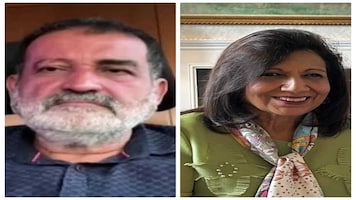
Ashoka University co-founder Sanjeev Bikhchandani on Thursday issued a sharp rebuttal to political strategist Yogendra Yadav’s recent article on Professor Ali Khan Mahmudabad’s arrest and the university’s handling of the controversy.
In two detailed posts on X, Bikhchandani called Yadav's observations "misplaced" and lacking "adequate comprehension" after the political analyst criticised an email the businessman sent to the Ashoka University community.
"Interesting observations by Yogendra Yadav although misplaced and perhaps without adequate comprehension of what I wrote in my email response to the Ashoka Alumnus. I don’t know if he actually read my email in detail," he said.
He recalled meeting Yadav years ago at a political fundraiser hosted by a friend, describing him as “soft spoken, polite and self-effacing.” However, he declined to contribute at the time, citing disagreement with Yadav’s politics and skepticism about his electoral prospects.
Bikhchandani suggested that while leaders like Yadav have a deep mistrust of the industry and continue to attack it, they also need its money and break bread with them.
"Yogendra’s child (ren?) go to Ashoka university where 50% of the students study on scholarships. These scholarships are enabled by financial contributions from industry - capitalist philanthropists. Another dilemma," he said, referring to the article wherein Yadav mentioned this own kids are students of the university.
Interesting observations by Yogendra Yadav although misplaced and perhaps without adequate comprehension of what I wrote in my email response to the Ashoka Alumnus. I dont know if he actually read my email in detail.I have met Yogendra Yadav once in my life. A few years ago I https://t.co/L3e22ORBEpSanjeev Bikhchandani (@sbikh) June 12, 2025
Responding to Yadav’s suggestion that the university had distanced itself from Mahmudabad and failed to protect academic freedom, Bikhchandani argued that institutional neutrality is essential to ensure critical thinking “happens in a space free from political capture—by any side.”
He said that while students should be encouraged to question power, “institutions themselves are not platforms for partisan campaigns.”
He reiterated that his earlier comments were about preserving the university’s educational mission, not denying dissent.
"Ashoka is not perfect. No university is. But it strives to be a space where ideas are debated, not dictated. That, in my view, is the most enduring form of academic integrity and freedom," he said.
The Info Edge founder said that he thinks of Yadav as a "decent fellow" who is "misguided".
Bikhchandani’s response follows an earlier email to an alumnus that had stirred debate.
In the email, he had expressed frustration with the pressures facing the university after Mahmudabad’s arrest. “Pramath, Ashish, and I have seriously discussed the option of walking away. Ashoka is too much of a headache. Is it worth the effort?” he had written.
Yadav, in his article published on Indian Express earlier this week, had questioned the silence of Ashoka’s leadership following the arrest of Mahmudabad.
He criticised what he called the university's reluctance to publicly defend the values it claims to uphold, suggesting that such reticence sends a message that “students and faculty must stay within invisible lines if they want protection.”
Drawing on Paulo Freire’s philosophy of education, Yadav argued that universities must be willing to stand up for those who challenge power.
Prof Mahmudabad was arrested in May over his controversial post on Operation Sindoor. The Supreme Court later granted him interim bail.
Discover the latest Business News, Sensex, and Nifty updates. Obtain Personal Finance insights, tax queries, and expert opinions on Moneycontrol or download the Moneycontrol App to stay updated!
Find the best of Al News in one place, specially curated for you every weekend.
Stay on top of the latest tech trends and biggest startup news.