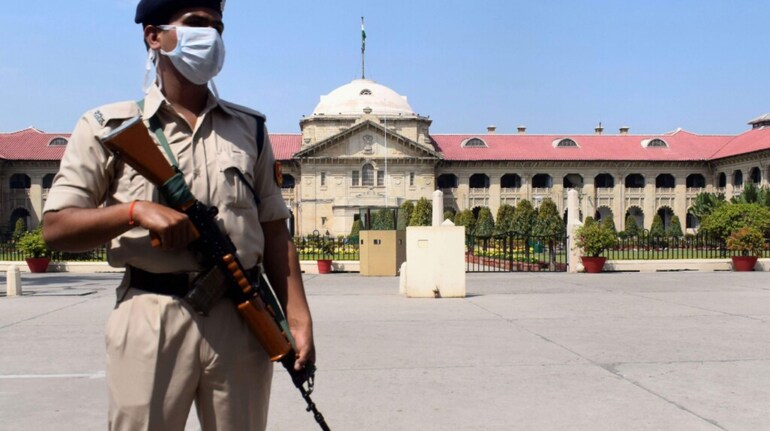
The 30 September 2010 judgment of the Allahabad High Court in the Ayodhya title suits was the first comprehensive judicial attempt to resolve, within a property law framework, a dispute that combined faith, memory, archaeology and modern constitutional claims. A three-judge bench of Justices S U Khan, Sudhir Agarwal and D V Sharma delivered separate but overlapping opinions that ran into thousands of pages and tried to answer a deceptively simple question: who owns the 2.77 acres on which the Babri Masjid stood until its demolition in 1992.
The court’s task was very different from that of the Liberhan Commission, which reconstructed political responsibility for the demolition. Here, the judges had to read centuries of documentary and oral evidence as a title dispute, decide which claims had matured into legally recognisable rights, and then convert this evaluation into a workable decree. In doing so, they drew on an enormous evidentiary record and produced a judgment that continues to be studied for how it treated faith, history and archaeology inside a courtroom.
The dispute and the questions before the bench
The High Court was dealing with four principal suits filed between 1950 and 1989. Hindu parties sought the right to worship the deity Ram Lalla at the disputed spot and to recognise the land itself as a juristic entity. The Sunni Central Waqf Board and other Muslim parties claimed title over the mosque and the land beneath it. The Nirmohi Akhara asserted management and shebait rights over the site as a religious institution. All these suits, stayed and transferred over time, converged into a single proceeding at the Lucknow bench.
What the judges had to decide was not only who possessed the land in 1949, when idols were placed under the central dome and the premises were locked, but how far back they could legitimately reach in reconstructing ownership. They also had to determine whether the long-standing Hindu belief that Lord Ram was born at the exact spot beneath the central dome had any relevance in a modern title suit, and how to treat centuries of simultaneous and competing use of the complex by both communities.
Reconstructing history and patterns of worship
To approach these questions, the bench immersed itself in a dense historical record. The judgment refers to 533 exhibits and nearly 14,000 pages of witness depositions, along with over a thousand reference works in multiple languages ranging from Sanskrit and Hindi to Persian and English. The material included travellers’ accounts, British-era gazetteers, revenue records, administrative reports, and testimonies about rituals and festivals at Ayodhya.
Across this diverse corpus the judges looked for patterns rather than single decisive documents. They noted that from at least the eighteenth and nineteenth centuries there were repeated references to Ayodhya as the birthplace of Ram and to a site within the town that Hindus treated as especially sacred. District records from the colonial period recognised Hindu worship at the Ram Chabutra and other spots in the outer courtyard, even as they treated the inner structure as a mosque under Muslim control. Over time, the pattern that emerged in the court’s reading was one of overlapping usage: Hindus and Muslims had both been present at the complex, but in different zones and with different degrees of control.
Justice Khan placed particular emphasis on the fact that, for decades before independence, Hindus had been openly worshipping in the outer courtyard and visiting the precinct as the Janmabhoomi, while Muslims had offered namaz inside the structure until 1949. Justice Agarwal went further in accepting the antiquity and consistency of the Hindu belief about the birthplace, arguing that even if such belief could not be “proved” like a modern fact, its continuity had legal significance when considering long possession and attached rights.
Archaeology in the courtroom: The ASI excavations
The most controversial part of the evidentiary record was archaeological. In 2003, acting on a High Court order, the Archaeological Survey of India carried out an excavation at the disputed site and submitted a detailed report running into hundreds of pages.
The ASI reported the remains of a large non-Islamic structure beneath the Babri Masjid. Excavators described rows of pillar bases in alignment, evidence of a pillared hall, architectural fragments such as amlak and decorative stone water spouts known as makar pranali reused in the mosque walls, and floors and walls consistent with a North Indian temple style. Archaeologist B R Mani, who led the dig, later reiterated that the remains pointed to a substantial temple or temple-like structure over which the mosque had been built.
The bench did not treat the ASI report as conclusive on its own, but both Justice Agarwal and Justice Sharma accepted its broad conclusion that a large non-Islamic religious building had existed on the spot before the mosque. Justice Khan was more guarded, noting that the destruction of an earlier structure centuries ago did not automatically resolve present title, yet he did not reject the report’s core findings. In the logic of the judgment, archaeology became one more strand that reinforced the court’s reading of long-term Hindu association with the site rather than a sole determinant.
Legal reasoning on title, possession and limitation
Once the judges had absorbed the historical and archaeological material, they turned to the central legal tests: proof of title, proof of possession and the impact of limitation. Unlike a commission of inquiry, a civil court cannot stop at narrative reconstruction; it must grant or deny legal rights.
On strict title, none of the claimants could produce a single deed or unbroken chain of documents establishing absolute ownership over the entire 2.77 acres. The Muslim side relied on waqf and revenue records and treated the mosque as a long-recognised place of worship. The Hindu parties leaned on the doctrine that a deity is a juristic person and that the land itself was the deity’s property. The Nirmohi Akhara argued that it had long functioned as the manager and custodian of the site.
The bench concluded that the history of the land was one of interlocking, not exclusive, control. In its reading, Hindus had exercised open and continuous rights of worship in at least part of the complex over a long period, while Muslims had also possessed and used the inner structure for namaz. The fact that the colonial administration erected a grill wall in the nineteenth century, separating inner and outer courtyards, was taken as evidence that both communities’ claims had been recognised in practice, even if they were often contested.
On limitation and adverse possession, the judges were reluctant to declare that any community had legally ousted the other from its claimed sphere. The 1949 placing of idols under the central dome, which led to the locking of the structure, was treated as a disruptive event but not sufficient to erase the prior history of use. In effect, the court arrived at a position where it believed that all three principal claimants had some legally cognisable rights but no one had an unassailable, exclusive title to the entire disputed land.
Why the court divided the land three ways
This reasoning led to the most widely discussed part of the verdict: the division of the 2.77 acres into three equal parts to be shared by Ram Lalla Virajman, the Nirmohi Akhara and the Sunni Central Waqf Board. Justices Khan and Agarwal constituted the majority in favour of this three-way split. Justice Sharma, dissenting, would have awarded the entire land to the Hindu side.
The majority’s core idea was that the remedy must reflect the longstanding reality of shared and overlapping claims. One-third of the land, including the area under the central dome, was allotted to the deity Ram Lalla, represented by the Hindu parties. One-third was to go to the Nirmohi Akhara, recognising its asserted role as shebait and manager. The remaining third was allotted to the Sunni Waqf Board in recognition of Muslim possession and worship inside the mosque over centuries. The judges described this as a preliminary decree, leaving details of exact demarcation to a later stage.
Critics argued that the High Court had strayed into an exercise in compromise rather than pure adjudication, effectively crafting a political settlement from the bench. Others, including some commentators at the time, described the verdict as an attempt to judicially encode coexistence by recognising that neither side’s narrative fully erased the other’s.
Reception, appeals and the Supreme Court’s final word
The verdict provoked complex reactions. Many Hindu organisations welcomed the judicial recognition of the birthplace belief and the grant of a key portion of the land to the deity. Muslim bodies expressed dismay at what they saw as the elevation of faith over legal title and questioned the reliance on the ASI report. None of the principal parties accepted the division as a final resolution, and all chose to appeal to the Supreme Court.
In 2011, the Supreme Court stayed the operation of the partition decree. In November 2019, after exhaustive hearings, a five-judge Constitution Bench set aside the three-way split and awarded the entire disputed land to Ram Lalla, directing that an alternative five-acre plot in Ayodhya be allotted to the Sunni Waqf Board for a mosque. The Supreme Court’s judgment acknowledged the High Court’s extensive fact-finding but disagreed with its ultimate remedy, holding that partition was not the correct legal answer in a title suit of this nature.
Legacy of the 2010 judgment
Although the Allahabad High Court’s solution did not survive on appeal, the 2010 verdict remains an important document for understanding how Indian courts grapple with disputes in which faith, history and law intersect so intensely. It showed a bench willing to order archaeological excavations, engage with a vast range of historical materials, and still acknowledge the limits of what any court can firmly “prove” about events centuries in the past.
Placed alongside the Liberhan Commission’s reconstruction of how the demolition happened and who enabled it, the High Court judgment illuminates a different axis of the Ayodhya story: the slow, documentary-heavy work of treating a charged sacred space as a parcel of land whose title has to be decided under civil law. Its method, and the criticisms it drew, continue to shape debates on how far courts should go in weighing religious belief and archaeological interpretation when deciding property rights in cases with profound political stakes.
Discover the latest Business News, Sensex, and Nifty updates. Obtain Personal Finance insights, tax queries, and expert opinions on Moneycontrol or download the Moneycontrol App to stay updated!
Find the best of Al News in one place, specially curated for you every weekend.
Stay on top of the latest tech trends and biggest startup news.