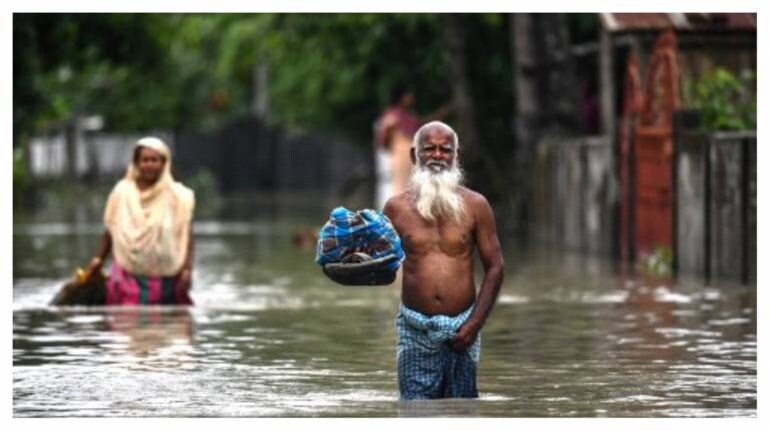
After experiencing extremely turbulent weather in May and June, which caused a series of devastating floods and deadly landslides, almost all north-eastern states recorded subdued and deficient monsoon rainfall in the first half of July.
The northern states of Uttar Pradesh, Bihar, Jharkhand, parts of West Bengal and other adjoining areas along the Indo-Gangetic plains also reported high rain deficiency even as an intense monsoon played out over central, western and most of southern India. Scattered rain caused temperatures to rise in the northern plains and parts of northeast India, causing extreme discomfort to people amid the high humidity and raising concerns among farmers because this is the peak sowing season for the kharif crop.
The Indian Meteorological Department (IMD), though, says things will get better by the month-end and predicts increased rainfall over the northern plains and the northeast over the next few days.
Deficient July for some states
Explaining the deficiency in some states even as India as a whole has recorded a normal monsoon so far on the back of intense rains in the west and south, IMD officials and other weather scientists said the trough had initially moved in a northerly direction till about June 23-24. But after that, the rain systems moved towards central and southern India and not in a northerly or northwest direction.
“Three rain systems moved towards Gujarat, Rajasthan, and central and western India. Because of this, the northeast, the northern plains and others got little or less rain,” senior scientist RK Jenamani, who heads national forecasting at the IMD, said.
In fact, from July 1 to July 19, Bihar topped the list, reporting a rain deficiency of 89 percent during this period. The state recorded 24.1 mm rain against a normal of 219.5 mm, according to IMD data. Neighbouring Uttar Pradesh was next in the same period, recording 39.8mm rain over a normal of 160.5 mm, which is 75 percent deficient.
West Bengal had 116.5 mm rain against a normal of 244.9 mm, a departure of minus 52%. Jharkhand was 50 percent deficient and recorded 95.8 rain, compared to a normal of 191.1 mm.
In the Northeast, Assam, which witnessed ravaging floods and killer landslides in May and June, was 52 percent rain-deficient. Meghalaya, which also recorded surplus rainfall and devastating landslides, was 72 percent deficient in July.
Assam recorded 139.4mm against a normal of 290.6 mm and Meghalaya had 160.6mm against a normal of 571.1 mm from July 1 to July 19. Arunachal was 48 percent deficient (180.2 mm against 344.2 mm), Nagaland 31 percent (129.1mm -186.1 mm, Manipur -70 (53.3mm-180.1mm) and Tripura 62 percent deficient (109.9 mm-291.1mm).
Mizoram was the only northeast state that did not record deficient rain, recording 238 mm against a normal of 258 mm in the same period, the IMD data showed. A -8 percent deviation is considered normal.
The rain gap in most north-eastern states, however, will be much less or even nil if one takes into account the rainfall recorded in June. But UP, Bihar and Jharkhand reported deficient rain in both June and July combined.
India on the whole recorded a total of 344.1mm rainfall against the average of 304.2 from June 1 till July 16. A rainfall departure ranging from -99 percent to -60 percent is considered ‘large deficient’ in MET parlance; -59 to -20 is ‘deficient’ and -19 to +19 is normal. ‘Excess’ ranges from + 20 percent to + 59 percent; and anything above 60 percent or more is termed ‘large excess’.
The lack of rain caused day temperatures to stay high both in the northern plains as well as parts of the northeast, especially in Assam, where the mercury shot up to almost 40 degrees in some places, quite unusual for the region. The high humidity factor also pushed up the heat index or the ‘real feel’ temperature and the wet bulb effect, causing immense heat stress and discomfort.
Relief in sight for farmers
Mahesh Palawat, vice-president of meteorology and climate change at private forecaster Skymet, said low pressure areas that developed one after another over the Bay of Bengal moved in a westerly direction across Orissa, Chhattisgarh, Vidharbha, North Telangana, south Madhya Pradesh and then towards Gujarat. “The rain glut caused flooding in many parts of these states,” Palawat explained.
Due to the continuous formation of low pressure areas, the monsoon trough remained over central India, south of its normal position, leaving UP, Bihar, Jharkhand and West Bengal dry, the experts said. Rain remained subdued over the Northeast in July because of the same reason.
In UP, amid concerns that a deficient monsoon could adversely affect kharif crops, Chief Minister Yogi Adityanath ordered officials to make preparations to face any kind of situation.
In Assam, local media reported how paddy fields with chest-deep water a month ago now resemble parched land in many districts of western and central Assam that reported large deficient rain. Goalpara district, for example, reported 97 percent rain shortage and Chirang -85 percent from July 1 to 19.
The MET department has predicted better days ahead for the deficient areas over the next few days as the rain-driving monsoon trough was near its normal position and shifting northwards from central India.
“Monsoon rains will increase in northwest India, northeast and sub-Himalayan West Bengal as the trough lifts northward to its normal position in the next few days,” Ashim Kumar Mitra, senior scientist at IMD, said.
Palawat said the western end axis of the trough was moving and the eastern end would follow suit. The upcoming rains will reduce the temperatures and the heat stress in the north, he said.
Group Captain SN Mishra, an independent climate change expert, says the window for the rice crop has expanded and if the rains catch up by July-end, it should not be a cause for worry.
“Many parts of the northern plains are well-irrigated. The coverage of dams and canals is good. Jharkhand depends a lot on rain though,” Mishra, a former senior weather forecasting official at the ministry of defence and the Indian Air Force, said. He added: “The axis is moving northwards and the monsoon will catch up in next few days.”
A variable monsoon or climate change?
So while the rain-deficient states and farmers are hoping for better days ahead, the jury is still out on whether the changing rain patterns could be linked to climate change or it is just the monsoon variability factor playing out.
Jenamani said such changes in rain patterns are not abnormal and a part of monsoon variability. “These changes could happen once in 10 or 20 years. There is nothing abnormal in it. It would be wrong to jump to the conclusion that these are happening because of climate change.”
Expressing similar views, Mishra said though climate change is real, the monsoon system is also extremely variable. And every variability factor need not be linked to climate change. According to Mishra, the extreme heat this year in India and elsewhere in the world as well as the early onset of summer were certainly because of climate change.
Monsoon rain always happens in spurts and is never continuous but heavy and localised rainfall events have definitely increased and are a matter of concern, Mishra said. “And with more intense localised rainfall, flash floods will happen.” He added, “The monsoon patterns are also changing but not that much to link it to climate change. A 5-10 percent increase in variability is not much.”
Palawat, however, believes the changes in monsoon pattern over recent years can be attributed to climate change. Weather systems developing over the Bay of Bengal, he said, are now taking a westerly route, leading to intense rain over central India
“Earlier, in the 90s and till the first decade of this century, weather systems travelled in a north-westerly direction, giving more rain to the northern plains. But this year, the Indo-Gangetic plains are almost dry till now because of the changed direction,” Palawat said.
Mitra said climate change is for real but cautioned that the monsoon is always a complex phenomenon. The IMD, he said, would enhance observations by radar and ground equipment in the coming days. “With our two satellites INSAT 3D and 3DR, we are constantly tracking the monsoon and providing information in our forecast bulletins and small video capsules,” Mitra said.
Discover the latest Business News, Sensex, and Nifty updates. Obtain Personal Finance insights, tax queries, and expert opinions on Moneycontrol or download the Moneycontrol App to stay updated!

Find the best of Al News in one place, specially curated for you every weekend.
Stay on top of the latest tech trends and biggest startup news.