






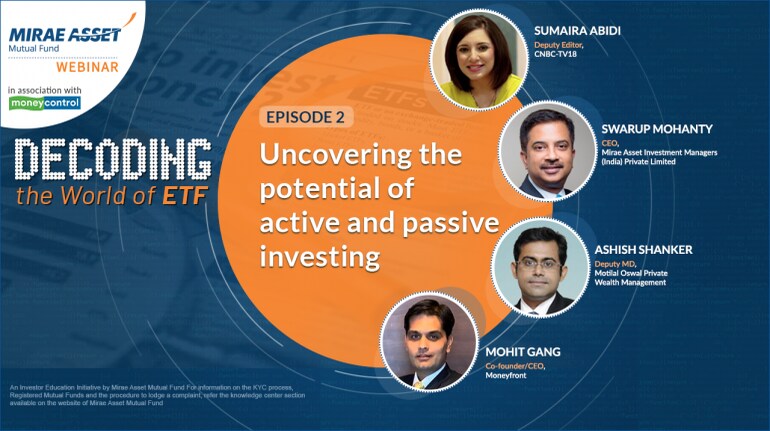
Exchange Traded Fund (ETFs) are rapidly gaining ground in the Indian market, but investors are still discovering this product and its benefits. In a special webinar series, we are bringing together industry experts to understand how ETF investments can boost your portfolio, the dos and don’ts to follow and explain how it can help you diversify your investment journey.
In the second webinar titled ‘Uncovering the potential of active and passive investing’, CNBC-TV18’s Sumaira Abidi did a deep dive into active and passive funds with Swarup Mohanty, Chief Executive Officer (CEO), Mirae Asset Investment Managers (India) Private Limited, Ashish Shanker, Deputy Managing Director, Motilal Oswal Private Wealth Management, and Mohit Gang, Co-Founder and CEO, Moneyfront.
Here are excerpts from their discussion:
Sumaira: We've spoken extensively about under-performing actively-managed funds, and how passive investing is catching on. In a recent show I did, there was a question on whether a three ETF portfolio is all that a person needs. It seemed like a radical thought, but many suggested otherwise. Do you think we are headed that way or is there still scope for active and passive investing to work together?
Swarup: The three ETF theory is probably the evolved status of that investor. At this moment, we are getting into the phase where most investments in India are on the active side and due to shrinkage in alpha 1 or 2 particular sides of the market—which is an eventuality with the efficiencies in the market going up—can come about. As a result, active funds could find it difficult to outperform its benchmarks. Active fund managers will have to develop new ways of finding alpha going forward. In such cases investors would start considering the advantages and disadvantages of costs involved. And they would start evaluating low cost passive funds to their portfolio that tracks the index such as Nifty50. This is generally how passive investments start and I believe that we are on the threshold of that phase in India.
Sumaira: Which side are you standing on regarding this theory, is that the future of ETFs or do you think there is some scope for a relationship the two?
Ashish: We are going through an interesting phase. I think the west has already gone through this phase maybe 2-3 decades ago. If you look at the US markets, it's very well discovered and passive investing is accepted as a core way to invest money into equities. In India, we've seen a series of regulatory changes, which has made labeling of funds more effective; with the large cap, mid cap, multi cap being defined very sharply. Going forward, at least in the well discovered category of large cap, it's going to be difficult for active managers to consistently outperform. Whereas there are other categories like focused categories or multi cap which give fund managers more flexibility to express their philosophy and convictions. Over time passive will become a larger allocation in most client portfolios. However, I think both can co-exist.
Sumaira: It's usually said that if you have an active portfolio that's under-performing, why not add an ETF to balance it. How long can ETFs help make up for it? Isn't it time to move the forefront and become part of the portfolio?
Mohit: Gradually, the cycle is moving globally with passive allocation overtaking active allocation, which means more and more investor are moving towards index. What ETFs also do is weed out low performing stocks every year who are high cost and can’t deliver outperformance over the index. Over the next 10 years, gradually category by category, ETFs will start overtaking few fund managers who consistently under-perform in the market. So, in the large cap category you can already see that wave coming through, but in other categories it will still take some time to catch on. But the regulatory changes and structure of Indian markets, consistently delivering alpha has become a mirage for fund managers. I think in the next 10 years, it will tilt completely towards ETFs in a large way.
If you missed this webinar, you can watch it here:
This is a partnered post.
DisclaimerAn Investor Education Initiative by Mirae Asset Mutual Fund For information on the KYC process, Registered Mutual Funds and the procedure to lodge a complaint, refer the knowledge center section available on the website of Mirae Asset Mutual Fund The views expressed or statements made in this document are purely the views of the author and do not necessarily represent the views of either Mirae Asset Investment Managers (India) Private Limited or its affiliates.Mutual Fund investments are subject to market risks, read all scheme related documents carefully.
Discover the latest Business News, Sensex, and Nifty updates. Obtain Personal Finance insights, tax queries, and expert opinions on Moneycontrol or download the Moneycontrol App to stay updated!



