(Bloomberg Opinion) -- From 1940 to 1960, the population of the nine counties surrounding the San Francisco Bay more than doubled to 3.6 million. In a 1959 report, the US Commerce Department’s Office of Area Development projected that it would double again by 1990, and yet again by 2020, when the region was expected to house 14.4 million people.
That’s not what happened. As of the April 2020 US Census, the population of the nine counties was 7.8 million, and according to Census Bureau estimates it has fallen by about 200,000 since then.
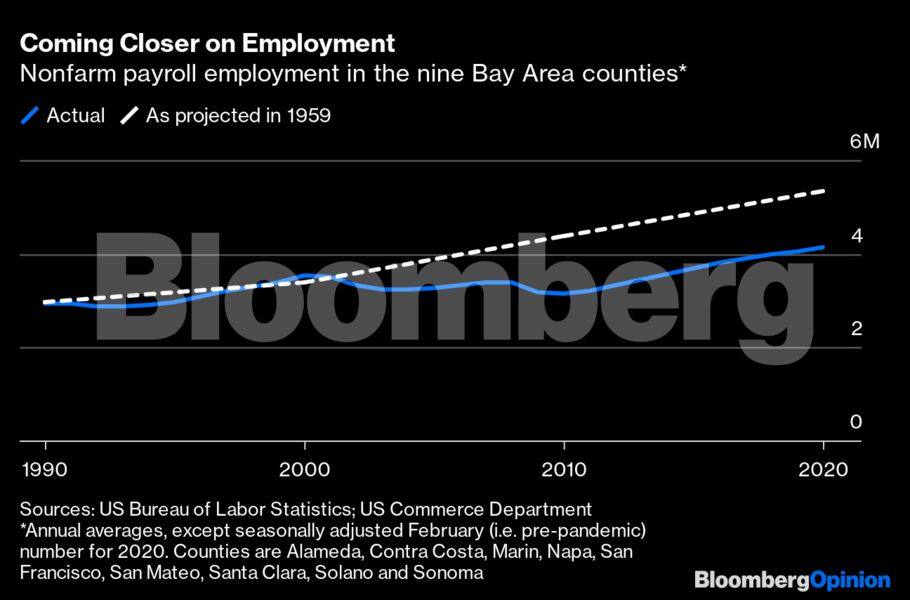
Long-run population projections often miss, of course, but what makes the 1959 report such a fascinating historical document is just how it went wrong. If anything, it undersold the region’s economic potential, understandably failing to envision that the Bay Area would establish itself as the world headquarters of a set of at-the-time-unimagined new technology industries. Through 2000, area job growth actually exceeded the projections. (This chart goes back only to 1990 because that’s how far back the jobs numbers are readily available.)
But the report also missed the rise of anti-growth attitudes that would come to dominate the region’s politics over the next half century — also understandably, given that those attitudes were only just beginning to emerge in 1959 and were to some extent unleashed by the report itself.
Titled “Future Development of the San Francisco Bay Area, 1960-2020,” it described a future that resembled the immediate past, with what were then the area’s two big cities, San Francisco and Oakland, growing slowly and most new housing in suburban developments. By 2020, it projected, 2,389 of the Bay Area’s nearly 7,000 square miles of land would be devoted to residential, commercial and industrial uses, up from 538 in 1958.
Most of that was to be converted agricultural land, but because the report had been commissioned by the US Army Corps of Engineers, it also examined the prospect of filling in parts of San Francisco Bay, which has a surface area of about 550 square miles. The base forecast foresaw only 18 of those being converted to developable land, but an additional 325 — the majority of the bay, that is — were deemed “susceptible of reclamation.”
It was a map of these “susceptible” areas and the sad, skinny harbor that would remain if they were filled in that “triggered alarm bells” when it was reprinted in local papers, San Francisco Chronicle urban-design critic John King wrote in a 2005 retrospective. The environmental group Save the Bay was founded in 1961, after the city of Berkeley announced plans to double its physical size by filling in the mudflats along its shoreline, and it led a successful effort to halt further encroachment.
Other organizations sprang up around the same time to oppose further loss of open space on land, and while their efforts didn’t completely halt the sprawl, they certainly slowed it. Development continued to swallow up farmland in the region’s eastern and southern fringes, with San Jose coming close to meeting the report’s ambitious population projections and Antioch and Vacaville surpassing them, but in most of the rest of the region, especially the North Bay counties of Marin, Sonoma and Napa, the visions of 1959 came nowhere close to being realized.
As of the most recent (2017) report of the Greenbelt Alliance, a local group that dates its origins to 1958, 1,235 square miles in the Bay Area were devoted to residential, commercial and industrial use — about half what was predicted in 1959 — compared with 1,864 permanently protected from development as parks and other preserves, and an additional 3,353 shielded by “policies such as growth boundaries, hillside ordinances and agricultural zoning.” That makes three-quarters of the region’s land off limits to development.
This turn against growth has long been celebrated in the Bay Area, where I grew up, as having averted dystopia. “Viewed in hindsight, the picture is bleak,” was King’s 2005 take on the sprawl envisioned in the 1959 report. “Napa Valley is filled with homes while thick bands of development connect such Marin County ‘hubs’ as Nicasio and Lagunitas, Olema and Point Reyes Station.” In the 1985 edition of his “The San Francisco Bay Area: A Metropolis in Perspective,” University of California at Berkeley planning professor Mel Scott wrote, “No one can fail to be impressed by the vigor with which conservationists, many political leaders, most members of the city planning profession, and thousands of concerned citizens throughout the Bay Area have challenged some of the frontier values and attitudes of this country in the past twenty-five years.”
It’s not so clear, though, that these efforts succeeded in heading off dystopia. The Bay Area has the country’s highest housing prices, a homeless population of more than 35,000 and, before the arrival of Covid-19, the nation’s largest concentration of “super commuters” who spent more than three hours a day getting to and from their jobs. Since the pandemic and accompanying rise of remote work, it has lost hundreds of thousands of residents for whom great weather and spectacular natural beauty apparently aren’t adequate compensation for the cost and hassle of living there.
Another fascinating historical document, from 1979, offered an explanation for what went wrong:
Resistance to growth began as a very reasonable political shift, concentrating on saving such priceless assets as the San Francisco Bay and Napa Valley wine country. But as it gathered power, and as people discovered they could stop growth at little cost to themselves, the movement became a good deal less reasonable. Soon it turned into general hostility toward homebuilding for the average family, using the rhetoric of environmental protection in order to look after the narrow interests of people who got to the suburbs first.
Those are the words of Bernard Frieden, an urban studies professor at the Massachusetts Institute of Technology who became acquainted with the Bay Area anti-growth movement while spending the 1975-1976 academic year at UC Berkeley. They’re from his 1979 book, The Environmental Protection Hustle, which described how anti-growth activists and sympathetic judges and politicians not only drove up housing prices but harmed the environment by pushing development out to fringe areas “where the new residents will use more gas and pollute more air while they drive longer distances to work.”
Frieden’s book offered detailed accounts of just how this transpired. One especially maddening chapter tells the story of Mountain Village in Oakland. In the early 1970s, a developer bought 685 acres, the last large tract of undeveloped private land in the city, and proposed turning it into a walkable community of 2,183 townhouses and condominium apartments with an average price of $28,471 ($205,000 in 2022 dollars) and a shopping center while preserving 480 acres of the tract for a new park. Despite grumbling from neighbors, the city approved the plan. Then a neighborhood group called Citizens Against Mountain Village sued, contending that Oakland had failed to follow the requirements of the new California Environmental Quality Act. The San Francisco chapter of the Sierra Club chimed in with an amicus brief. Completing the environmental impact report required under the law took years, and the developer concluded that it would face continued lawsuits unless it cut a deal with the neighbors and the Sierra Club. In 1976, it did just that, drastically revising its proposal to 150 to 200 condos and 100 “estate homes” with a combined average price of about $450,000 in 2022 dollars and a smaller park.
This fall I visited the neighborhood, now called Ridgemont, and from the looks of it, developers have squeezed in about 200 single-family houses, the prices of which range on Zillow from $1.3 million to $4.8 million, and while I’m not sure exactly how many condos there are it seems like much fewer than 200, with an average price of about $500,000. The adjacent Leonia Canyon Open Space Regional Preserve covers 290 acres, and when I was there the people and dogs who visited (attracted by its leashes-optional policy) appeared to get there mostly by car.
It’s the story of the Bay Area since the 1960s in a nutshell. Activists, courts and local governments put an end to rampant sprawl but also made it nearly impossible to build the kind of dense in-fill development that would have been compatible with the new commitment to preserving open space, affordable for people with median-wage jobs and conducive to less car-dependent, more environmentally friendly lifestyles.
Frieden’s arguments began to resonate in the region only decades later, when impossibly high real estate prices led to the advent in the Bay Area of the Yimby (yes in my backyard) movement, and state officials began to respond with new laws aimed at circumventing local Nimbys. There are signs that the tide may truly be turning — in October, residents of another Oakland neighborhood protested against a proposal to build a new Home Depot on a large vacant lot, arguing that what really needed to go there was a bunch of apartment buildings. But after more than 50 years of running in the other direction, it’s going to take a while to have an impact.
Justin Fox is a Bloomberg Opinion columnist covering business. A former editorial director of Harvard Business Review, he has written for Time, Fortune and American Banker. He is author of “The Myth of the Rational Market.”©2022 Bloomberg L.P.
Discover the latest Business News, Sensex, and Nifty updates. Obtain Personal Finance insights, tax queries, and expert opinions on Moneycontrol or download the Moneycontrol App to stay updated!
Find the best of Al News in one place, specially curated for you every weekend.
Stay on top of the latest tech trends and biggest startup news.