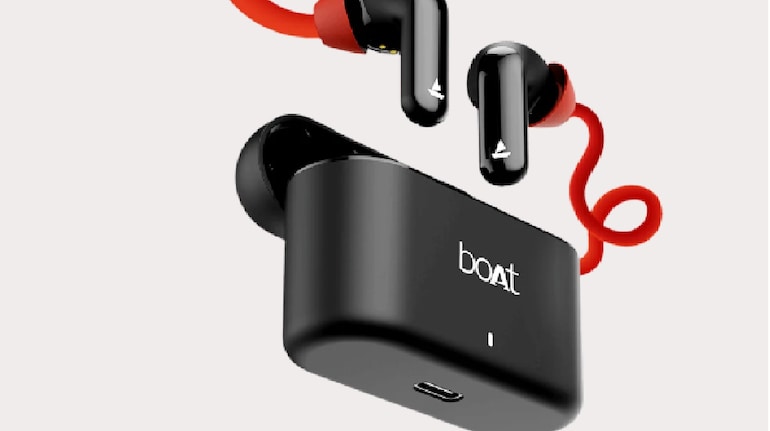
India’s largest audio brand boAt is making a decisive push to localise its component ecosystem by co-designing a chip with Bengaluru-based semiconductor startup HrdWyr to reduce its import dependence and tighten supply chain control.
The new HrdWyr Indus 1011, an MCU-class SoC for headset charging cases, will be assembled and packaged in India by Tata Electronics. boAt plans to integrate it into 25 percent of its devices by 2026, starting with the premium Nirvana range.
“Despite designing most of our Prime and Nirvana series of products locally, we still ended up procuring most of the silicon from countries like Taiwan and China. Together with HrdWyr, we identified the chip,” boAt Co-founder and CEO Sameer Mehta told Moneycontrol.
The chip is designed to improve power and battery management in charging cases. “The first products with this SoC will launch in the Nirvana range. By late 2026, we plan to deploy it across about 25 percent of our devices. The prototype will be ready by December, and the commercial chip will be plugged into Nirvana products by mid next year,” Mehta said.
Mehta said this marks the first locally sourced chip in the category. The SoC combines an MCU with a power management IC, delivering 20–30 percent better charging efficiency. “Over time, we’ll add AI features to keep optimising battery performance. The roadmap will evolve — first get the chip right, then add software layers to make it smarter,” he said.
By localising chip development, boAt expects to gain greater control over its supply chain, reduce import dependence, achieve shorter lead times, and realise long-term cost benefits as scale improves.
“Initially, we’ll use them in higher-end devices, and costs will come down as volumes grow. The idea wasn’t about immediate cost savings, but about building the local ecosystem. Chip development is expensive and front-loaded, and no one invests without an anchor customer. We decided to step in as that customer,” Mehta said. “Of course, in the long term, once economies of scale kick in, costs will become competitive.”
boAt plans to expand integration into its Prime and later AirDopes portfolio as volumes rise. HrdWyr too is betting on scale. “This is a merchant chip, so aggregating volume is critical. Initially, it will go into boAt’s use case, but later it can expand to other applications. We won’t match Taiwan or China on price immediately, but over time we will,” Ramamurthy Sivakumar, co-founder and CEO, HrdWyr told Moneycontrol in a joint interaction.
The partnership, both companies said, is about creating an ecosystem. boAt has invested resources in defining requirements, quality assurance, and integration, while HrdWyr has focused on IP with 30–35 engineers working on the chip. “We’re headquartered in Bangalore with 80 percent of our engineering here. India already has strong design talent; the bigger challenge is manufacturing and packaging. We looked at options in Southeast Asia but chose to do the work in India with Tata Electronics. This will be one of the first high-volume branded products coming out of India,” Sivakumar added.
boAt continues to dominate India’s audio market, leading in TWS and audio devices for 13 consecutive quarters with a 30–33 percent market share, nearly double its nearest competitor. “Even if others grow, it’s usually at the expense of smaller brands. We’re confident of maintaining leadership. Post-COVID, the boom has slowed, but with premium demand and AI, the outlook is positive,” Mehta said.
On supply risks, Mehta noted that China’s embargo on rare earth magnets had little impact on boAt.
“Since most of our products use sub-assemblies, we weren’t severely impacted.”
Currently, about 80 percent of boAt’s 30 million annual units are already made in India, roughly 24 million devices. “We aim to raise that to 90–95 percent. In terms of trends, premiumization is a big driver across categories. AI on voice is another major trend that could drive replacement cycles,” Mehta added.



Discover the latest Business News, Sensex, and Nifty updates. Obtain Personal Finance insights, tax queries, and expert opinions on Moneycontrol or download the Moneycontrol App to stay updated!





Find the best of Al News in one place, specially curated for you every weekend.
Stay on top of the latest tech trends and biggest startup news.