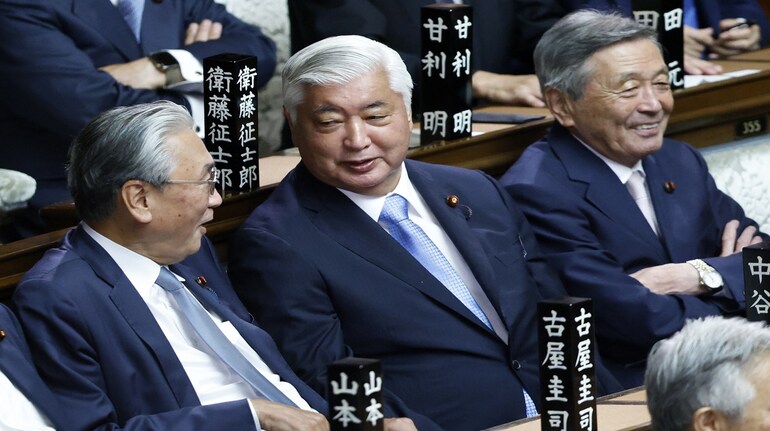

A channeling of US resources into the conflict ravaging the Middle East could cause an imbalance in the current security environment surrounding Japan, renewing the need for the country to strengthen its defense capabilities, according to Japan’s former Defense Minister Gen Nakatani.
“In particular, the transfer of equipment or a shift in the focus and priorities of US forces could become factors that destabilise the balance of power around Japan,” Nakatani said in an interview Tuesday.
“Japan must ensure that such developments do not lead to unforeseen contingencies. We need to address this by maintaining and strengthening our own deterrence and response capabilities,” he added.
The comments come ahead of a summit meeting between Japanese Prime Minister Sanae Takaichi and President Donald Trump as the US-Israeli conflict with Iran shows no signs of abating. Trump has repeatedly called out allies including Japan for their lack of support in providing warships to ensure safe passage of commercial ships passing through the Strait of Hormuz.
While Nakatani sees risks emerging if the US focus stays outside Asia over a longer period, he also sees scope for the summit on Thursday providing an opportunity to start cooling down the situation.
“I imagine Trump is looking for the moment to resolve the situation,” Nakatani said, adding that Japan’s friendly history with Iran could be a strength that could be played into as a means to bring some calm to the situation.
“Japan has conducted very good diplomacy with Iran, so I think this is the time for that to come to fruition,” he said.
Still, a prolonged war would have a deep impact around the world, including in the US.
The US has already diverted resources from South Korea to the Middle East and a US amphibious ship and marine unit based in Japan have been dispatched to the region as well, according to media reports. Those moves show how Washington is pulling resources from the Indo-Pacific into its war with Tehran.
Nakatani drew parallels between the current situation in the Strait of Hormuz and possible conflict in the Indo-Pacific region, saying that the burden of defending sea lanes that are vital to Japan’s survival could weigh more heavily on Japan and other like-minded countries.
“In particular, the most critical routes run from Southeast Asia, around Singapore, up to the East China Sea toward Japan. These are also essential sea lanes, and if they are not properly secured, China’s influence will continue to grow under the pretext of ensuring security,” he added.
The way to counter these shifting security challenges is for Japan to boost its own defense and deterrence capabilities.
“For these reasons, Japan must strengthen its own security framework in these areas and carefully consider how to ensure that the situation in the Middle East does not impact the situation in Asia,” he said.
Trump had ramped up pressure on allies to dispatch ships as he sought to secure the strait, before abruptly dropping the demand on Tuesday. But Trump is still likely to raise the issue of Japan’s support for the US at the summit.
Takaichi reiterated Wednesday that there are no current plans to send Self-Defense Forces to the region. Japan has constitutional restrictions that put limitations on its military’s involvement in active conflicts abroad. That limits Takaichi’s options for offering assistance that might placate Trump. At the same time, Japan relies on the Middle East for about 90% of its oil, putting acute pressure on Takaichi to do something.
Nakatani avoided commenting directly on how Japan could appease Trump’s demands for support, instead saying that it was a decision Japan must also make in the interest of its own economy.
“This isn’t something we should do just because the US tells us to, but something we must think through as an issue of our own,” he said, adding that the dispatch of ships monitoring the situation in neighboring seas might be one option.
Japanese ships were dispatched on an information-gathering mission in response to a breakdown in ties between the US and Middle East in 2019. Although the US led a multilateral initiative to protect ships in the Strait of Hormuz at the time, Japan did not take part and instead limited the geographic scope of its ships’ activities to adjacent seas such as the Gulf of Oman.
Discover the latest Business News, Sensex, and Nifty updates. Obtain Personal Finance insights, tax queries, and expert opinions on Moneycontrol or download the Moneycontrol App to stay updated!
Find the best of Al News in one place, specially curated for you every weekend.
Stay on top of the latest tech trends and biggest startup news.