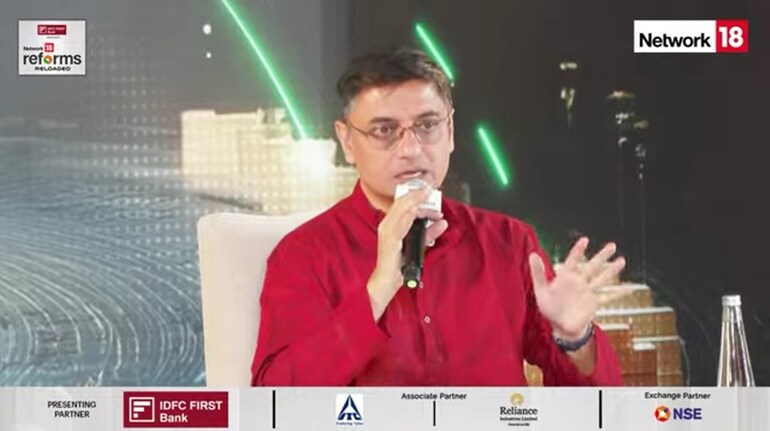
Speaking at Network18’s Reforms Reloaded 2025 summit in Delhi, Sanjeev Sanyal, Economist and Prime Minister's Economic Advisory Council (PMEAC) member, said GST rate cuts must translate into lower prices for consumers, stressing public pressure and competitive markets over a return to “Inspector Raj.”
Here is the full transcript:
Shweta Punj:
Thank you, Sanjeev, for being here. Can we get a louder applause, please, for Sanjeev for embodying the spirit of Navratri today? I think you've gotten so many compliments, and it's lovely. Please take a seat. A very warm welcome to Reforms Reloaded. What a day to be talking to you. It's the start of the Savings Festival, as the Prime Minister called it. It's the first day of Navratri, and this morning I was on an e-commerce platform, a quick commerce platform, and I was trying to buy something, but the prices have not gone down yet, Mr. Sanyal. Some companies are talking about why it will be difficult for them to pass on the rate cuts because it's just the price points are tricky; they'd rather increase the product size. I just want to get your thoughts in on this.
Sanjeev Sanyal:
Now, never confuse capitalism with the private interests of capitalists. Of course, nobody wants to reduce their prices. However, let me say that the government has been very, very clear that we don't want to introduce another anti-profiteering type of thing because, in the end, creating another Inspector Raj in that sense is not helpful. So, it would be good if prices were passed through. Some may prefer to pass it through larger quantity; obviously, it depends on the particular product. I mean, I can't see how you can pass on 25% or 18% more television, but anyway, it may be possible in some products, I don't know. But let me say that there should be public pressure on the manufacturing and producers and companies to pass this through because it is a windfall, but the windfall is not meant for them; it is meant for consumers.
Shweta Punj:
Absolutely. In fact, yesterday the Prime Minister also said that the citizen is God, and you're saying that the public needs to speak up and put public pressure. However, having said that it's easier said than done, and we've had an anti-profiteering agency in the past that's not really worked, and you've categorically come out and said that there should be no Inspector Raj. Is there a thought process in the government on how do we ensure that the rate cuts are passed on? Because that is the question that I think everyone in the audience has here at the moment.
Sanjeev Sanyal:
Look, I think business needs to understand that they are as much citizens as anyone else. So, as a country, we do expect good behavior. Now, some of this has to come from social pressure. As I said, giving additional powers to the bureaucracy has its own connotations. So, therefore, that is not something that I'm very keen on pushing for. So, this is something that hopefully will, over time — I'm not saying it may need to happen immediately — but over the next few months, it would be important to see this pass through. And maybe it will. I mean, that's why you need competitive markets. Some people will pass it through, their prices will fall, and presumably others, you know, they will, therefore, their market share will go up and so on. So, to some extent, the market may force it through anyway.
Shweta Punj:
All right. In terms of a consumption push, there are various estimates that have been doing the rounds. How soon do you expect the consumption to pick up, and what are the estimates that you are working with?
Sanjeev Sanyal:
So, first of all, it's impossible to put a number to this. So, there are some people trying to put numbers to this, but let me tell you, as a person who trained as an economist, it is not possible to draw those demand and supply graphs. So, because it's not just at one point, right? It's across the entire supply chain that you have reduced prices. So, it's impossible to try and guess how much that will be. So, I would say that it would be significant, but let me say one more thing. I think thinking of the benefit from just this one-time demand boost during Navratri, whatever you think, is, in fact, the wrong way to think about it in the first place.
You have to understand that the real benefit from this is to make the economic machinery more efficient. So, what happened is — and so I need to step back a little bit — is to go back to how we implemented GST in the first place. We implemented GST, and I've said this to you before as well, we basically wanted to shift the whole complicated morass of excise, sales, and all kinds of other taxes onto a unified system. So, that was the focus. What we didn't do at that time was to look at the slabs and the actual rates from a first-principles basis. All we did is, we slid the rates to the nearest slab that we could find, just because, at that time, we didn't want too many changes. So, look, we are changing the system. So, at least let the rates go to the nearest one that you can find.
The result was that things like, for example, cement ended up being in the 28% slab. Why? Because it just happened to be something that was heavily taxed in the old system. Then, of course, it took two years to stabilize that system. We then got hit by COVID — another two, two and a half years — and then we didn't want to disturb the system while we got the recovery. So, it's only in ’24 that we came to the conclusion that, look, it's all happened now. We now need to move to first principles and think through why any slab is where it is. So, that is the context that we are trying to do here, is now we have a much more logically consistent system, where, when you know the name of the item, you can, more or less with a reasonable amount of certainty, say which slab it should be, because it's a logical one. All the inverted duties and all kinds of things have now eased up. And now you don't have to get into these debates about, is the popcorn salted or is it caramel?
Shweta Punj:
Right. No, no, definitely. It's really both things.
Sanjeev Sanyal:
So, this is the real benefit of the system — simply to make the system more efficient. Now, when it becomes more efficient, then it's good for producers; it's also good for consumers. It's just a pure economic gain.
Shweta Punj:
So, we've spoken about the impact on consumption. What are the estimates that we are working with where growth is concerned? There are estimates doing the rounds between one to one and a half percent. That's the kind of growth that…
Sanjeev Sanyal:
As I keep telling you, it's not possible to estimate all of this, because growth is impacted at every point in time by so many things. It'll be impacted simultaneously by Trump tariffs. It'll be impacted by oil prices. It'll be impacted by 200 other things — our own spending of our government, interest rates that MPC is doing. So, the net impact of the GST, to strip that out from a one-time event, is very, very difficult. You can do it if there's something that happens repeatedly. Then, if you have, you know, some 30 data points, you can work out statistically what the impact of something is. But from a single data point, it is not possible to work out the impact of a one-time event.
Shweta Punj:
Okay, but inflation is expected to go down further. So, does this set the stage for maybe a rate cut cycle to begin or to get accelerated? Do you think now is the time?
Sanjeev Sanyal:
Well, inflation is anyway very low, as you know. And yes, it's expected that inflation will fall further from this. So yes, there is certainly space for doing some easing. But obviously, it will depend on what the Monetary Policy Committee thinks — it's their prerogative.
Shweta Punj:
Let's talk about the next-generation reforms, Sanjeev. And you have been a proponent of a very, you know, different form of governance, which is focused on process reforms and ease of doing business. And you personally are working on mapping the government and so on. So, what do we expect from here? Now, this is a big structural shift that has been brought in on GST reforms. But then there is a hundred-year agenda that's being put together. Can you tell us a little bit about the focus areas that are likely to be implemented in the short term and long term?
Sanjeev Sanyal:
So, most of the time, when you think of reforms, people like to think about massive structural reforms — one-time big reforms. So, the original 1991 reforms, or introducing GST, introducing the Insolvency and Bankruptcy Code, or the inflation targeting system, or whatever it is. Basically, those are structural changes because they change the structure of whatever that activity is.
However, I have been arguing for many years, as many of you know, that most of what needs to be done, however, is actually process reform. It is some rule number 53, subsection D, some clause C, where three words have to be changed. Most of the pain points of business — the small reforms in the system that need to be done — I have argued for some time, and now I think many people in government and in the wider economics field also agree, that much of what needs to be done is cleaning this up.
Now, this is not going to hit the newspaper anytime, because most of these reforms are extremely sectoral, and, as I told you, they are very, very specific. Unless you happen to be from that little sector, you may not care about it. But the accumulation of literally thousands of these small reforms is what is needed to be done. It's very painful stuff, meticulous work, and I and my team at the Economic Advisory Council have been working on this for some time. Now, a committee has been set up under Rajiv Gauba ji to look into deregulation. But this kind of process reform, and doing literally hundreds of them, is something that we need to do.
As I said, you usually do not become a hero by doing them because literally nobody other than that little segment knows this, but there are thousands of such reforms that can be done at the central and broadly state and municipal levels as well.
Shweta Punj:
Right. So, we have now the H-1B visa controversy, right? And there is hope and expectation that this could lead to reverse talent, you know, reverse talent coming back into the country, and process reforms are closely integrated to that. Because if we do get talent back into the country to encourage the entrepreneurial spirit, we need to simplify processes. I want to understand from you on, one, how are you viewing the H-1B visa situation playing out for India? And secondly, when it comes to process reforms, what are the top three things that you are going to be focusing on that we can expect?
Sanjeev Sanyal:
See, my views on H-1B and any other long-term visa to another country have been the same for a long time, that this is really a good thing for that country. Even today, H-1B visas are primarily used by Amazon, Google, and so on, and not so much by Indian companies. In any case, if they are IT companies, why do they need to move to America? I mean, surely if you are outsourcing it to some email account or something, no? You are doing it online; if you can do it sitting there, you can do it sitting here. After all, you are in the industry that claims that you can work from anywhere, so surely work from anywhere. Go by, you use the business visa to visit it once in a while — why do you need to move there? So, I have had a long view, which I have written before as well in newspapers, that, look, Indian negotiators with any country should not actually negotiate for long-term visas. Why are we using this up as a negotiating point? This should be something they should be negotiating with us, not us asking.
Shweta Punj:
But this is a key point in many negotiations.
Sanjeev Sanyal:
Yes, so my view on this has been the same for a long time, and, as I said, it's a public view; it's not a view I've just come up with, that these kinds of visas primarily benefit the recipient country.
Shweta Punj:
H-1B was benefiting the United States more than…
Sanjeev Sanyal:
Absolutely, it's entirely been unclear to me how it benefits us. So, this is something I've said a long time. Now, whether people return or not — well, I don't think we are doing process reforms because of returning NRIs; we should be doing process reforms because it's a good thing to do even for residents.
Shweta Punj:
Absolutely.
Sanjeev Sanyal:
So, we should do those reforms.
Shweta Punj:
We should accelerate them now.
Sanjeev Sanyal:
We should accelerate them irrespective of this business of H-1B. We should have been pushing for this, and I have been working on this now for several years, and we have literally done hundreds of these reforms.
Shweta Punj:
In fact, you were talking to me about some of the agencies that were redundant, and there was a Tariff Commission that was done away with. Can we expect — are there any other such agencies that are on your…?
Sanjeev Sanyal:
Yes, there are dozens, if not hundreds of them. So, I am currently carrying out a mapping of the central government, the first time we have done this since independence, to work out where is the central government. I mean, not just the ministries or departments but what are the bodies under them — you know, subordinate offices, attached offices, agencies, regulators, tribunals, etc., you know, promotion councils of various kinds. I haven't completed it. I have done two-thirds of the government so far. I have got one more third to go, and this same thing can be done, by the way, at the state level as well. And it's very clear that, we need to clean the stables out, and this is something I've been doing for some time, but I didn't do it for the government as a whole; I did it for some ministries.
Some of it is not known widely, but some of them did find their way, like railways — my note on railways became public knowledge. So, I had been doing this even when I was in the finance ministry, but I have been doing it more systematically now. And yes, there is a large amount of the Indian government that is either redundant or should be cleaned up, but also there are many parts of the government that need to be grown as well.
In fact, one of my findings so far — it's not a completed thing, so don't hold me to it — but so far it appears, if anything, the central government is too small for a country our size. The problem is that it is in the wrong place. There are parts of the government that should actually be grown, and some parts should be shrunk. So, the bigger problem is the distribution of the government across areas rather than the size of the government.
Shweta Punj:
Can you elaborate a little bit more on that? Because, you know, when Prime Minister Modi was voted to power, one of his key plans of governance has been maximum governance, minimum government. But now you're hinting that we might see a bigger government.
Sanjeev Sanyal:
So, I think we need to be careful about what you mean by this. You also need maximum governance. Don't forget, everybody likes the minimum government bit, but it only comes with maximum governance. The point I'm making is — and as I said, I'm still doing this mapping — but the results, as it appears so far, is that there are many outdated parts of the government which have too many people there, and there are parts of government where we don't have enough people. We don't have enough people in, say, for example, cybersecurity. We should have more people there. We need more archaeologists.
Shweta Punj:
And departments where there are more people than required?
Sanjeev Sanyal:
There are many. I'll give you one example of something we shut down a couple of years ago called the Tariff Commission. So, let me tell you the story of the Tariff Commission, then you'll appreciate what I'm talking about. You see, before we became a market-driven economy, we were a socialist economy, and we used to have something called the Bureau of Industrial Costs and Pricing. Do any of you remember this body? Well, this body was the body that used to set the prices for commodities like cement, various grades of steel, aluminium, and so on.
So, it was a very powerful body because, obviously, one-rupee up-and-down price change could make and break that body. And this was a very large body. It had over 300 people working in it. A very senior secretary-rank officer tended to be the head of it, and it was a very powerful and, some would argue, much misused body. Anyway, 1991 happens. This body now overnight becomes redundant because all these prices now are market-driven.
But the body was never shut down. So, it continued to exist in the system till somebody decided that, look, if we are discovered, we will get shut down. So, one fine day, somewhere in the late ’90s, they renamed themselves as the Tariff Commission. The problem was that they had nothing to do with setting tariffs. See, tariffs are basically set by the finance ministry with maybe consultation with the relevant line ministry, maybe with commerce. DPIIT has nothing to do with the whole thing, whereas the Tariff Commission sits in DPIIT.
So, there this Tariff Commission sat for all these years, doing nothing relating to actually setting tariffs. Still, by chance, during my… while I was in the finance ministry, bumped into it and discovered this body. So, I then wrote a note saying that it should be shut down. And you'll be pleased to hear, after much discussion and debate, in 2022, it was finally shut down.
Shweta Punj:
So, now what's shutting down next?
Sanjeev Sanyal:
That I'm not in a position to list out. But let me say that many similar bodies have got either shut down or dissolved. There was the All India Handicrafts Board, All India Handloom Board, and so on. So, many of them have been dissolved over time. And in this, you have to understand, the moment you state what kind of things you want to shut down, typically those who are incumbents there — not just bureaucrats, by the way, there is usually a large patronage system associated with that institution — they will always accuse you of being fascist, of you not understanding the issues, and so on. So when the All India Handicrafts Board was being shut down, the person who was kind of the head of that for some twenty-odd years, the chairman of the All India Handicrafts Board, she wrote a very nasty note stating that this is a fascist government that doesn't care for artisans and so on. And, you know, shutting this down.
Now, you have to understand, it's not about the name of the body. The question is not whether artisans should be supported. There are many bodies that are supporting artisans. Just within the central government alone, there is the Silk Board, there is Khadi Udyog, there is Cottage Industries Emporium, many people. So, the question is not whether the activity is good or bad. The question is, what does this body do? Is the All India Handicrafts or Handloom Board serving its purpose? And that is the real issue, right, when you're shutting down a body.
So, when we decided that this should be closed down — it was closed down, I think, in 2023 — the then chairman, who had been chairman for some twenty-odd years, wrote a note in public, in social media or in a newspaper, saying that this is a fascist government that doesn't care, etc. So, the then textile minister, Smriti Irani ji, under whom this body came, she basically wrote back a retort, saying, "Madam, if you can give us the minutes of any meeting held by this body in the last seven years, we will reinstate the body." We are still waiting for them.
Shweta Punj:
Well, thank you. We have to wrap up, but one last comment from you. Any message that you'd like to give out to the businesses and to the consumers sitting here, starting today?
Sanjeev Sanyal:
So, well, the effort of the GST over the last eight years — we introduced it to unify the system. You know, the original introduction of GST was like a free trade agreement that India signed with itself. The second round that we have now done is to radically simplify it and lower the tax rates: one, to benefit the consumers, and second, to make the system radically more efficient. The idea is that, one, of course, our consumers are able to consume goods, particularly India-produced goods, and also that our producers are able to now take advantage of a much simpler system to basically "Make in India."
Shweta Punj:
So, buy Swadeshi and Make in India, and you are embodying all of that. All right, thank you so much. A big round of applause for Sanjeev Sanyal. Thank you.
Discover the latest Business News, Sensex, and Nifty updates. Obtain Personal Finance insights, tax queries, and expert opinions on Moneycontrol or download the Moneycontrol App to stay updated!





Find the best of Al News in one place, specially curated for you every weekend.
Stay on top of the latest tech trends and biggest startup news.