





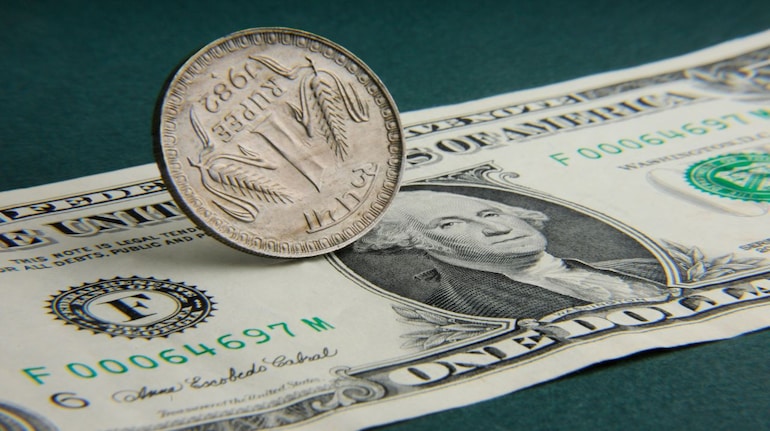
Economists warned that the Indian rupee may weaken past 91 a dollar in the months ahead if India and the US fail to reach an agreement on tariffs.
But they say a weaker rupee now would have only a limited impact on imported inflation and the current account deficit (CAD).
On Thursday, the rupee hit a fresh record low of 90.42 per dollar, and is down about 5 percent this year.
“Commodity prices are benign, imported inflation is not much of a threat, and food inflation is low. Also, the GST rate cuts are still being passed-through. Hence, these factors are providing a cushion with respect to price pressures in the wake of rupee depreciation,” said Dhiraj Nim, economist, ANZ Bank.
Retail inflation has stayed moderate so far in FY26, averaging 1.9 percent in the first seven months of FY26. The 50 percent tariff on certain Indian goods shipments to the US is the real threat, added Nim.
“Tariffs, if they stay, will cause the rupee to depreciate further. In the near-term, my forecast is that the rupee will be around 91.2-91.3/$, assuming status quo.”
India’s CAD widened to 1.3% of the GDP in Q2 FY26, from 0.2% of GDP in Q1. In absolute terms, CAD in the September quarter stood at $12.3 billion, up from $2.4 billion in the April-June period, according to RBI data.
Announcement of the India-US trade deal, along with the removal of the penalty tariff by December 25, could lead to a current account deficit at 1.3% of GDP (up from 0.8% projected earlier). However, if trade negotiations are stretched beyond March 2026, the FY26 current account deficit could widen to 1.5% of GDP, QuantEco Research said in a report.
"With capital flows turning negative and RBI allowing more two-way movement, USD-INR testing the 90 level is a natural outcome. Even so, inflation looks contained and the CAD — which we see rising toward 1.1–1.4% of GDP this year — is still some distance from flashing red," said Rishi Shah, Partner and Economic Advisory Services Leader, Grant Thornton Bharat, adding the pressure is real, but not "destabilizing".
Economists say that, traditionally, depreciation of the rupee has helped increase exports, but with global demand low, the support will remain somewhat muted. The International Monetary Fund has projected global economy to grow at 3.2 percent in 2025, down from 3.3 percent in 2024.
In its October World Economic Outlook edition, the IMF said that higher tariffs imposed by the United States are curtailing external demand, with “profound implications for several large export-oriented economies”, while heightened trade policy uncertainty is dampening firms’ appetite for investment.
Meanwhile, a weaker rupee is likely to impact inflows to the capital account, said Sakshi Gupta, Principal Economist at HDFC Bank. Gupta expects Balance of Payments (BoP) to remain in deficit for the second half of FY26 as well, in the wake of the rupee trading in the range of 90-92/$ and the US tariffs remaining at the same level.
In H1FY26, there was a depletion of $6.4 billion to the foreign exchange reserves (on a BoP basis) as against an accretion of $ 23.8 billion in the corresponding period a year ago, according to RBI.
QuantEco Research projects a balance-of-payments deficit of $30 billion in FY26 if the US-India deal is not concluded. A tariff cut to 25 percent, it said, would limit the deficit to roughly $14 billion this fiscal.
Discover the latest Business News, Sensex, and Nifty updates. Obtain Personal Finance insights, tax queries, and expert opinions on Moneycontrol or download the Moneycontrol App to stay updated!

Find the best of Al News in one place, specially curated for you every weekend.
Stay on top of the latest tech trends and biggest startup news.




