As the conflict in Iran unfolds, many Indian nationals in the Middle East are grappling with whether to return home or continue staying abroad. For those who do return even temporarily, the concern is not just about safety or job continuity, but also about an often-overlooked aspect: their tax status in India.
A prolonged stay in India due to such disruptions can unintentionally alter an NRI’s residency status, which determines how their income is taxed.
Why tax status matters for returning NRIs
Under Indian tax laws, residency status decides whether an individual is taxed only on Indian income or on global income as well. For NRIs, a change in status can significantly increase tax liability.
How residency is determined under Indian tax laws
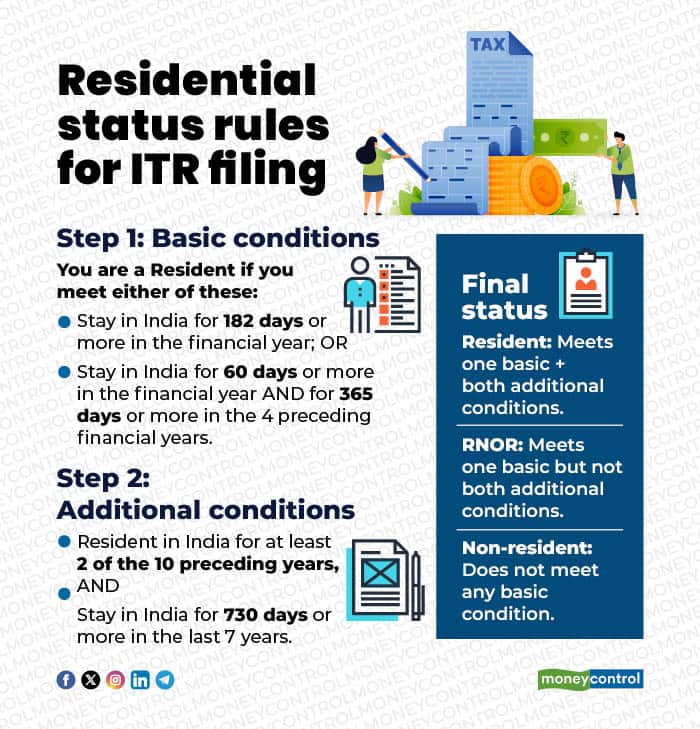
Residency is primarily linked to the number of days spent in India during a financial year. An individual becomes a resident if they stay in India for 182 days or more. A secondary condition also applies if a person spends more than 60 days in a financial year and 365 days over the preceding four years; they may still qualify as a resident.
“Tax residency in India is determined largely by days of stay. Even a part of a day counts as a full day. For NRIs with India-based income, tracking travel days becomes critical as a change in status can expand the scope of taxable income, including global income,” said Archit Gupta, Founder & CEO, ClearTax.
Relief available but only up to a point
There is some relief built into the law. For Indian citizens and Persons of Indian Origin (PIOs) visiting India, the 60-day threshold is relaxed to 182 days. This effectively allows most NRIs to stay in India for up to 182 days without losing their non-resident status.
However, this flexibility narrows for those with higher India-linked income. If an NRI earns more than Rs 15 lakh in India (excluding foreign income), the threshold drops to 120 days instead of 182 days. Crossing this limit can trigger a shift in tax status.
This is particularly relevant for high-income NRIs with rental income, capital gains, or business income in India.
When extended stay can trigger RNOR status
If such individuals stay beyond 120 days, they may lose their non-resident status and be classified as Resident but Not Ordinarily Resident (RNOR).
“Such individuals may not be taxed on their foreign income, but they need to carefully track their stay. Crossing these thresholds can significantly change their tax exposure,” said Kunal Savani, Partner, Cyril Amarchand Mangaldas.
RNOR status offers relief, but not fully
The RNOR status, which typically applies for a limited period after returning to India, offers partial relief. Individuals under this category are generally not taxed on foreign income unless it is linked to a business or profession controlled from India. However, income earned in India remains fully taxable.
Experts caution that while RNOR provides a cushion, it is not a blanket exemption. “Sometimes, this status is not fully evaluated. Maintaining accurate travel records and periodically reviewing residency status can help avoid unintended tax implications,” Gupta added.
Why tracking days in India is critical
With geopolitical uncertainty making travel plans unpredictable, NRIs returning to India need to be especially vigilant. A few extra days of stay could make the difference between retaining non-resident status and facing a broader tax liability.
In such situations, careful tracking of stay duration and a clear understanding of applicable thresholds can help avoid unpleasant surprises when filing tax returns.
Disclaimer: The views and investment tips expressed by experts on Moneycontrol.com are their own and not those of the website or its management. Moneycontrol.com advises users to check with certified experts before taking any investment decisions.
Discover the latest Business News, Sensex, and Nifty updates. Obtain Personal Finance insights, tax queries, and expert opinions on Moneycontrol or download the Moneycontrol App to stay updated!
Find the best of Al News in one place, specially curated for you every weekend.
Stay on top of the latest tech trends and biggest startup news.