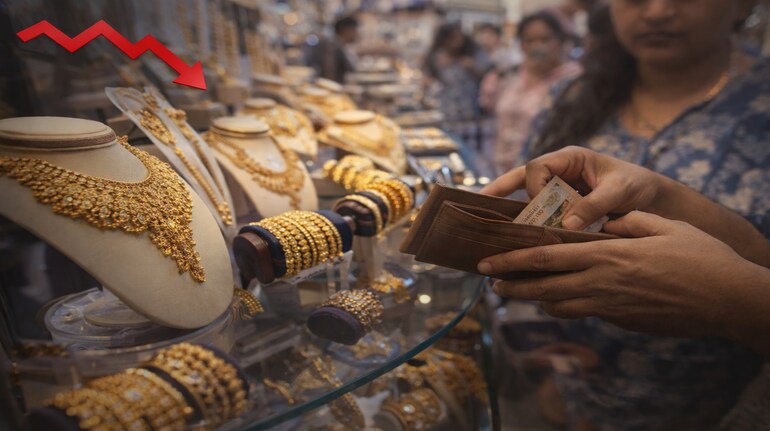

Gold demand in March has fallen sharply amid the escalation of the Iran conflict, which has driven precious metal prices to see-saw and the dollar to rise, sending the metal retreat to pre-war levels.
“The sale of gold has significantly gone down in recent months. There is no interest among retail customers, as it seems everyone is preserving cash to buy fuel, gas and essential items,” said IBJA secretary Surendra Mehta.
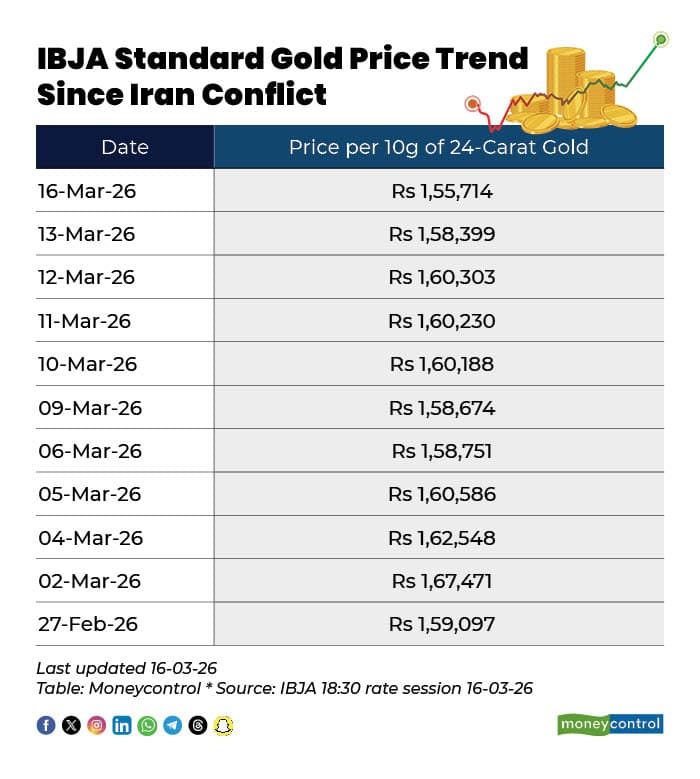
The standard price of gold stood at Rs 1,59,097 per 10 grams before the Iran conflict (Feb. 27). The metal’s price then surged sharply by nearly 5.5 percent to Rs 1,67,471 when the market opened amid the Iran war on March 2.
The prices have steadily fallen to pre-war levels, hovering at Rs 1,58,399 per 10 grams, according to bullion prices set by the International Bullion Jewellers Association. These rates are often cited by the RBI to benchmark the valuation of Sovereign Gold Bond (SGB).
Mehta says that there’s been no increase in gold buying despite the prices falling to pre-war levels. “There has been no increase in customer footfall despite gold and silver prices going down. In fact, it can be said that on a month-on-month basis, there is a reversal in gold sales after the Iran conflict.”
Here’s how the standard prices of gold have been since the Iran conflict
Demand for gold declines as jewellers' purchases decline
The current phase of the Iran conflict also coincides with jewellers focused on closing their financial books ahead of the March financial year-end. Analysts say that retail demand is not effectively moving through the supply chain, from wholesalers to retailers and ultimately to consumers.
“The jewellery sector exhibits particular vulnerability, with jewellers demonstrating minimal purchasing activity as they prioritise year-end financial accounting. Weak retail demand transmission throughout distribution channels suggests limited near-term support for precious metals prices at current levels,” the Augmont Bullion report, published on March 16, noted.
Why is gold price retreating to pre-war levels?
Brent crude prices hovered at $106 per barrel on Monday after recently climbing to highs of around $120 per barrel due to the prolonged closure of the Strait of Hormuz. This has pushed the dollar index (USD/INR) to inch higher against the rupee, which peaked above the 92.70-mark.
Commodities, including crude and precious metals, are priced in dollars when the market opens. As the USD strengthens, commodities become more expensive for global investors, reducing demand.
“Investors are also adjusting their expectations about interest rates, with markets increasingly believing that central banks may keep rates higher for longer due to the ongoing conflict and potential inflationary issues higher oil prices can bring. Higher interest rates generally make non-yielding assets, such as gold and silver, less attractive,” said Ross Maxwell, Global Strategy Operations Lead, VT Markets.
The Augmont Bullion estimates that gold could regain upward momentum and potentially move toward $5,200 (Rs 1.64 lakh), followed by $5,250 (Rs 1.65 lakh) in the near term, if prices manage to stabilise and rebound from current levels.
Disclaimer: The views and investment tips expressed by experts on Moneycontrol.com are their own and not those of the website or its management. Moneycontrol.com advises users to check with certified experts before taking any investment decisions.
Discover the latest Business News, Sensex, and Nifty updates. Obtain Personal Finance insights, tax queries, and expert opinions on Moneycontrol or download the Moneycontrol App to stay updated!
Find the best of Al News in one place, specially curated for you every weekend.
Stay on top of the latest tech trends and biggest startup news.