A week ago, chipmaker NVIDIA became the first company to reach $5 trillion in valuation, vaulted by dizzy rally in global AI and tech names.
Shares of Apple, too, hit a record high after the iPhone maker came out with an upbeat holiday sales forecast. Though Elon Musk’s Tesla shares have hit a rough patch, they are up 300-fold since the IPO 15 years ago.
These shares make up a dream portfolio but are quite expensive. Take the example of Seaboard Corp, a global food, energy and transport player. As of November 5, a share was trading at $3,682, or around Rs 3.2 lakh, putting them out of reach for most retail investors.
The good news is retail investors can own a piece of them with small investment and be part of the growth story.
There are two ways to own these US shares in fractions. Take a look:
Through Gift City
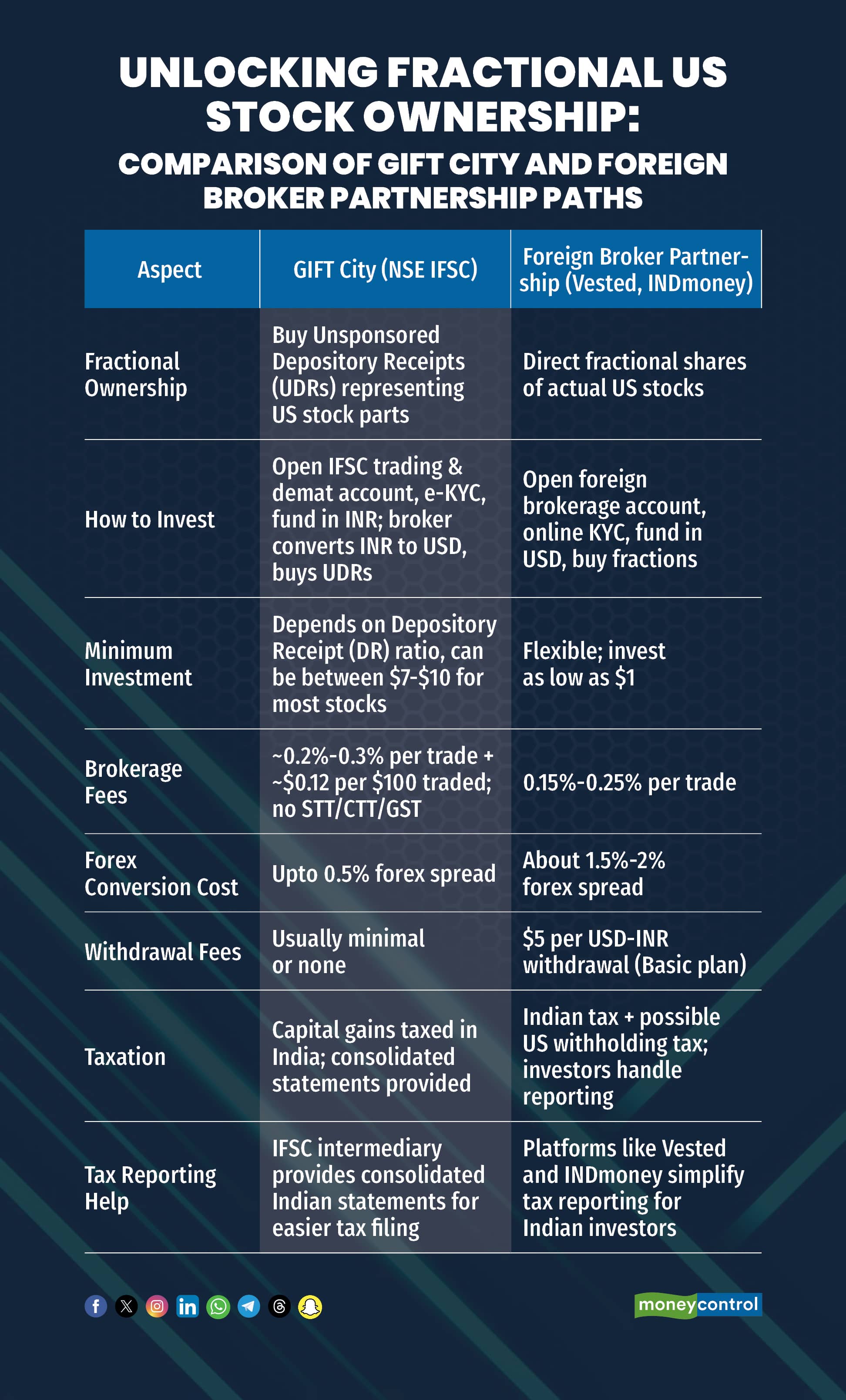
Through GIFT City, the process feels almost as simple as investing locally. Investors open a trading and demat account with an IFSC-registered intermediary, complete e-KYC, and fund their account in the Indian rupees. However, here you have access to only the top 50 US stocks.
“The intermediary converts the funds into U.S. dollars through an IFSCA-licensed bank within the IFSC ecosystem and executes trades on the NSE IFSC platform,” said Nilesh Choudhary, founder and CEO, Aikyam Capital Group. It is completely digital, typically completed in three to five days, and provides a single, transparent interface.
Through GIFT City (NSE IFSC), Indian investors can buy small parts of US stocks such as NVIDIA, Apple, or Tesla. But they do not buy an actual share. Instead, they buy a depository receipt (DR), which represents a fraction of the stock. The DR ratios for these top 50 US stocks help investors to invest in fractions and have ownership of the global stocks.
“For example, the NVIDIA stock is at $210 and the DR ratio is 1: 25, thus an interested investor can buy NVIDIA stock fraction for $ 8.4 . This is pocket-friendly for an investor. The customer having fractions in their demat account, these US stocks are also eligible for corporate action benefits,” said Niteen D, CEO and Head-GIFT City, IFSC Business, Anand Rathi International Ventures. Thus, through GIFT City (NSE IFSC), the smallest investment depends on the DR ratio.
On BSE GIFT City INX, another way to invest in US shares through GIFT City, fractional ownership of US stocks is not allowed because the platform lists only full shares and does not use DR like NSE IFSC. This means investors must buy entire shares, as the legal and operational framework for splitting US stocks into fractions is not in place at BSE INX yet.
Through The Foreign Broker Route
“Under the foreign broker route, Indian investors typically gain exposure to overseas equities, most commonly US stocks, through platforms that hold client securities, fractional or whole, in pooled omnibus accounts under global custodians,” Choudhary said. Vested And INDmoney are in this space.
Here, buying a fractional share works in a different way. Let us take an example. On November 5, an Apple share cost around $270. When you buy a fractional share through the foreign broker route, you can buy just the fraction of the share. For example, one-tenth of an Apple share would cost you $27, and one-twentieth around $13.5, and so on.
Here, there is no fixed minimum amount. “You can buy stocks like Nvidia, even in small fractions (e.g., $1 worth),” Viram Shah co-Founder and CEO of Vested, said.
Here, Vested buys the full Apple share through a US brokerage account. When you invest, you are allocated a proportional fraction of these full shares. The fraction value is recorded in your account, so you can track value and buy more fractions. When Apple pays dividends, you receive the amount that is proportional to your fraction. This lets you own expensive US stocks without paying the full share price, while you still benefit from the price movements and dividends.
Fee comparison: GIFT City and foreign brokers
The cost of investing in GIFT City includes the account opening charges and yearly AMC by the trading member. These charges are in the range of $10-20 for an account. Apart from these charges , the brokerage for investing is in the range from 20-30 basis points.
“It should be noted that there is no STT (Securities Transaction Tax), CTT (Commodity Transaction Tax), GST (Goods and Services Tax) applicable in GIFT City,” Niteen said.
Trading on NSE IFSC does not attract securities transaction tax or stamp duty, and currency conversion happens through Indian banks at standard interbank rates. Investors pay a one-time remittance charge under LRS, and the overall transaction cost remains low and consolidated.
The other costs incurred in these transactions include the forex spread and trade commission, which the investor's bank will charge at the time of remittance to the customer's GIFT City account. The trading member may charge monthly or yearly mobile app usage charges to the customers.
“The foreign broker route does offer slightly lower brokerage rates, often under 0.5 percent but that advantage is offset by foreign exchange spreads of 0.5 to 2 percent, wire charges, and intermediary fees,” Choudhary said.
Both routes operate within the RBI’s Liberalised Remittance Scheme, with the annual limit of $250,000 and a five percent tax collected at the source. “GIFT City, however, makes global investing far more cost-efficient for smaller and mid-sized investors,” he added.
Discover the latest Business News, Sensex, and Nifty updates. Obtain Personal Finance insights, tax queries, and expert opinions on Moneycontrol or download the Moneycontrol App to stay updated!





Find the best of Al News in one place, specially curated for you every weekend.
Stay on top of the latest tech trends and biggest startup news.