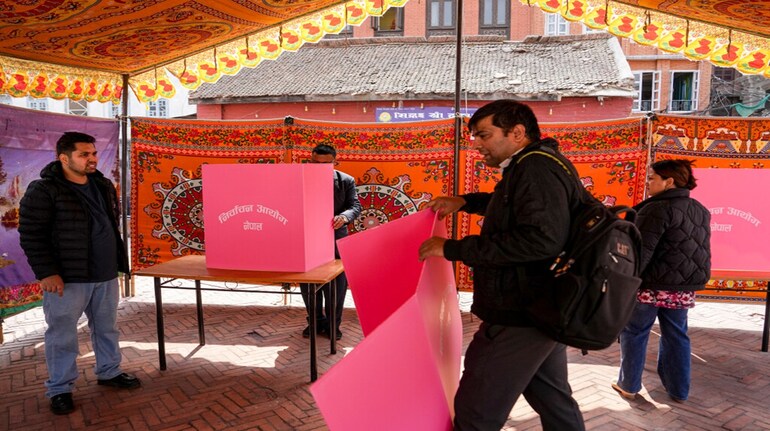

Nepal is set to vote today in the crucial general elections, six months after a violent Gen Z-led protest toppled the KP Sharma Oli-led government last year. The election will replace the interim government of Sushila Karki, who has been leading the Himalayan country since September 2025.
Who all are in the election fray?
The election is being seen as a test for Nepal's Old Guard who ruled the Himalayan kingdom for over a decade vs the popular youth leaders. Some of the contenders in the election are:
KP Sharma Oli-the former Prime Minister from the communist Party CPN-UML who was ousted last year following the Gen Z protests.
Pushpa Kamal Dahal- Popularly known as 'Prachanda', the long-time Maoist leader will fight the election with a ticket from the Communist Party of Nepal (Maoist Centre) or CPN (MC).
Balendra Shah- the former mayor of Kathmandu and a popular youth leader has been fielded by Nepal's Rashtriya Swatantra Party as its Prime Ministerial candidate. The rapper-turned-politician has cast himself as a symbol of youth-driven political change. With Balen's growing popularity, he has chosen to contest from Jhapa-5 constituency, giving Oli, who has won the seat six times in him home turf, a tough fight.
Gagan Thapa-The 49-year-old popular youth leader has been fielded by the country's oldest party, Nepali Congress.
The voters will elect 275 members of the House of Representatives, the lower chamber of Parliament -- 165 of them directly through the first past-the-post system, with a further 110 through proportional representation.
Election preparations
Interim Prime Minister Sushila Karki has urged people to vote "without any fear".
Acting Election Commissioner Ram Prasad Bhandari said all preparations for the election have been completed and urged voters to participate actively and enthusiastically in the democratic exercise.
Bhandari said foolproof security arrangements have been put in place, with the deployment of more than 300,000 security personnel under an integrated security plan coordinated with the Nepal Army.
VIDEO | Kathmandu, Nepal: Kathmandu's former Mayor and Rastriya Swatantra Party's (RSP) Prime Ministerial candidate Balendra Shah casts his vote for the General Elections being held in the country for the first time since the overthrow of the previous government during the… pic.twitter.com/xpMJVpFbeH— Press Trust of India (@PTI_News) March 5, 2026
The preparations for the election are complete, including flying election materials to snowbound areas of Nepal, home to eight of the world's 10 highest peaks, including Mount Everest. The details are as follows
What led to the protests last year?
Nepal has been in a chronic political instability: 14 governments in 17 years under eight different Prime Ministers since the abolition of the monarchy in 2008. Corruption was endemic while youth unemployment was also at its peak.
What added fuel to the fire was when on September 4, 2025, Prime Minister Oli's government suspended 26 social media platforms, including Instagram, Facebook, YouTube, WhatsApp, and X, for failing to register with Nepali authorities under a controversial new digital law.
September 8- Thousands of young protesters marched towards the Parliament, raising slogans against corruption and nepotism. The government responded with security forces opening fire at the crowd, killing 17 protesters in Kathmandu alone.
September 9- The Parliament building, the Supreme Court complex, the prime minister's and president's residences, police stations, the headquarters of KP Oli's Communist Party were either damaged or burned.
Under reported persuasion from Nepal Army chief General Ashok Raj Sigdel, KP Oli submitted his resignation as PM to President Ramchandra Poudel.
September 10-Army imposes curfew, scores of people dead and injured.
September 12- After Oli's ouster, President Ramchandra Paudel dissolved the 275-seat Parliament and Sushila Karki was sworn in as Nepal's 42nd Prime Minister, becoming the first woman in the Himalayan republic's history to hold the office.
Nepal has not completed a full five-year term of government since the abolition of the monarchy in 2008. Although the date for the next elections was announced as March 21, 2026, in October 2025, Sushila Karki said in her briefing to diplomats, "This non-political, transitional government has one sole and non-negotiable mandate: to hold free, fair, and impartial general elections to the House of Representatives on March 5, 2026. We are committed to a maximum six-month term, after which we will peacefully hand over power to a democratically elected government."
Discover the latest Business News, Sensex, and Nifty updates. Obtain Personal Finance insights, tax queries, and expert opinions on Moneycontrol or download the Moneycontrol App to stay updated!
Find the best of Al News in one place, specially curated for you every weekend.
Stay on top of the latest tech trends and biggest startup news.