Muted capital spending could help the Centre better its fiscal deficit target of 4.9 percent of GDP this year, but it may risk dampening consumption further.
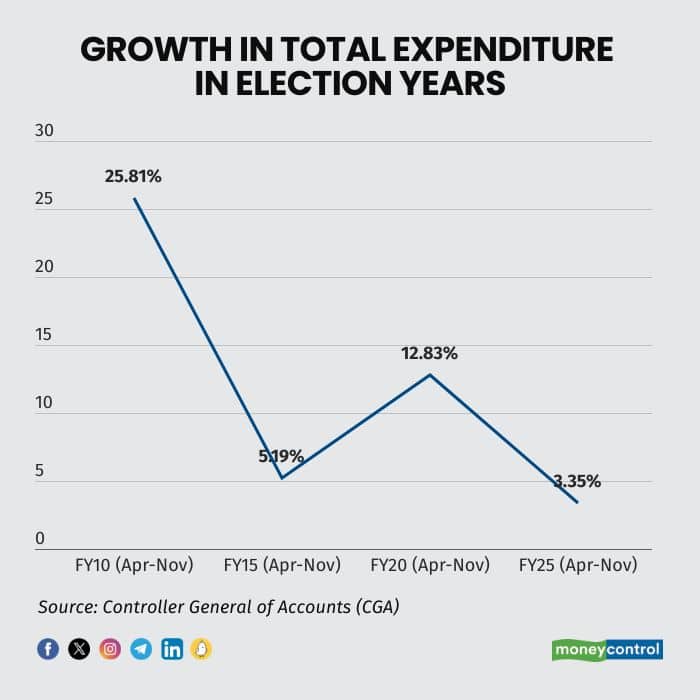
Capital expenditure for the first eight months of FY25 contracted over 12 percent to Rs 5.1 lakh crore, raising concerns about meeting the record budgeted capex target of Rs 11.11 lakh crore. Meanwhile, total government spending grew 3.3 percent to Rs 27.4 trillion, the slowest pace in a decade.
While lower expenditure could allow the Centre to narrow the fiscal deficit, this trend does not bode well for consumption, especially in urban India.
After accelerating to a seven-quarter high of 7.4 percent in Q1 FY25, Private Final Consumption Expenditure or PFCE, slowed down to 6 percent during July-September.
In the eight months to November, India’s fiscal deficit crossed the halfway mark at Rs 8.5 lakh crore or 52.5 percent of the Budget estimate of Rs 16.13 lakh crore. This was higher than the 50.7 percent figure recorded in the same period in the previous fiscal year.
The November data shows revenue expenditure rose a mere 0.5 percent from a year earlier, while capital expenditure surged 21.3 percent, led by a sixfold jump in loans and advances.
Motilal Oswal Financial Services pointed out a 20.2 percent contraction in capital spending, excluding loans and advances, in November, extending its decline for a fourth straight month. Capital spending fell 26.6 percent in October.
The growth in revenue spending was, however, better during the April-November period, rising 7.8 percent to Rs 22.3 lakh crore.
Government spending typically tapers in election years, but total expenditure rose nearly 13 percent in the April-November period during the 2019 polls, much faster than the 3.3 percent growth seen this fiscal year.
The lack of a pick-up in spending comes at a time when economists are advocating a shift in policy from revenue maximisation to fostering growth.
In a pre-budget meeting with Finance Minister Nirmala Sitharaman last month, economists recommended reconsidering the current fiscal consolidation path and re-evaluating key taxation policies to boost growth.
According to the fiscal consolidation path laid out in 2021, the Centre aims to bring the target below 4.5 percent by FY26. Given demand concerns, the industry has also asked the central government to avoid targeting sharper contractions in the fiscal deficit.
These concerns come at a time when India’s GDP growth for the second quarter of the current fiscal came in at 5.4 percent, the slowest in seven quarters. Many attributed this drop to a slowdown in spending, especially in capex.
Income tax boosts revenues
The slowdown in spending coincided with relatively healthy growth in receipts, which rose 8.5 percent from April-November.
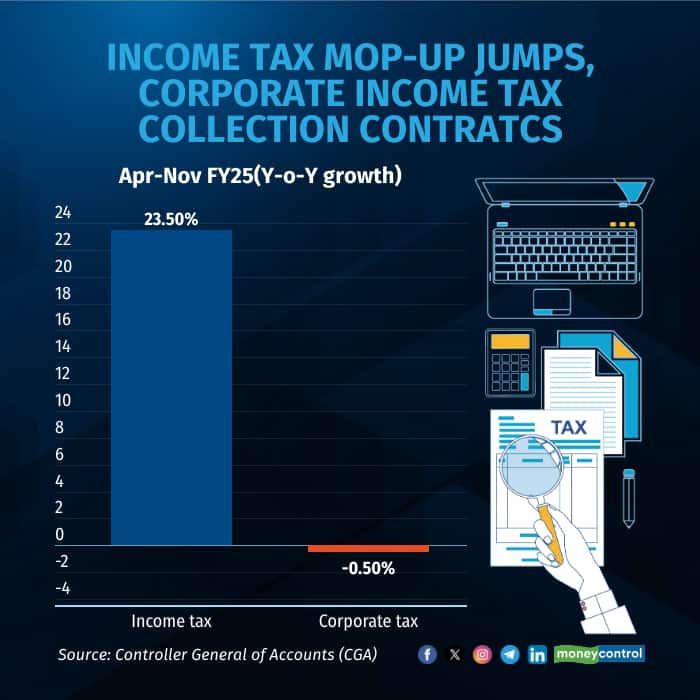
A closer look at the numbers shows that direct tax growth was led by a 23.5 percent surge in individual income tax collections over the eight months to November, while corporate tax receipts shrank by 0.5 percent.
In November alone, individual income tax collections jumped 61 percent from a year earlier, while corporate tax revenues fell 27 percent.
Indirect tax collections also grew at a tepid 1 percent pace in November, highlighting the reliance on income taxes to drive the Centre’s overall tax receipts.
The trend of lower spending versus higher revenues led by income tax collections, has led to a call for lowering the burden on India’s salaried class.
Ahead of the presentation of the Budget for 2025-26, the Confederation of Indian Industry urged the finance ministry to reduce the marginal tax rates for personal income of up to Rs 20 lakh per annum to boost consumption.
Discover the latest Business News, Sensex, and Nifty updates. Obtain Personal Finance insights, tax queries, and expert opinions on Moneycontrol or download the Moneycontrol App to stay updated!
Find the best of Al News in one place, specially curated for you every weekend.
Stay on top of the latest tech trends and biggest startup news.