--------------------------------------------
S&P 500 is down close to 20 percent from its all-time high signalling a bear market may be on its way. Interestingly, the US markets stayed rock solid in the first three quarters of the calendar 2018 despite trade wars and continued monetary policy tightening, mainly because of strong earnings growth partially aided by a fiscal stimulus in the year. Consensus earnings growth expectation for CY2018 is about 20 percent, much higher than the earnings growth in CY2017.
It’s noteworthy that markets across the Atlantic were not as strong. The UK, Eurozone, China and Indian markets had weakened much earlier, due to various local and international factors including consumption and trade slowdown.
So what made the US markets fizzle out now?While the US Federal Reserve raised its policy rate by another quarter of a percent in the last Fed meet, the median projections for rate hikes moderated for the next year and the expected levels for the long run level for funds rate have come down to 2.8 percent. Together with Fed Chair Powell’s statement that they had reached the lower range of the neutral rate estimates, the implication is that the policy rate is nearing levels where it neither stimulates nor restrains economic growth by changing its interest rate policy.
However, markets apparently expected much more from the Fed, perhaps a re-think on quantitative tightening. The US 10-year yield has already dropped below the expected long-term level for funds rate (2.8 percent). From its recent high of about 3.24 percent, the market is already pricing in moderation of 50 basis points (bps) in the interest rate hike cycle. The US financial market CME says the probability for the current Fed policy rate to continue by the first meeting of 2020 (Jan 29) is 57 percent. In fact, the market is now assigning some probability for a rate cut in this meeting (21 percent now vs. just 5 percent a month before).
So the US market is certainly worried that the Fed doesn’t sound very accommodative about the growth slowdown and event risk concerns.
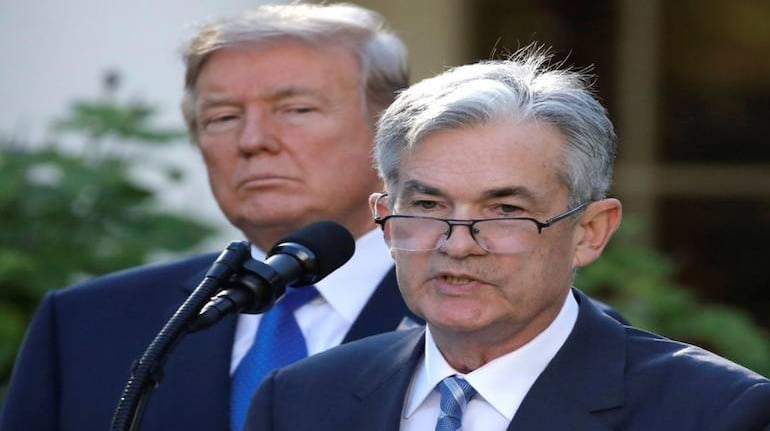
Near-term domestic concernsAdditionally, domestic policy uncertainty has spiked as the US president turns quite critical about the Fed policy. At the same time, political brinkmanship is elevated as Trump's insistence on demand for funds to build a wall on the US-Mexico border has led to a partial shutdown of the Federal government.
Global growth slowdown garnering attentionThe market is concerned about a slowdown in global growth particularly in the Eurozone and in select emerging markets, particularly China. When read together with two event risks i.e. the USA- China trade talks and the possibility of no-deal Brexit, there’s some room for concern. Earlier this month, while bringing its quantitative easing programme to an end, the European Central Bank observed the balance of risk is towards the downside. Further, the European Commission and UK government have given signals that they are working on a possibility of no-deal Brexit which could have an adverse impact on the region’s economy.
To add to the concerns, oil markets have also seen a sudden collapse. From around $84 a barrel, Brent is currently hovering at $50 which reminds one of the 2015-16 periods, when deflationary concerns in the oil market had emerged. While OPEC and Russia have agreed to implement output cuts recently, investors seemed sceptical whether the reductions will be enough to restore the supply-demand balance. While part of the imbalance is on account of a supply glut due to some exemptions to Iran and improved production in the US and Saudi Arabia, the demand outlook has also moderated.
It must also be noted that IEA (The International Energy Agency) had moderated its global oil demand outlook to 1.4 million barrels per day for 2019 which implies a reduction of 110,000 barrels per day from earlier projections, on account of weaker economic outlook and trade concerns.
What to expect?The oil market also assumes importance because a part of the earnings growth story for the US corporate sector has been driven by the energy market (6 percent weightage). However, a sizeable part of the US and the global corporate sector may find relief on the net margin level, in the near term, if oil prices remain in the $45-$60 range and the interest rate cycle pauses.
But while there are clouds on the global macro situation, partly on account of the trade war, interest rate cycle and volatile exchange rates, some factors are not doing badly. US corporate earnings growth for CY19 is expected to be around 7.4 percent as the tax stimulus fades away. However, CY20 earnings are estimated to rebound to double digits. Add to that, the inflationary scenario is reasonably benign.
Given this context, a 20 percent stock market correction seems like an over-reaction. It must be recalled a similar correction was seen during 2010 and 2011 when European debt crises and US debt downgrades were the overarching concerns.
Having said that, the global growth moderation remains the key factor to watch out for. The market is factoring in a worsening in demand, more than what is visible in the data. Financial conditions have tightened, which the Fed also is wary of. In view of all these factors and given the event risks like the possibility of the USA China trade talks going nowhere or a no-deal Brexit, markets are likely to remain volatile.
Follow @anubhavsaysFor more research articles, visit our Moneycontrol Research Page.
Discover the latest Business News, Sensex, and Nifty updates. Obtain Personal Finance insights, tax queries, and expert opinions on Moneycontrol or download the Moneycontrol App to stay updated!
Find the best of Al News in one place, specially curated for you every weekend.
Stay on top of the latest tech trends and biggest startup news.