




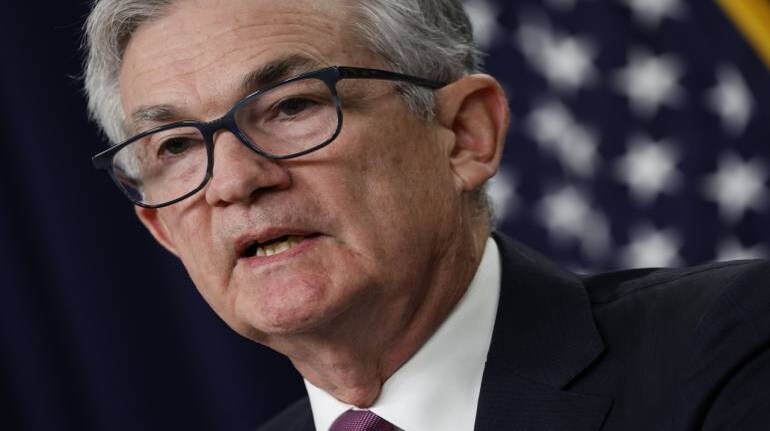
As most of us were preparing to celebrate Holi, Fed chair Jerome Powell poured cold water on markets’ hopes that the US central bank will soon adopt a more accommodative stance.
In his much-awaited semi-annual testimony before the Senate Banking Committee, Powell said stronger-than-expected macroeconomic data warranted larger rate hikes and the Federal Reserve was prepared to do more to tame scorching inflation.
"If the totality of the data were to indicate that faster tightening is warranted, we would be prepared to increase the pace of rate hikes," Powell said, sending shockwaves through the global markets.
His hawkish remarks boosted bets that the Fed will revert to 50-basis points (bps) hikes, thus putting pressure on other global central banks as well.
One basis point is a hundredth of a percentage point.
What seemed outrageously outlandish at the beginning of the year is suddenly looking painfully probable – what if the Fed hikes rates to 6 percent?
According to analysts at UBS, while markets were fully pricing in three further Fed rate hikes to 5.5 percent, tightening towards 6 percent would firmly test historical “pain thresholds” for emerging market assets.
Also read: Asian stocks tumble after hawkish Jerome Powell commentsIndia ‘more sensitive’India’s sticky core inflation at 6 percent and strong breadth (more than half of the items in core CPI baskets growing above 5 percent) make it likely that the Reserve Bank of India (RBI) will maintain its hawkish stance, UBS said in a recent note.
“…we remain unconvinced that the RBI-Fed policy rate spread will be allowed to tighten by 60 bps this year to close to a 20y low,” it added.
India is among the more sensitive markets to US rates, demonstrating the most sensitivity to local rates given higher influence of domestic flows into the market, UBS analysts said.
Indian equities have further downside risk on valuations as domestic flows can peter out in case of persistently elevated interest rates, especially if sticky US inflation is fanned by rising oil prices and the impact of China reopening, the analysts wrote.
The FII, DII twistWhile earlier domestic flows used to be in lockstep with the foreign institutional investor (FII) movement, the relationship has inversed in recent times.
Experts say a sharp FIIs sell-off will unlikely trigger a meltdown on Dalal Street as domestic investors are maintaining their composure despite the drumbeat of negative headlines.
From panic selling in tandem with FIIs during the Global Financial Crisis of 2008 to regularly “buying the dip” now, domestic investors have indeed come a long way.
Mark Matthews, Head Research Asia, Julius Baer, said as of December 2022, domestic institutional ownership continues to remain at record highs (13.7 percent), as DIIs pour money into the Indian market on the back of strong retail participation through monthly Systematic Investment Plans (SIPs).
Encouragingly, foreign institutional ownership has also started bouncing back —from decade lows of 18.4 percent in June 2022 to 18.9 percent in December 2022.
Valuations looking betterThere’s good news on the valuations front as well.
“Over the last four months, India’s valuation premium versus the emerging market (EM) peers retraced sharply from a high of 120 percent in November 2022 to its 10-year average of 70 percent, as the Chinese markets bounced back over 50 percent during the same period,” he added.
Julius Baer also believes that incremental foreign selling will decrease due to valuation comfort, superior earnings growth versus EM peers, and the lowest decile foreign ownership.
However, this is not to say a Fed rate of 6 percent — or even higher — will not strain the already stretched corporate balance sheets, tip the US economy into recession and seriously jeopardise the post-Covid global recovery.
Still a rough surfaceDespite its strong internal growth engines, India, too, can’t be completely immune from the global aftershocks.
In fact, some cracks are already appearing on the windscreen.
“…corporate earnings are showing signs of weakness: leverage levels back to pre-pandemic highs, working capital at 8-year highs, inflation creeping into sticky costs like employees and SG&A (selling, general and administrative expenses) etc,” the UBS note said.
It means investors should be prepared to bat on an uncertain pitch for an extended period of time. Unless, of course, Powell bowls a googly at the Fed’s policy meeting later this month.

Discover the latest Business News, Sensex, and Nifty updates. Obtain Personal Finance insights, tax queries, and expert opinions on Moneycontrol or download the Moneycontrol App to stay updated!
Find the best of Al News in one place, specially curated for you every weekend.
Stay on top of the latest tech trends and biggest startup news.




