India may be relatively better-placed in terms of the drastic tariff levies by Donald Trump on other Asian economies, but that doesn’t imply a return of foreign inflow into the country, for FIIs may be more concerned about valuations and the earnings trajectory, several equity analysts have told Moneycontrol.
Impact on India
Arindam Mandal, Head of Equity Research at Marcellus said India is relatively better-positioned compared to other Asian economies when it comes to the impact of Trump’s tariffs.
While many Asian countries are export-dependent, India’s economy has been largely been driven by domestic demand. "...even while global markets are absorbing the shock, the reaction in India is cautious. FPI (foreign portfolio investor) inflows are not going to flood back just because India’s hit is slightly softer. The global mood remains risk averse,” Arindam said.
He also pointed out that FIIs are more concerned about valuations and the ongoing earnings downgrades in India than any tariff-related impact. The problem stems from the fact that India's strong growth relative to the world over past few years has led to a higher base. At the same time, domestic indicators like job creation have not kept pace, creating a disconnect, he added.
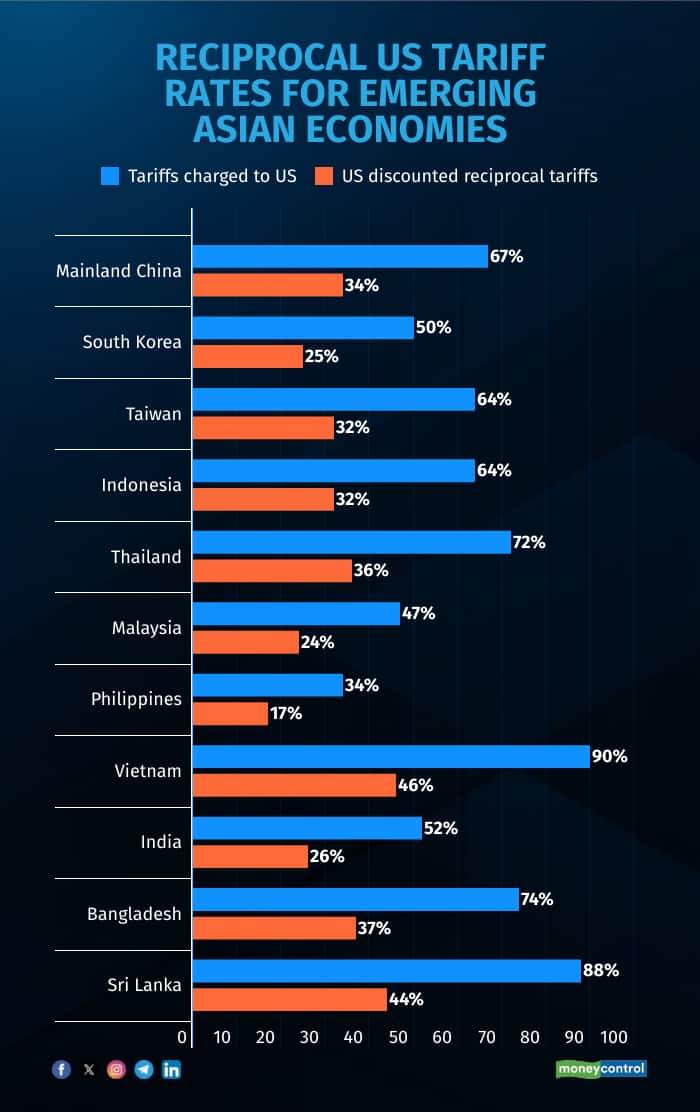
FII Flow - Do Tariffs Matter?
Marcellus' Arindam Mandal does not think that FIIs would make a short-term move based solely on the tariff levy. "High-quality FIIs do not typically react to short-term fluctuations. Instead, they remain cautious primarily due to valuation concerns and the lack of earnings visibility in several sectors," he added.
“FPIs are in a cautious mode and are unlikely to make quick, bullish moves just because India appears less impacted, compared to other emerging markets," Mandal said.
Another equity analyst, Deepak Jasani said, “FPIs’ view on emerging markets will depend on the relative hit to the growth of these economies by the Trump tariffs.”
What if Tariffs Are Not Rolled Back?
Deepak Jasani said emerging economies and India may be staring at an extended period of selloff, if tariffs are not rolled back substantially, or the global risk appetite begins to shrink. “We could be looking at an extended downtrend in the markets. This may start with a lag of a couple of weeks from now and may continue for some time," his stance remains.
The eventual impact could be on India’s GDP growth and corporate earnings, he said. “As it is, these measures may dent global risk appetite, to some extent. Hence, it is important that corporate earnings are not negatively impacted," Jasanin added.
Investors may also be fearing a second-order impact of the reciprocal tariffs, in terms of inflation, interest rates and exchange rates. "What may be impacted are the interest rates of various countries, inflation and growth. There may also be changes in fiscal policies of the affected countries, as their trade deficits will be altered and welfare spending may need to be upped," he said.
The veteran investor added that he would closely watch for subsequent revisions or negotiations, and in case tariffs on India turn out to be relatively lower, funds may get 'diverted from other emerging markets to India'.
The exclusion of some industries from the additional tariff regime may not be of much help, Deepak Jasani said. "The MSME (micro, small and medium-sized enterprises) sector in India that derives a good amount of revenue from the US may get hit and may need to be protected." he added.
While a large part of this uncertainty is already discounted by the markets in the current valuations and there could be some recovery, that may not last very long in Jasani's view.
Deepak Jasani also told Moneycontrol that there may be other events lined up, including corporate earnings for the March quarter and RBI monetary policy meeting next week, which will be tracked more keenly.
Inflationary Pressure in US
Siddharth Bharme, Head of Research at Asit C Mehta believes market will react to Trump’s announcements, regardless of whether they are final or not. "These tariffs would lead to a reduction in global trade, which is not a good thing for anyone,” said Bhamre, adding that the immediate impact of tariffs would be inflationary pressure on the global consumer.
Inflation typically make FIIs cautious, as it could lead to a tighter monetary policy, which may trigger outflows from emerging markets, including India, as investors seek safer assets.
Read More: Indian IT sulks on 'Liberation Day' as analysts fear risk to US demand, client spends
According to Nirav Karkera of Fisdom, not every sector will be hit by the trade levies, and even those that are vulnerable might face less damage than initially feared. This selective reaction may mitigate the overall impact on India’s economy, Karkera said, especially since India leans more on domestic demand, compared to some of the export-heavy Asian and emerging economies.
He also thinks India’s relatively stronger diplomatic ties with the US could mean fewer trade escalations, and possibly even an opportunity to negotiate better terms.
Market expert Kranti Bathini cautioned about the lingering impact of the tariffs, extending from short to medium term, when it comes to FIIs. Some countries are likely to resort to retaliatory tariffs, which may have consequences for the global economy. "...uncertainty is likely to remain the operative word for global markets in the coming days as well," Bathini said.
Impact of Tariffs on Dollar, Global Order
Market expert Ambareesh Baliga has cautioned that US is moving towards stagflation, and these tariffs may even push the global trade against the US dollar, possibly sparking the beginning of a change of global order.
At the same time, Baliga thinks India's domestic resilience - captured by FMCG, real estate, infrastructure, and cement companies - is likely to hold up better since they are more insulated from global supply-chain disruptions.
Read More: Gems & Jewellery: Can the sector keep its sparkle amid Trump's tariff blitz
In the short term, FII flows might decline, even though India may be relatively better-positioned compared to other emerging market peers, said Baliga. "However, India’s relative stability - for instance, its advantage in textiles compared to Bangladesh - might eventually attract interest again," Baliga added.
Disclaimer: The views and investment tips expressed by experts on Moneycontrol.com are their own and not those of the website or its management. Moneycontrol.com advises users to check with certified experts before taking any investment decisions.Discover the latest Business News, Sensex, and Nifty updates. Obtain Personal Finance insights, tax queries, and expert opinions on Moneycontrol or download the Moneycontrol App to stay updated!





Find the best of Al News in one place, specially curated for you every weekend.
Stay on top of the latest tech trends and biggest startup news.