
Heightened volatility, an FII sell-off, and tightening liquidity have caused the markets to enter a sharp corrective territory. However, the small- and mid-cap segment of the equities has taken a sharper fall compared to their large-cap peers, falling as much as 15 percent since the end of September.
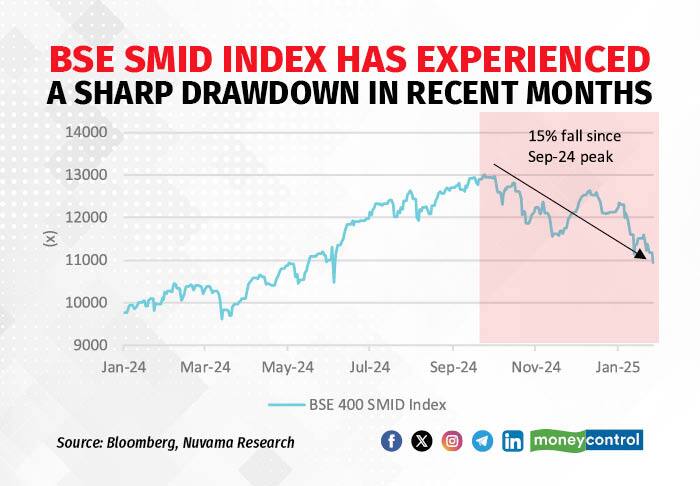
The BSE400 small and midcap index is poised for its fifth 20 percent-plus correction post-GFC.
Is this a blip or a bear market?
However, is this fall a blip or a serious correction? According to analysts at Nuvama Institutional Equities, this downturn could be the beginning of a bear market as domestic growth slows and durable liquidity slips into a deficit. Further, despite the 15 percent correction, SMID valuations are still high.
The past corrections can be classified as blips, such as those seen in 2015–16 and 2021–22 or bear markets, which was seen in 2011–13 and 2018–19.
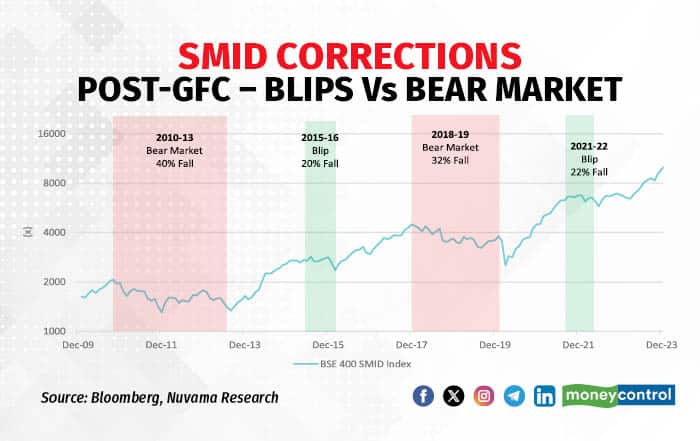
As per Nuvama Institutional Equities, blips are short-lived, lasting two–three quarters as SMIDs fall in line with large-caps. On the other hand, bear markets are prolonged correction phases with a 30–40 percent correction over two–three years and large underperformance to the Nifty 50 and Sensex.
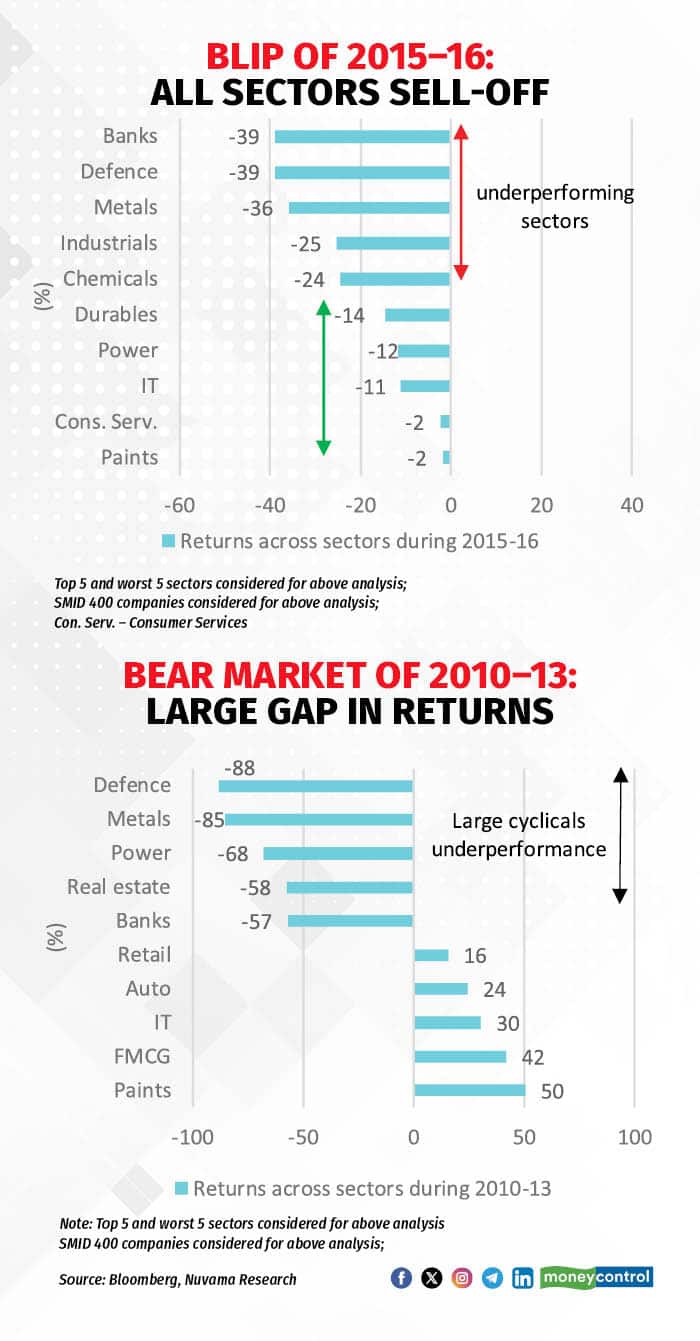
During blips, all sectors decline, with little difference in sectoral performance. However, during bear markets cyclicals (real estate and industrials) tend to experience large underperformance and usually tend to correct by more than 50 percent.
Further, the brokerage noted that SMIDs are more exposed to the domestic economy than large-caps. Thus, it is only when domestic growth slackens do SMIDs tend to experience bear market and correct.
"The best way to assess the same is by looking at the domestic credit cycle and exports trend. If the credit cycle is weakening, then it is a sign of domestic weakness in which SMIDs will invariably underperform," said Nuvama analysts.
Bear markets are preceded by large 5Y returns (20 percent or above) while blips occur in the initial phases of bull markets and tend to have 10–15 percent 5Y returns in the run-up. Therefore, bear markets typically occur when domestic credit slows, liquidity tightens and midcaps experience a strong five-year rally on an absolute as well as relative basis.
Also Read | Budget cheer coming for railways? RVNL, Railtel, other rail stocks surge ahead of Budget 2025
Blips on the other hand are an outcome of global weakness while domestic growth and liquidity conditions are generally stable. Furthermore, they are not preceded by a large medium-term rally.
So is this current correction a blip or bear market? Most signs point towards the SMIDs space entering a bear market. Domestic growth that is slackening this, which is evident in the credit cycle, while it was strong in 2023, in H1CY24 it has experienced a sharp moderation.
Also, excluding BFSI, SMID earnings are now underperforming large-cap peers and have moved into contraction. "In fact, even in the Q3FY25 results season so far, SMID earnings have been disappointing and experienced large downgrades," noted the brokerage.
The performance of SMIDs relative to the Nifty 50 have been the highest in a post GFC-world. Even after the correction, they remain quite elevated – a trend that is typically observed in market corrections preceding bear markets.
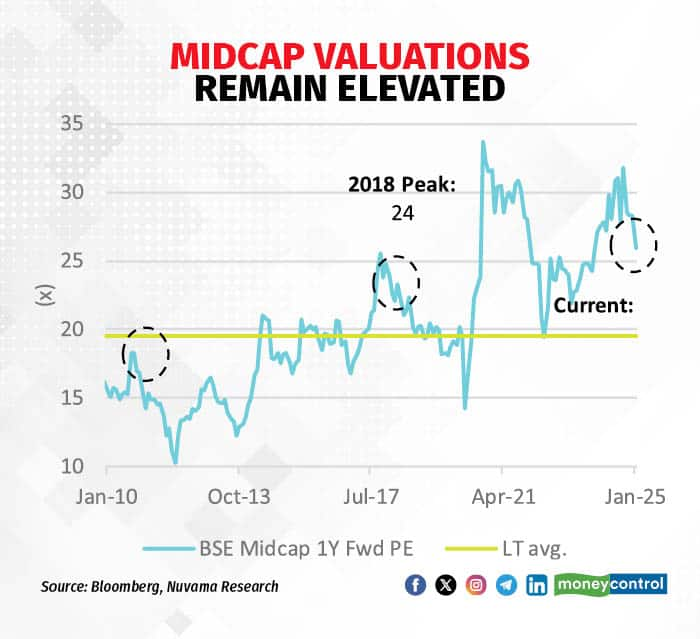
With a sharp run up comes stretched valuations. Even, after the 15 percent correction, valuations are higher than the previous peaks.
Way forward
As domestic growth is slackening, liquidity conditions are tightening and valuations as well as 5Y returns are quite elevated, Nuvama Institutional Equities believes there could be risks of a bear market. "These have higher resemblance to the 2011–13 and 2018–19 phases. Thus, it is perhaps not yet a time to buy the dip," noted analysts.
The reversal from the previous bear markets, especially in 2018–19, was due to the US Federal Reserve. Hence, it is very important to monitor Fed actions and global liquidity hereon, as that will shape the SMIDs outcome.
Investors should maintain a very low beta bias as growth is still subdued and liquidity remains tight. "In sectors, where margins are close to cyclical lows, and demand has stabilised, we think consolidation/costs focus could happen and those stocks/sectors could see larger upside," said Nuvama, adding, "Despite the sharp correction, we recommend avoiding cyclical exposure in SMID portfolio."
Disclaimer: The views and investment tips expressed by investment experts on Moneycontrol.com are their own and not those of the website or its management. Moneycontrol.com advises users to check with certified experts before taking any investment decisions.
Discover the latest Business News, Sensex, and Nifty updates. Obtain Personal Finance insights, tax queries, and expert opinions on Moneycontrol or download the Moneycontrol App to stay updated!
Find the best of Al News in one place, specially curated for you every weekend.
Stay on top of the latest tech trends and biggest startup news.