Indian markets have historically experienced sharp volatility on Budget days while reacting to policy announcements, economic conditions, and global cues.
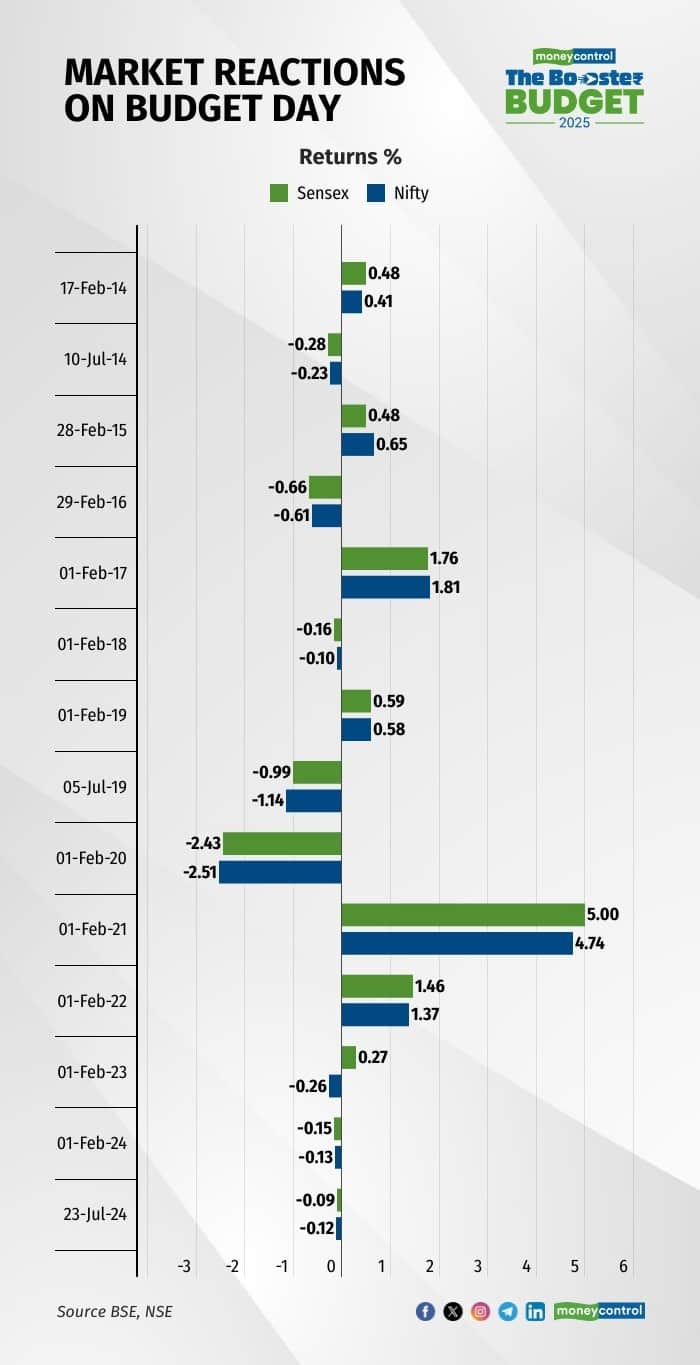
Over the past decade, the BSE Sensex and Nifty have closed lower on five and six occasions, respectively, with the last three budgets seeing weaker sessions for Nifty on budget day. Notably, on only three occasions have both benchmark indices closed over 1 percent higher, while on two occasions, they ended over 1 percent lower. Nifty has tumbled 9% in the last four months and investors will be looking for a relief rally from Budget 2025.
The biggest rally was seen in 2021, when Sensex surged 5% and Nifty jumped 4.74%, fuelled by a growth-oriented budget. In contrast, markets saw sharp declines of over 2% in 2019 (Union Budget) and 2020, reacting negatively to tax changes and global uncertainties. Interim budgets generally saw muted reactions, with marginal gains or losses, reflecting investor caution. Overall, budget days tend to be volatile, with markets reacting strongly to unexpected policy shifts.
Analysts have observed that markets typically face pressure in the week leading up to the budget, but once the uncertainty is resolved, they tend to recover. Historically, the average return of the Nifty one week before the budget is -0.46%, while it rebounds with a 1.35% gain one week after.
According to Samco report, of the 18 budget sessions since 2010, the Nifty has closed positively 12 times post-budget. Additionally, whenever the Nifty has dropped by more than 1% in the week before the budget, it has consistently bounced back with positive returns afterward. If market pressure persists next week, there is a strong likelihood of a significant rebound following the budget.
According to a JM Financial report, on a one-week basis post the budget, Nifty has closed in positive territory on 75 percent occasions, delivering an average return of 1.1 percent. The Nifty Mid-Cap Index has closed higher on 67 percent occasions, with an average return of 1.5 percent. In terms of sectoral performances, the Pharmaceutical Index has been the strongest performer, closing in the green on 92 percent occasions and an average return of 3.2 percent, the report added.
Analysts expect the Union Budget this year to prioritise fiscal prudence amid muted growth, with a continued focus on core capex in railways, roads, and defence though a sharp rise in overall capex appears unlikely. The fiscal deficit is projected at 4.5-4.6% of GDP for FY26 and 4.6-4.7% for FY25, with potential fiscal expansion to 4.7-4.8%
Discover the latest Business News, Sensex, and Nifty updates. Obtain Personal Finance insights, tax queries, and expert opinions on Moneycontrol or download the Moneycontrol App to stay updated!
Find the best of Al News in one place, specially curated for you every weekend.
Stay on top of the latest tech trends and biggest startup news.