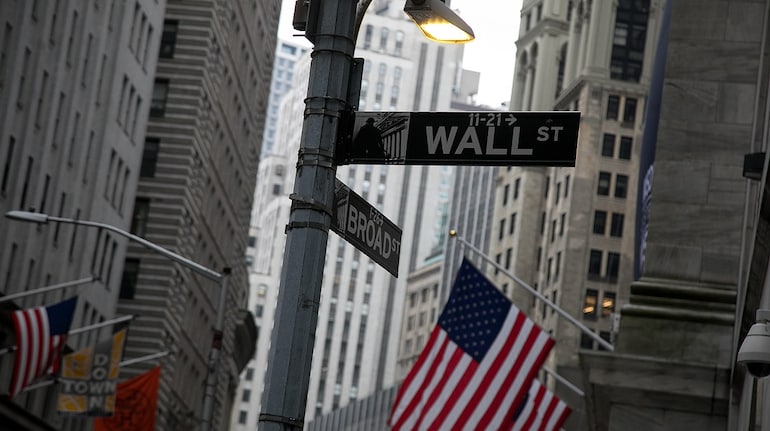
The world’s largest stock market is heading for its best start to a presidential term since Ronald Reagan was sworn in to power in 1985.
Equities hovered near all-time highs on Friday, with the S&P 500 climbing about 2% this week. That was after President Donald Trump talked up policies to boost the economy and lower taxes, while appearing to soften his stance toward tariffs on China — even as he continues to threaten sweeping action. The dollar was poised for its biggest weekly drop since July 2023. The MOVE Index of expected Treasury volatility hit the lowest since mid-December.
“It is early days but nothing that President Donald Trump has said or done has caused a bad reaction in financial markets,” said Chris Iggo at AXA Investment Managers. “Quite the contrary. It is paying to stay invested.”
The S&P 500 was little changed. The Nasdaq 100 fell 0.2%. The Dow Jones Industrial Average slid 0.1%. A Bloomberg gauge of the “Magnificent Seven” megacaps wavered. The Russell 2000 rose 0.3%.
Among the corporate highlights, Meta Platforms Inc. climbed on plans to invest as much as $65 billion on artificial-intelligence projects in 2025. Cryptocurrency-linked firms rallied following Trump’s executive order favoring the industry. A proposed ban on menthol cigarettes and flavored cigars was withdrawn by the Trump administration, boosting the sector’s shares.
The yield on 10-year Treasuries declined three basis points to 4.61%. The Bloomberg Dollar Spot Index fell 0.7%.
Oil was poised for its first weekly drop this year, with Trump calling for lower prices, which tends to ease concerns about inflation. Russian President Vladimir Putin said he’s ready to discuss energy issues with the US president.
To David Lefkowitz at UBS Global Wealth Management, while US equities will likely be more volatile this year due to periodic concerns about the return on AI investment spending, tariffs and interest rates, any dip will likely be a buying opportunity.
“In our base case, we expect higher tariffs, but we don’t think they will rise to a level that alters the economic growth trajectory,” he noted.
Wall Street also waded through a slew of economic data on Friday, with the highlight being a drop in US consumer sentiment for the first time in six months. Consumers expect prices will climb at an annual rate of 3.2% over the next five to 10 years. They see costs rising 3.3% over the next year, the highest since May.
“Despite Wall Street’s recent concerns surrounding inflation, we’ve been able to lean on a fairly strong economy and labor market, while the stock market remains near all-time highs,” noted Bret Kenwell at eToro.
Similar findings from eToro’s quarterly retail investor survey also suggests a feeling of cautious optimism, as a majority of investors expect the bull market to continue in 2025. However, there’s also a focus on raising cash and being underexposed to assets they expect to do well this year — like AI stocks, he said.
“We’re interpreting investors’ responses as optimistic, but viewing their actions as somewhat cautious, perhaps looking to buy the dip sometime this year. The survey also found that inflation was the top concern among retail investors,” Kenwell noted.
“Disappointment in the stickiness of near-term inflation is likely the main culprit for a dip in consumer sentiment,” said Jeffrey Roach at LPL Financial. “The Fed still has credibility as long-term inflation expectations remain well anchored. Inflation data make it unlikely that the Fed will cut rates at the March meeting and the probability of a cut in May is a coin flip.”
After cutting rates three times in late 2024, Fed policymakers are expected to hold rates steady until they see inflation make more downward progress toward their 2% target.
Money markets and economists surveyed by Bloomberg are unanimous in expecting Fed Chair Jerome Powell and his colleagues to keep the key benchmark rates in a range of 4.25% to 4.5% next week. Looking further ahead, rate swaps now favor two quarter-point reductions by year-end, compared to just one such cut seen last week.
“The US economy doesn’t get in big trouble until profits fade,” said Don Rissmiller at Strategas. “With US animal spirits around investment rising, productivity gains are plausible (though not guaranteed). Profits are generally a leading indicator for the economy, however, so we have time to see how this story develops. Stay tuned.”
As the earnings season rolls in, four of the so-called Magnificent Seven companies are expected to report slower quarterly sales next week with cautious consumer sentiment and the adverse effects of a stronger dollar seen as common themes.
While the outlook for Apple Inc. remains clouded by tepid demand for iPhones, investors expect sales momentum to pick up later this year for Tesla Inc. and Microsoft Corp.
Discover the latest Business News, Sensex, and Nifty updates. Obtain Personal Finance insights, tax queries, and expert opinions on Moneycontrol or download the Moneycontrol App to stay updated!





Find the best of Al News in one place, specially curated for you every weekend.
Stay on top of the latest tech trends and biggest startup news.