
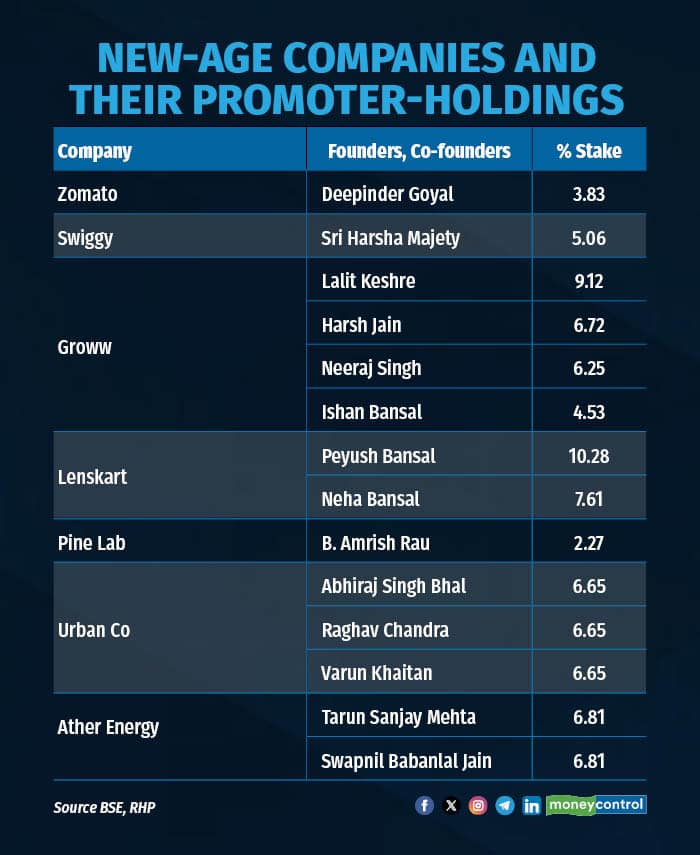
In several upcoming and recently listed firms, founder shareholding has slipped into high single digits or low double digits. Across 2021-2025, promoters and early backers have collectively encashed Rs 3.37 lakh crore, a cash-out cycle unprecedented in scale. “India has not yet evolved to fully board-driven supervision”, said Pankaj Tibrewal, Founder & CIO of IKIGAI Asset Manager, who is among those flagging the tension between market euphoria and governance readiness.
As a market structurally tilted towards high promoter ownership, India still has ~50 percent average promoter shareholding (compared to barely 5 percent in the US). The shift itself is not inherently problematic but it places greater responsibility on boards, public shareholders and professional CEOs.
The first governance question in any low-promoter-holding IPO is simple: who is truly invested in the company’s long-term future?
“Promoter stake in many companies is high single-digit or early double-digit,” Tibrewal noted, adding that several new-age and PE-backed firms are effectively being run by “PE guys or external investors.” For him, the issue is structural, not moral. The key question, he said, is continuity: “If promoters cash out early, who runs the business for the next three, five, seven years?” He believes investors may look back on this period with regret if narrative outpaces accountability.
Siddharth Oberoi of Prudent Equity says the risk is often about shifting priorities rather than malintent. “Low promoter holding does signal a potential ‘one foot out the door’ mindset,” he said. When founders meaningfully reduce stake, their attention can move from building the business to exploring new ventures, weakening alignment with minority shareholders. This brings investors back to a simple question: how committed is the promoter to the company’s long-term trajectory?
For Satwik Jain of Generational Capital, a low stake isn’t automatically negative “as long as the promoter is not operating any other business and his all focus is on the listed business.” In his view, dilution in new-age companies is an investment reality, not a red flag. He draws a distinction between (1) legacy, family-run businesses with high promoter ownership and (2) digital consumer-internet firms where multiple funding rounds naturally push founders to dilute. These businesses operate in winner-takes-all markets, he said, requiring heavy upfront spends on technology, teams and platforms — making equity dilution inevitable.
Kuunal Shah of Carnelian Asset Management argues that lower promoter ownership increases free float, reduces concentrated control, and nudges companies toward professionally managed, board-run structures. “Listing in India is gradually moving in that direction. Intent, transparency behind selling, business fundamentals and management stability matter more than the percentage,” he said.
Vikas Gupta of Omniscience Capital adds that new-age firms have already gone through several angel/VC/PE rounds. “This equity dilution of promoter/founders cannot be judged directly as being something wrong. It is just the nature of evolution of the shareholding patterns for these companies.” Such companies, he said, are used to boards dominated by external shareholders and focused on value creation for all stakeholders.
He also notes that “skin in the game” must be seen in absolute value terms: “Say it is 20 percent promoter holding. But that 20 percent is, say, Rs 2,000 crore. Then the promoters have a lot of skin in the game.”
Governance advisory firm InGovern views the issue through the lens of board quality. “Low promoter shareholding in many companies would be a key governance risk if the Board of Directors is not a strong one with independent thinking directors,” said founder Shriram Subramaniam. He warned that in downturns, these companies “could become acquisition targets for larger companies.”
Sandeep Jain, MD and Head of Wealth Equities, Neo Wealth Management, adds, "Low promoter holding is seen as a governance risk because it weakens alignment". His goes on to explain that when promoters have little skin in the game but full control, the chances of dilution, related-party deals and short-term decisions rise. But at the same time, some of the most respected global companies (Apple, Microsoft, Unilever) have no promoters at all.
Experts also point out that the current bull cycle is masking some of these risks. When liquidity is abundant and sentiment is gung-ho, weaker governance structures often escape scrutiny. And some time we have silent indicators like that of mutual funds' avoidance of certain IPOs, one manager noted.
“Several recent IPOs have been structured entirely as offer-for-sale issues, with no new capital flowing into the business. In such cases, even if the shares list at rich valuations, earnings don’t expand meaningfully and there is little room for re-rating -- leaving retail investors exposed to high PEs and stagnant stock performance,” adds Kresha Gupta, Founder, Steptrade.
Promoter dilution rarely becomes a headline concern in buoyant markets but in a downturn, it may matter more.
Discover the latest Business News, Sensex, and Nifty updates. Obtain Personal Finance insights, tax queries, and expert opinions on Moneycontrol or download the Moneycontrol App to stay updated!
Find the best of Al News in one place, specially curated for you every weekend.
Stay on top of the latest tech trends and biggest startup news.