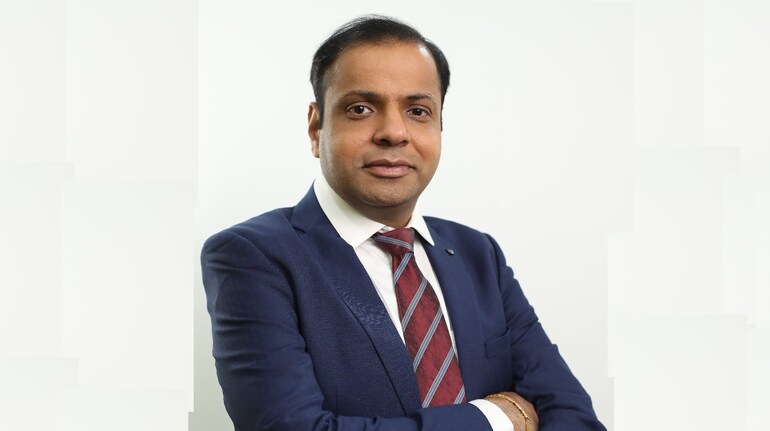
"The 2025 Union Budget must balance tax reforms, fiscal discipline, and strategic investments to sustain growth," Manish Goel, the Founder and MD at Equentis Wealth Advisory Services said in an interview to Moneycontrol.
According to him, priorities in the budget should include direct tax relief, a simplified GST, infrastructure development, and boosting household incomes for economic stability and job creation.
With more than 15 years of experience in the financial services industry, he believes after the recent correction, Nifty-50 is trading at ~19x FY26 EPS, offering a better risk-reward balance. "While mid- and small-cap stocks remain pricey (56% and 17% premiums), large caps now provide a more stable entry point in these uncertain markets," he said.
Do you think the valuations will become attractive if the Nifty comes down to around the June 2024 lows?
If the Nifty drops to its June 2024 low of ~21,281, valuations will definitely look more attractive. The market P/E would fall to 20x (5-year average: 21x) on a TTM basis, making it a good entry point for long-term investors—as long as earnings growth holds at 10-12% YoY.
Key market drivers
Market Performance: After a 10% correction, we’re seeing a shift from the high-growth phase (20%+ EPS CAGR, FY20-24) to a more subdued 4% in H1FY25.
Sector Trends: BFSI, Capital Goods, Tech, Healthcare, and Real Estate saw weak growth, with Metals (-8% YoY), Oil & Gas (-4% YoY), and Cement (-45% YoY) underperforming.
Institutional Flows: FIIs pulled $12 billion (Q3FY25), but DIIs stepped in with record SIP inflows, pushing total DII investments to $22 billion.
Macro Factors: Urban consumption is slowing (Q2FY25 GDP: 5.4%), but rural demand is picking up, thanks to good monsoons and higher wages.
Global Impact: Trump’s US election victory, global monetary shifts, and rising protectionism have added to volatility.
After the recent correction, Nifty-50 is trading at ~19x FY26 EPS, offering a better risk-reward balance. While mid- and small-cap stocks remain pricey (56% and 17% premiums), large caps now provide a more stable entry point in these uncertain markets.
Do you see upside risks to inflation from higher-than-expected tariffs (if) imposed by Donald Trump?
Higher-than-expected tariffs, such as a 35% hike on China and 10-20% on other countries, are likely to raise global import costs, intensifying inflationary pressures. During the 2018-19, US-China trade war, tariffs increased import costs by 10-15%, adding 0.3-0.5% to inflation in the U.S. A similar impact could occur globally, including in India, where CPI inflation averaged 5.4% in 2024. A projected 50-70 bps rise could push inflation beyond the RBI's 6% comfort zone, prompting potential policy tightening.
For India, key imports like crude oil and metals are vulnerable to price volatility, further amplifying wholesale and retail inflation. Rising costs for essential commodities may also strain household budgets and dampen consumption, potentially slowing economic growth.
Do you expect growth to return this year due to the anticipated fiscal capex spending and monetary easing by the RBI?
India’s growth in FY 2024-25 relies on a rebound in fiscal capex spending and monetary easing by the RBI in the year’s second half. Capex utilization in the first half was 37.3%, lower than last year’s 49%, but a surge is expected to meet budget targets, particularly in infrastructure, boosting private sector participation, GFCF, and domestic demand.
Key growth drivers include strong rural consumption, supported by a 3.5% agricultural growth rate (a five-quarter high), and a 7.2% expansion in the services sector, led by finance, insurance, and real estate. High value manufacturing exports, contributing 31% of merchandise exports, highlight resilience amid global challenges.
With projected GDP growth of 6.5%-6.8%, India is positioned to leverage fiscal and monetary policies for stronger growth, provided global disruptions or inflationary pressures remain contained.
What is your top priority for the upcoming budget?
The 2025 Union Budget must balance tax reforms, fiscal discipline, and strategic investments to sustain growth. Priorities include direct tax relief, a simplified GST, infrastructure development, and boosting household incomes for economic stability and job creation. Interest-free loans for capital projects should be tied to states’ fiscal management, with those prioritizing infrastructure over welfare eligible for Rs 30,000-50,000 core in additional support.
Direct Tax Reforms
Lowering the highest income tax rate could save high earners Rs 50,000-1,00,000 annually, driving consumption and investment, while enhanced MSME tax incentives could boost output by 10-15%, creating 5-8 million jobs in 3-5 years; closing tax loopholes and broadening the tax base could add Rs 50,000 crore in annual revenue.
Simplifying Taxes and Reform Dividend Policy
Simplifying GST and eliminating double taxation on dividends could save businesses and consumers Rs 20,000-30,000 crore annually while streamlining compliance. Reducing GST rates could also potentially lower the business compliance costs by 15-20%.
Prioritize Household Income over Consumption Stimulus
The government should focus on boosting household incomes rather than merely supporting consumption. Measures could direct ?40,000-60,000 crore into key sectors like FMCG and real estate, encouraging long-term growth.
Focus on Fiscal Consolidation and Capex Growth
To sustain growth and investor confidence, the government should maintain fiscal discipline by achieving the FY26 fiscal deficit target of 4.5% of GDP, prioritize a 10-15% capex increases for economic and infrastructure growth, and set a clear long-term debt-to-GDP target.
Encourage Corporate Investment Smartly
Corporate investments grew at a modest 6% CAGR (FY20-24), but reduced tax rates could unlock Rs 30,000-40,000 crore annually for reinvestment, boosting GDP growth by 0.5-1%, while GST formalization in real estate may draw Rs 50,000 crore in yearly institutional investments.
Do you expect a gradual or sharp improvement in consumption trends in FY26?
Consumption in FY26 is expected to improve, driven by stronger rural and urban demand. Rural growth (3.5% annually) may benefit from higher agricultural output, aided by a 20% MSP hike and irrigation investments. Urban consumption (8% YoY) could rise with higher disposable incomes and job growth in IT and financial services, though wage stagnation remains a challenge. Overall, FY26 consumption is projected at 6.5-7% (versus 5.5% CAGR in the last decade). Raising the basic tax exemption limit to Rs 3 lakh could inject Rs 30,000-50,000 crore into markets.
Disclaimer: The views and investment tips expressed by experts on Moneycontrol are their own and not those of the website or its management. Moneycontrol advises users to check with certified experts before taking any investment decisions.Discover the latest Business News, Sensex, and Nifty updates. Obtain Personal Finance insights, tax queries, and expert opinions on Moneycontrol or download the Moneycontrol App to stay updated!
Find the best of Al News in one place, specially curated for you every weekend.
Stay on top of the latest tech trends and biggest startup news.