Asian equities trimmed their gains after Chinese shares opened lower as caution prevailed among investors with trade tensions rising between the world’s two largest economies.
Hong Kong equities fell while a gauge of Asian shares gave up some of its advance as China’s market reopened Wednesday after Lunar New Year holidays. Contracts for US equities edged lower as Google’s parent Alphabet Inc. and Advanced Micro Devices Inc. tumbled in extended trading. Treasury yields edged higher and the yen gained against the dollar.
Investors are reducing risk as uncertainty remains high with Beijing’s swift retaliation to the US’s 10% tariff on imports from China. The first volleys in the latest US-China trade war made clear that Xi Jinping is taking a more cautious approach than during Donald Trump’s first term.
“Trade relations between the US and China remain a risk, though if the 10% US tariff and China’s response measures were to be postponed, it will good for the market,” said Kenny Wen, head of investment strategy at KGI Asia Ltd. “On the other hand, the disputes may escalate again.”
While China’s tit-for-tat response to US were seen by some investors as a measured response to avoid a full-blown standoff, others are concerned that the weaker-than-expected manufacturing activity data and yuan’s depreciation could weigh on Chinese stocks.
China’s services activity unexpectedly slowed while extending its monthslong growth streak, a private survey showed, as one of the country’s busiest spending seasons around the Lunar New Year supported demand.
China continued to support the yuan by setting the daily reference rate for the currency at a level stronger than 7.2 per dollar as a trade war with the US added to depreciation pressure on the yuan.
The MSCI China Index may rise by 14% by year-end as Beijing unleashes its much anticipated policy stimulus, Goldman Sachs said, citing its base-case scenario.
After Trump gave a last-minute reprieve to both Canada and Mexico, his tariffs on China took effect after midnight Washington time on Tuesday. Within minutes, Beijing announced additional tariffs on roughly 80 products to take effect on Feb. 10, launched an antitrust investigation into Google, tightened export controls on critical minerals, and added two US companies to its blacklist of unreliable entities.
Trump told reporters there’s no rush to talk to Xi and he’ll speak to the Chinese president at the appropriate time.
“The delay in US-China trade negotiations may drive some near term volatility for China markets,” said Marvin Chen, an analyst at Bloomberg Intelligence. “But Trump has shown that negotiations are possible.”
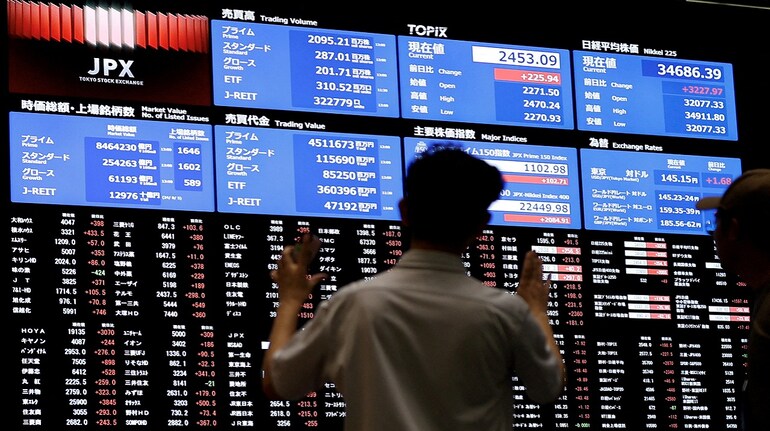
Elsewhere, Japanese stocks retreated, erasing their morning’s gains as the yen strengthened against the dollar. The currency appreciated on expectations that Bank of Japan will continue with rate hikes, following strong domestic wage data and government comments on inflation.
In commodities, oil edged lower as concerns that the trade war would hurt global growth outweighed the announcement of reinforced sanctions on Iran.
US stock indexes had earlier rebounded after a wave of dip-buying with a Bloomberg gauge of the “Magnificent Seven” megacaps advancing 1.7%.
Discover the latest Business News, Sensex, and Nifty updates. Obtain Personal Finance insights, tax queries, and expert opinions on Moneycontrol or download the Moneycontrol App to stay updated!
Find the best of Al News in one place, specially curated for you every weekend.
Stay on top of the latest tech trends and biggest startup news.