







Despite the industry-wide debate over fairness in anchor allotments, data from Meesho’s anchor book suggests that the allocations are too small relative to scheme sizes to materially move fund NAVs. Among domestic mutual funds, the highest anchor exposure was in Invesco Technology Fund, where the allocation accounted for 2.97% of scheme AUM. Motilal Oswal Consumption Fund followed at 2.50%.
Even in SBI Mutual Fund’s case — despite the noise around its larger slice of the anchor book — the most aggressive exposure was in SBI Innovation Opportunities Fund at 1.99% of assets. Other schemes that took positions of over 1% of AUM included Invesco India Consumption Fund, SBI Consumption Opportunities Fund, Franklin India Technology Fund and Motilal Oswal Focused Fund.
Market participants emphasise that mutual funds are not required to disclose scheme-level deployment to bankers. Fund houses only indicate the quantity they wish to bid for; internal allocation across schemes is determined later by fund managers based on their mandates and portfolio needs.
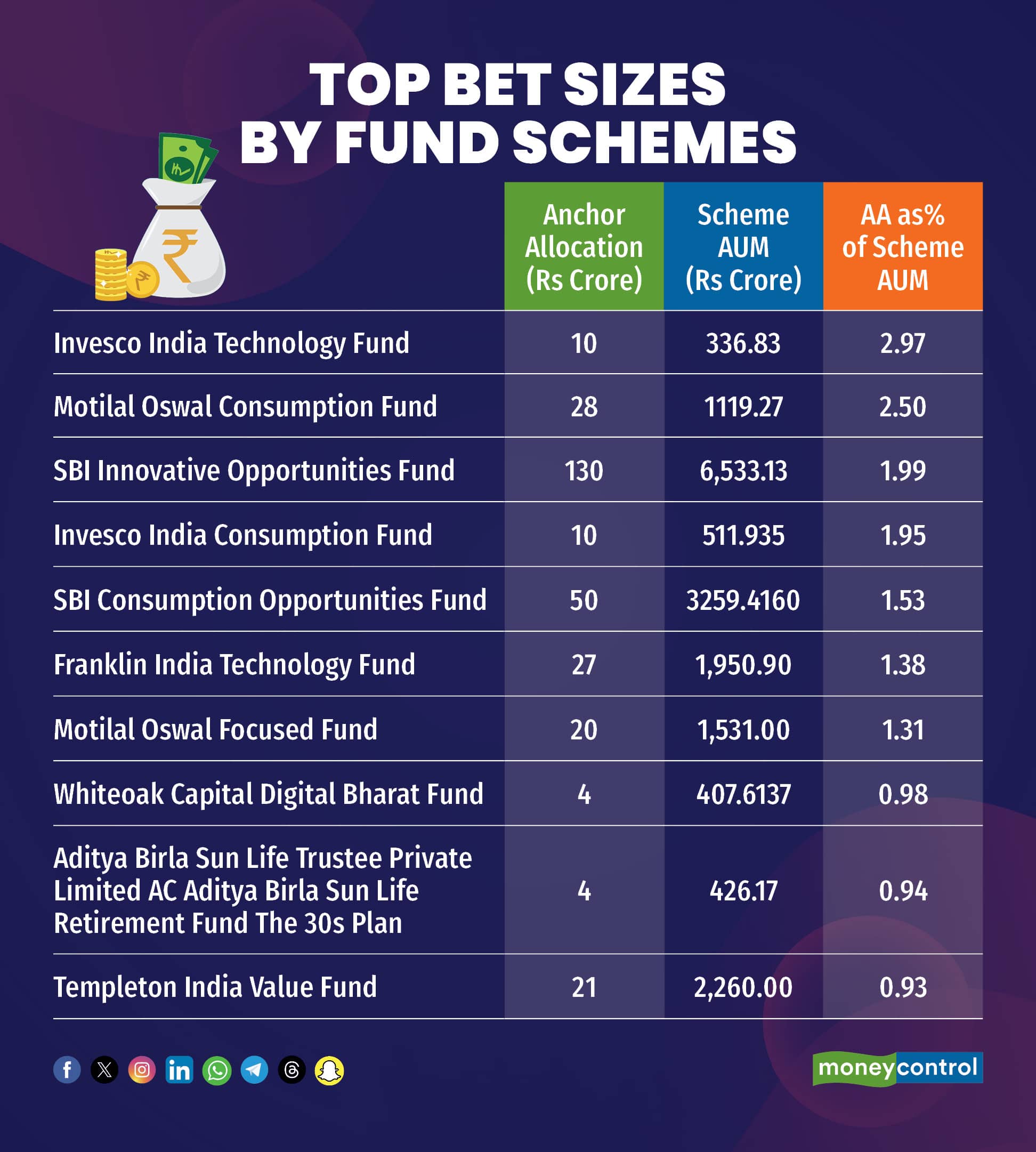
Unless funds increase positions in the main IPO or see substantial post-listing gains that persist through the one-month lock-in, anchor allotments alone rarely shift NAVs in a meaningful way. A 3% position that doubles within a month would translate to roughly a 3% lift in scheme NAV — and that assumes the initial listing pop holds through the lock-in.
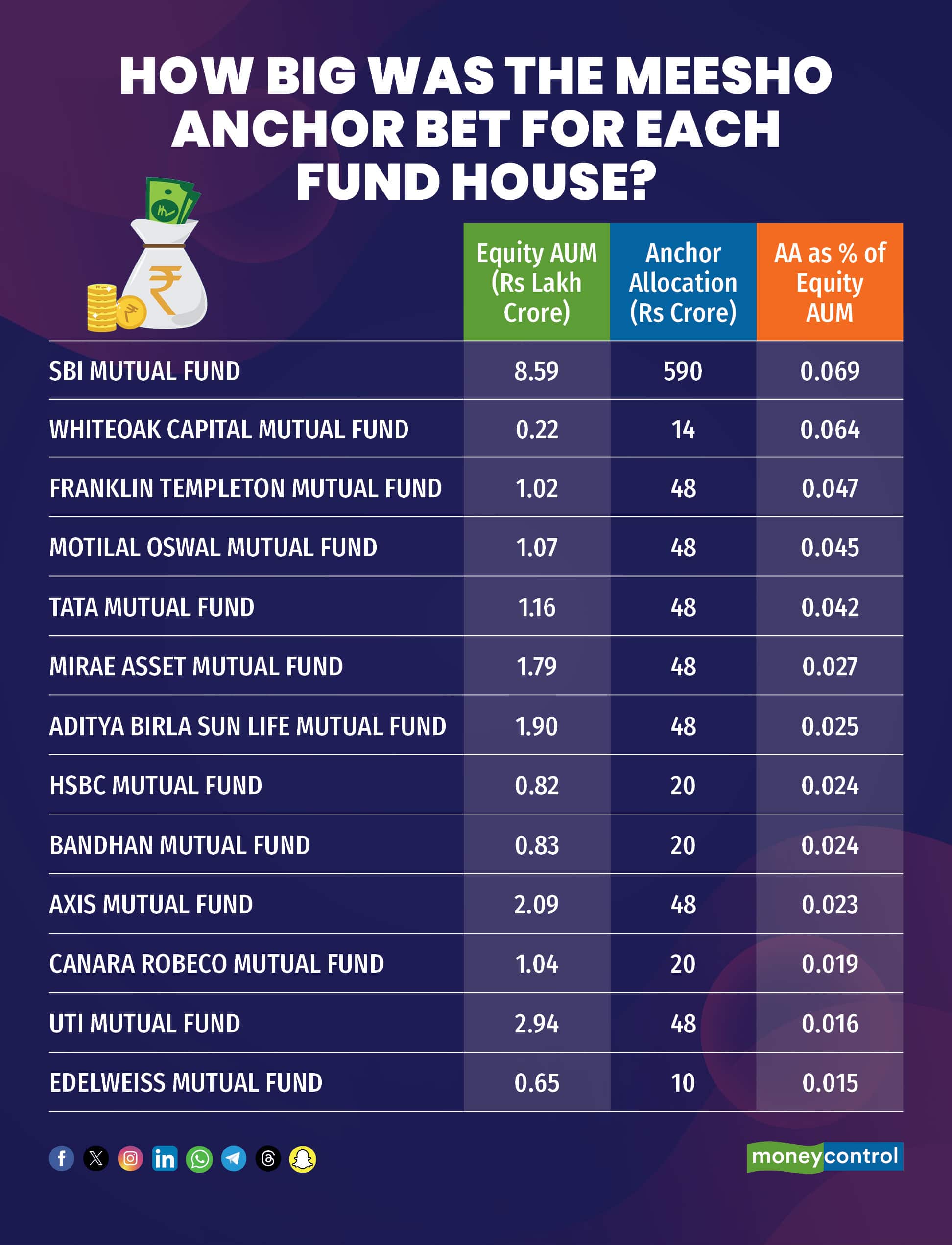
As a share of total equity AUM, the highest anchor exposure was recorded by SBI MF at 0.068%, closely followed by WhiteOak Mutual Fund at around 0.064%. Interestingly, SBI MF manages ₹8.5 lakh crore in equity assets while WhiteOak is tiny in comparison at ₹22,000 crore in AUM. The next three were Franklin Templeton, Motilal Oswal and Tata Mutual Fund, all around 0.04% of equity AUM.
Read: Meesho’s unusual and bold anchor allocation call exposes growing tensions in new-age tech IPOs
The Meesho anchor allocation controversy erupted after the company assigned an outsized share of its ₹2,439-crore anchor book to SBI Mutual Fund, prompting several large institutions to pull out in protest. Capital Group, Norges Bank Investment Management, ICICI Prudential MF and Nippon India MF withdrew their bids, arguing that the allotment to SBI MF was disproportionate despite comparable demand.
Multiple stakeholders told Moneycontrol that the decision was taken by Meesho’s management — not the merchant bankers — following early price and quantity commitments from SBI MF. The episode exposed long-standing concerns over opacity and discretion in anchor allocations, where issuers have wide latitude to decide the final split as well as the fundamental role of an anchor in price discovery. SEBI sources told Moneycontrol that the matter was a commercial call and that no rules were violated.
Discover the latest Business News, Sensex, and Nifty updates. Obtain Personal Finance insights, tax queries, and expert opinions on Moneycontrol or download the Moneycontrol App to stay updated!
Find the best of Al News in one place, specially curated for you every weekend.
Stay on top of the latest tech trends and biggest startup news.









