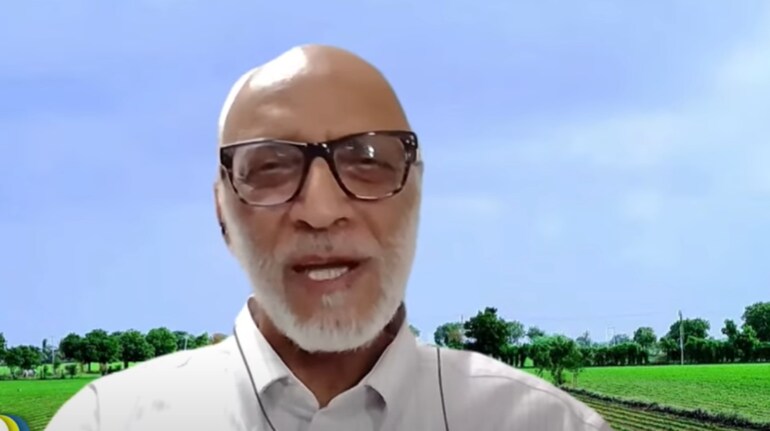
As India negotiates one of its toughest trade agreements, with the United States pushing for greater access to India’s farm markets, Agri economist, Ashok Gulati, in conversation with Shweta Punj says that 91 reforms should be a lesson for India. India’s farm sector can be opened up in exchange for other lucrative sectors for India. Permanently putting protective duties breeds inefficiency in the system. Full tracsript.
Ashok Gulati:
Well, one is a negotiating stand and the other is how far do we compromise because there are many other interests. As you rightly said, that India has a trade surplus with the U.S. to the tune of about $45 billion and overall trade deficit of U.S. is about $1.2 trillion. So, their ultimate objective is to reduce their trade deficit and that can be done through several ways. One of the easiest way, India is importing crude oil to the tune of about $180 billion. Almost 40% is coming from Russia and then there are other countries, even smaller ones, Qatar and Saudi Arabia, Iran, Iraq and what not.
Now, out of $180 billion, you can easily afford $25-30 billion of oil to buy it from U.S. So, this will bring down your trade deficit vis-a-vis U.S. Then you need high-tech defense equipment. If you need some of those things, you can always get it from them or some high-tech things and you can reduce the deficit.
Coming to agriculture, our agriculture trade with U.S. is very limited. As you said, only $8 billion and we have trade surplus again in that. Shrimp is our biggest export item to U.S. and shrimp is going at 0-5% duty in the U.S. market. Now, naturally, the other party says if we are allowing your products to come at 0-5% import duty, why are you putting 60% duty on milk or you are not allowing our soybean exports or maize exports? Our argument is your soy is GM, genetically modified, so is your corn and your milk. If you are interested in sending that, your cows are unfortunately non-vegetarian. They are fed on things besides the fodder. There are some elements of blood and what is coming out of the slaughterhouses.
So, our religion will be ruined. So, U.S. says we are ready to give you a certification that these cows have been fed on grass. So, they are pure vegetarians, but you are putting a 60% import duty on skimmed milk powder.
So, naturally, the two sides have to come to some agreement. You can't keep on fighting and have a stand on one way or the other. Think about if U.S. tomorrow says we are going to cut down your H-1B visas by 50%. What will you do? You will lose billions and billions of dollars. Okay? So, they have relatively an upper hand in terms of destroying your exports, both in the goods as well as services. Luckily, they are not talking of the services today. They can talk it tomorrow. Ultimately, that's the game. So, the question is, how much do we accommodate? If we say, no, we are not going to open up agriculture at all because your products are GM, well, our cotton is also GM and GM seed is very much in the food system.
So, there is a bit of, you know, I would say hypocrisy in that sense. But how much to allow, what should be the duty, that is what a matter of negotiation is. And in that matter, I think one can do okay, you know, a million or two million tons, we will allow to import at 15% duty, but then our duties are at 50%, 60%.
And then give us three years, five years to reduce those duties gradually. Corn, you can put it in the ethanol production. Why are you putting your rice in ethanol? The economic cost of rice is 42 rupees a kg and they are giving to ethanol industry at Rs22.50 paisa a kg. This is a disaster. And I think we have to save our water. And if corn can come for ethanol from outside, fine, go ahead with that. How much at what duty? Of course, this is a matter of negotiation. You give up some space to get some extra space there. And the best thing to get space in the US market, there could be processed products.
Fresh ones always have difficulty in terms of sanitary and phytosanitary measures, but we have succeeded in shrimps. But on the textiles, particularly the textile industry, the duty is about 10 to 11%.
And if Bangladesh is being imposed now 35% duty and China higher or Vietnam higher, India can be a huge gainer if they can negotiate 0% duty on textiles.
So, if you want to get into that at zero import duty on textile, that will be a major gain. And if you have to give some space, you know, you cannot be self-sufficient in agriculture for everything. And that should not be the objective. You know, 55 to 60% of our edible oil is being imported. So saying that we want to have self-sufficiency in everything, that's not feasible. That's not desirable.
Wherever you have comparative advantage, you should be exporting that. And where you have comparative disadvantage, you should be importing that. Now, how much to be imported and whether they are subsidizing, usually US agriculture and you need to realign your policies on subsidies. All those internal reforms will have to be done when the external borders are open. That was the whole game in 1991. What did we do? We opened up to the global world. We adjusted our exchange rate and then we reduced the duties. And then you have to carry out the domestic reforms to cope up with that situation. And we have come out pretty well. '91 reforms should be a lesson for us. Rather than remaining under protective duties of 60%, 100%, they are good for negotiations, but permanently putting that breeds inefficiency in the system.
Shweta Punj:
So, Dr. Gulati, you're saying now that now is the time to open up agriculture. It needs to be like what we did with our private sector in 1991. 2025 could well be that for the agriculture farm sector. But the counter argument to that could be that that could really push our farmers to the brink. They are not ready for the competition right now. Land holdings are smaller. Technologically, we are not as advanced. So that could really aggravate the pain in the rural economy.
Ashok Gulati:
We are a net exporter of agriculture. We are small, but we are the largest exporter of rice in the world. One third of the rice exports of the world is from India. So if we are smallholders and we are not competitive, how are we exporting? We are a net exporter. People don't know. US is a net importer of agriculture. They export many commodities, but they import processed food. And the import of processed food is much more than the export of fresh commodities. So US is a net importer.
China is a net importer. India is a net exporter of agriculture. So if we are not competitive, how are we exporting? But having said that, there are also imports. Our exports last year, '23-24, was about $52 billion. And our imports are about $36-37 billion. That's roughly the range. And out of that, when we are importing, we are already integrated to the world. And as I said, edible oil is our biggest import item. 55-60% of our consumption of edible oil is being imported.
Next is pulses. We are importing at least 5-7 million tons of pulses. So saying that, oh, farmers are on the brink and therefore they can't cope with this. Well, you are exporting also. First liberate them to export as much as they can. And then import in a gradual manner, in a regulated, somewhat controlled way in the beginning. But saying that we will not allow 1 kilogram of imports from the US is totally a misguided philosophy and a misguided policy.
Shweta Punj:
Dr. Gulati, according to you, what are the low-hanging fruits that India could go for in this negotiation?
Ashok Gulati:
You know, you are taking almonds every day. 90% of almonds being sold in India is coming from US. 90%. Now, what has happened to our farmers? Apples also is being imported quite a bit. Right? And we have put 50% duties and all that, calculating all the SAD (Special Additional Duty) and special taxes on that. Their interest is, if almonds can come at 10 to 15% duty, why not walnuts? Walnuts have 100% duty. Their interest is in walnut. So, let it also come, if almonds can come at 10 to 15% duty, why walnuts are at 100%? Cranberry, their interest is in cranberry. We are putting 30% duty. You can reduce it to 20%, 15%, 10%, whatever.
So, those are the commodities which don't impact the larger segment of agriculture at all. Then, there are issues with, because their biggest export item to the world, agriculture, is soybean. And soybean is all GM. And the world, the largest exporters of soybean in the world, US and Brazil, it's all GM all over. Now, we don't want to say, we don't want GM, but your cotton is all GM, 90% cotton is
GM.
So, it's a tussle. And when we needed feed, we did import GM feed. We have imported GM feed of soybean and corn. So, controlled way is that you give a tariff rate quota. That, okay, up to 1 million tons, 2 million tons, we will allow at 15% duty, and at present we have 50, and that will be gradually reduced over a period of 3 years, 4 years, 5 years. That is how the negotiations are.
And to do this, when we are giving space, you kindly give us space in the textile sector, in the leather sector, and footwear, which are labor intensive. That's the way to bargain.
Shweta Punj:
So, from a political point of view, how would you see this move of opening up India's agri and dairy? Because politically there could be a backlash, and we've seen in the past also India has tried to bring in farm laws, which were taken back. So, from a political point of view, this government would not like to be seen on the bad side of the farmers because then the whole battle becomes about messaging and this is something that the opposition party will not let go.
Ashok Gulati:
Yes, sure. Opposition has to oppose everything. That's why they are called opposition. Whether right or wrong, the farm laws were right they wanted to do and then if this government wants to do, they start opposing it. So, this is the politics of India but it's a communication exercise of the Prime Minister. You know, you have to take due care and in a somewhat regulated and under your watch how to open up the system. Otherwise, stop the import of edible oil in the country. Is that not hurting to the edible oil farmers or oilseed farmers in the country? I am saying 55 to 60% of what you are consuming in the country is being imported. This is huge.
Shweta Punj:
And why is it that we are not growing oilseeds here?
Ashok Gulati:
So why are the farmers not coming on the streets that you are killing us? So, it's a way gradually you build up the system. You are importing pulses. Is that not hurting the pulses’ growers. Stop it and let the prices of pulses go to 200 rupees a kg. So, you have to see the balancing act of the consumer as well as the producer. And how much to open at what rate it should be opened. This is what the calibration of the policy analysis is.
You know, you can't open all the gates at zero import duty. Okay, everything you can throw in the country. It will be like floodgates coming and the country may not be prepared. So, first you open through tariff rate quota. But saying that we will not allow anything to import, you are already importing. So, soybean oil is coming already from US. You have become a net importer of cotton because you have killed your own gene revolution in cotton. We were the second largest exporter of cotton and today we are net importer of cotton.
Shweta Punj:
Can you elaborate a little bit more on that? How did we kill our own gene revolution?
Ashok Gulati:
The gene revolution, it was Mr. Atal Bihari Vajpayee who had the foresight and he said what IT, Information Technology is for India, BT, Biotechnology is for Bharat and it should be Jai Jawan, Jai Kisan but Jai Vigyan it should be science-based agriculture. This was the vision of Mr. Atal Bihari Vajpayee and in 2002 he took a bold step to allow GM cotton in the country BT cotton came in. At that time, the production of cotton was only 13.3 million bales. Within 10 years, it went to 39 million bales from 13 to 39. Look at that 300% increase roughly. That was the gene revolution in the country. But then there is some Luddites and some other left-leaning people they started shouting Monsanto and these multinationals this that and you should not give them any trait fee and all that because the receipts were coming from the multinationals and they had a system of charging the trait fee and we started imposing all those price controls and the companies the big companies who have all these innovative seeds they went out and said nothing we don't want to do business in India.
Now the production has come down our productivity has come down from 14-15, 13-14, 14-15 that was the last and after that it had been gradually coming down. And today our productivity is low. Our productivity is 435 kilograms per hectare or so. China, Brazil, Australia are hovering between 1800 to 2000 kilograms per hectare and they are all GM and next generation GM. So this is how you kill your gene revolution and then you become in 2023-24 we have become a net importer of cotton and US is interested in selling cotton it's all GM but we say that, that will also not be allowed.
Shweta Punj:
Is it a health argument that we are making or is it a commercial argument why is India so against GM?
Ashok Gulati:
And that's a very good question. I think, one, we don't believe in science. Perhaps our own Genetic Engineering Approval Committee, which looks into the safety part of it, right? Once they approve, they go through all the trials and all this. But we have very vocal NGOs, and then we have some ideological wings in the country who want to go back to nature. Perfectly fine, go back to nature — provided you can feed 1.4 billion people. Farmers should have all the choice, but I think allowing science to work with all the safety precautions — there is no doubt about that.
And science, when it comes, it comes all the world over. GM crops — 200 million hectares are being grown all over the world, in 76 countries. And India is also part of that, but it is growing only cotton, and illegally, because Bt brinjal is already in the field. Because Bangladesh has formally announced, and they are adopting it. They are getting — and if the farmers of Bangladesh are gaining from Bt brinjal, which is actually from the companies being selling — Mahyco is selling in Bangladesh — and farmers will smuggle this way or that way. Our system is so loose.
So I think it is a matter of time, and even today HT Bt, illegally, is on almost 15 to 25% of the area. Government has not allowed, but farmers are getting it, and it is all fly-by-night operators. It is very well known.
Shweta Punj:
So one of the commercial arguments, Dr. Gulati, that has been put forth is that — from a commercial point of view — is that we get increasingly dependent on the United States to get the GM seeds into the country, which is what happened in the past, and that could give them, you know, more room to flex muscle and increase prices at their whim. Do you see merit in that argument?
Ashok Gulati:
I would say the same argument — 88% of your crude oil is being imported, and from a few countries. So today Russia wants to tighten up the screw, or Saudi Arabia or anyone else — you have to go. These are big multinational companies which are competing and bringing science. It is not the US government, okay? The one company, Bayer, which bought Monsanto at 63 billion dollars, is spending today 1.7 billion dollars in agriculture research and development. 1.7 billion dollars — that is more than the entire Government of India ICAR budget. It is 70% higher than that, okay? So one company is spending more than — and they basically work on 4–5 crops — and our budget of 9000 crores, 10,000 crores — ICAR entire budget — is for all crops. And God knows we are way behind on agriculture research and development.
We are a nation of freebies. We are giving all these subsidies on fertilizer — 2 lakh crore for free food. We are a nation of freebies. Prime Minister says opposition is giving freebies, but the government is giving the biggest freebies. They need to control that and put that saving into research and development, into irrigation, raise the productivity. Ultimately, it is the productivity that will win the world, and we have to feed the largest population with very limited land. And the quality of that land is degrading, unless we invest in R&D. High tariffs and protectionists — because we are small this and that. These are all illogical arguments.
Shweta Punj:
So Dr. Gulati, my concluding question to you. At the moment, from the arguments that have just heard, it seems that the negotiators are approaching this specific area on agriculture and dairy more from a political point of view than an economic point of view. Would that be a correct inference to make?
Ashok Gulati:
I would say this is — how do you want to—what is the perception you want to leave with the country. Because we know we are a very vocal democracy. Lot of opposition and misinformation will immediately be there — "Oh, we have surrendered to the US, Modi has surrendered, and Modi surrendered" — this is the way opposition is communicating. I think these are all political thing. They have to deal it politically. From an economic point of view and policy-making which is in the interest of the country, you cannot totally close the system. And you cannot allow the floodgates to suddenly come. You have to prepare precautionary measures, yes. But saying that oh, no, our farmers are… We are the largest exporter of rice in the world, and we have an import duty of 70% on rice. The world should be afraid of us. And we are putting an import duty of 70% on rice whereas we are the largest exporter of rice. So these are contradictions, because hardly anybody has looked at these things rationally.
Now, GM question, when the genetic GEAC has approved those things. then it's a political call. I think Vajpayee sir had great vision of science-led agriculture. We could have been the major exporter of gene technology to Africa and South Asia and the developing world. We could be the leader. The way we are saying IT, IT, IT — we could have been saying the same thing on gene, gene, gene, gene. The future is all gene editing. Are you going to stop it? Okay fine, stop it — live the way you lived 2,000 years back. Go back. At that time, what was the population? What was the life expectancy? And how much was your area? You have to feed the largest population. You must increase your productivity. Your productivity is at least 30 to 50%t below the world averages — and at many places, more than 50 percent less than Chinese agriculture. China has lesser cropped area — 129 million hectares — and they are producing more than double of India’s agriculture. More than double. And their holding size is less than ours, it's a smaller holder — smallest, okay? So saying that small holders can't do, I don't believe that. You have to tune your technology and other resources to the small holders.
Shweta Punj:
All right. Thank you so much, Dr. Gulati.
Watch full interview: Can India open agriculture? | India - US trade deal- the red lines

Discover the latest Business News, Sensex, and Nifty updates. Obtain Personal Finance insights, tax queries, and expert opinions on Moneycontrol or download the Moneycontrol App to stay updated!





Find the best of Al News in one place, specially curated for you every weekend.
Stay on top of the latest tech trends and biggest startup news.