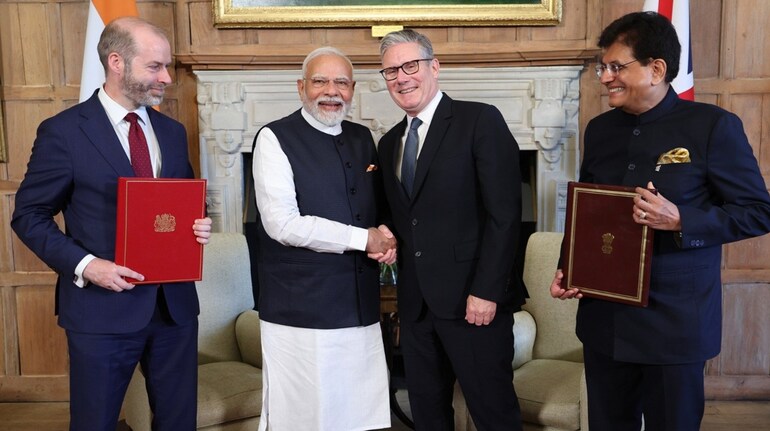
India's free trade agreement (FTA) with the United Kingdom will offer British companies exclusive treatment in its ‘Make in India’ policy, which presently extends preferential benefits only to local manufacturing firms.
Once the FTA is operational, UK companies will be treated as a class 2 supplier if at least 20 percent of their product or service is from Britain – granting them the same status that only Indian firms currently enjoy.
To be sure, Indian suppliers will continue to receive preferential treatment as “Class-I local suppliers”, if their goods or service have more than 50-percent local content from India.
This provision means that UK goods with only 20-percent domestic content will be treated as local suppliers under India’s Public Procurement Order (PPO), a classification previously reserved for Indian suppliers with 20–50 percent local content.
However, sensitive areas like health, agriculture, MSME procurement, and low-value contracts has been excluded from this benefit.
India will open approximately 40,000 high-value contracts from central ministries and departments in sectors such as transport, green energy, and infrastructure to UK bidders, according to Global Trade Research Initiative (GTRI).
British firms will be allowed to participate through India’s Central Public Procurement Portal (CPPP) and the GeM platform, and will be granted national treatment for all covered procurements.
Indian suppliers will, on the other hand, receive non-discriminatory treatment in the UK procurement markets. Additionally, India has also preserved its policy space to provide preference to MSMEs under the Public Procurement Policy for Micro and Small Enterprises Order, according to the government.
This is the most extensive concession on government procurement offered by India in any FTA to date and marks a strategic shift away from using it as a tool for domestic industrial development, GTRI's founder Ajay Srivastava said.
"The 20 percent local content rule allows UK firms to use up to 80 percent inputs from third countries, such as China or the European Union, while still receiving preferential treatment, effectively diluting the benefits that programs like ‘Make in India’ and Atmanirbhar Bharat were designed to protect," Srivastava said.
According to the Indian government, the UK has agreed to more favourable terms for India by setting lower contract value thresholds on procurement rules.
While, for goods and services, the UK’s threshold is SDR 130,000 (around Rs 1.6 crore), India’s is higher at SDR 450,000 (around Rs 5.5 crore). For construction services, both countries have agreed on the same threshold of SDR 5 million (about Rs 60 crore).
According to the government, Indian suppliers will be able to participate in procurements by major government departments in the UK such as the Cabinet Office, Department for Business and Trade, National Highways, NHS Foundation Trusts (Department of Health and Social Care), Foreign, Commonwealth and Development Office, Department for Education, among others.
India and UK signed a Comprehensive Economic Trade Agreement (CETA) on July 24, three months after agreeing to the deal on May 6.
The agreement is not yet in force. Both the UK and India are required to complete their respective domestic procedures for the agreement to come into effect.
Discover the latest Business News, Sensex, and Nifty updates. Obtain Personal Finance insights, tax queries, and expert opinions on Moneycontrol or download the Moneycontrol App to stay updated!
Find the best of Al News in one place, specially curated for you every weekend.
Stay on top of the latest tech trends and biggest startup news.