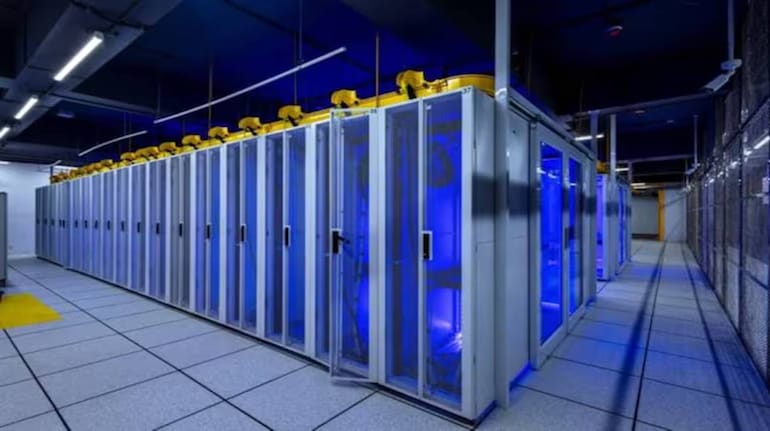
As major data centre operators and data hyperscalers face attacks on their data centres in countries like the UAE amid the current crisis between Iran, Israel, and the United States, the burgeoning data centre market in India may receive another shot in the arm, as hyperscalers may look at India to expand their data co-location operations.
"The recent developments in the Gulf region highlight a broader reality of the digital economy — data infrastructure has become strategic infrastructure. As geopolitical tensions evolve, global hyperscalers and enterprises are increasingly prioritising locations that offer not only cost-efficiency but also long-term stability, regulatory clarity, and infrastructure resilience," said Niranjan Hiranandani, chairman, Hiranandani Group, which includes the Yotta data centre platform.
India's data centre capacity slated to touch 4 GW
India's data centre capacity is slated to reach 4 gigawatt (GW) by 2030, powered by large-scale capacity additions in major markets, particularly the Mumbai Metropolitan Region (MMR). A report by Cushman & Wakefield, a property consultancy, found that developers of data centres in India may invest nearly $20 billion for onstreaming their capacities, spending $7.1 million per megawatt of capacity, excluding land costs.
Industry observers said that besides hyperscalers such as Google, Microsoft, and Amazon Web Services, which build significant captive capacities, pure-play data centre players promoted by major conglomerates, real estate developers as well as large funds, such as Blackstone, Brookfield and others, may stand to benefit due to the shift. Large data hyperscalers also depend on capacities by data centre operators due to computing needs for generative AI applications and cloud.
"As hyperscalers and operators look to diversify their infrastructure footprint, India offers both scale and long-term stability, making it a natural destination for the next wave of investments. India is increasingly being viewed as a strategic location for data infrastructure in the Asia-Pacific region. Its scale of digital consumption, expanding fibre connectivity, and growing ecosystem of technology companies make it a natural hub for long-term data centre investments," said Raghavendra Mirji, business head, energy solutions business, Godrej Enterprises Group.
Major players had set up their data centres in the Gulf countries, especially in the UAE and Saudi Arabia, and had been planning for more, due to the relative ease of doing business in these countries, plentiful and cheap electricity powered by increasing adoption of renewables, and ample availability of land. Currently, Gulf countries have around 2 percent of the global data centre capacity, compared to around 4 percent for India.
These countries have also rolled out incentives to attract data centres, such as 100 percent ownership and other tax incentives, eager to cash in on the emergence of AI that require large-scale data centre capacities. A 2025 report by PwC noted that industrial land in Saudi Arabia costs between $10 and $50 per square metre, compared to $150-$600 per square metre in areas of the US such as northern Virginia, the world's largest data centre hub.
However, recent attacks by Iran, which regard data centres as legitimate wartime targets due to their technical and data support for some American defence suppliers, have damaged the Gulf's data centre ambitions. Since the start of the war, AWS reported damage due to Iranian drone attacks across facilities in UAE and Bahrain. The company has six data centres in the Gulf region.
Data centres have been a significant driver of investments in these countries, both from domestic and foreign sources. US President Donald Trump, in a visit to the region last year, hailed the $700 billion AI data centre investment in Abu Dhabi, a joint effort of OpenAI, Cisco, Nvidia, and Oracle. Saudi Arabia has committed $100 billion to the Transcendence AI initiative through the Public Investment Fund (PIF), with AWS also committing around $5.3 billion in Saudi Arabia to build data centres.
Analysts said that while Gulf countries have a marked advantage on electricity costs, India is also cost-efficient to build data centres on a number of metrics, including cost of production, and recent government initiatives, such as the Union government's tax holiday for data centres. A number of states, such as Karnataka, Maharashtra, Uttar Pradesh, and West Bengal, have dedicated data centre policies with incentives such as land at discounted rates, and electricity duty exemptions.
"On the electricity side, UAE would be cheaper. But for India, the cost of construction is almost 40 to 45 percent cheaper compared to world average. And similarly for electricity, it would be about $0.08 per kilowatt hour. For US, Singapore, and Japan it would be as high as $0.2-$0.3 per kilowatt hour. If you look at the competitive landscape plus the favorable government policies which are coming in India, they definitely augur well for the industry," said Puja Jalan, director, CareEdge Ratings.
Discover the latest Business News, Sensex, and Nifty updates. Obtain Personal Finance insights, tax queries, and expert opinions on Moneycontrol or download the Moneycontrol App to stay updated!





Find the best of Al News in one place, specially curated for you every weekend.
Stay on top of the latest tech trends and biggest startup news.