






Maharashtra Chief minister Devendra Fadnavis on March 7 expressed confidence that his government will turn Maharashtra into a $1 trillion economy by 2030, and underpinned Maharashtra’s dominance in attracting capital and the state's growing role as a fintech and startup hub.
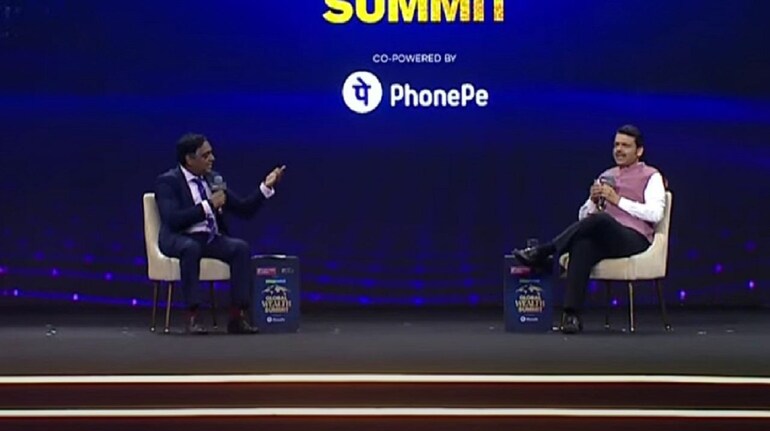
CM Fadnavis, was in conversation with Moneycontrol's Managing Editor Nalin Mehta at the Global Wealth Summit 2025 in Mumbai.
Here's the full transcript:
Sonal:
I invite upon stage Nalin Mehta to introduce our next guest.
Nalin Mehta:
Thanks very much, Sonal. As we race towards the grand finale of the Moneycontrol Global Wealth Summit, it's only fitting that we close with a leader who's been instrumental in driving India's economic powerhouse, Maharashtra. Under his visionary leadership, Maharashtra has not only cemented its status as India's financial capital, but is also on the path to becoming the country's first trillion-dollar sub-economy. He has championed a policy-driven approach that attracts global investments, fosters technological advancements, and promotes sustainable development.
Ladies and gentlemen, it is our great privilege and honor to have amidst us the dynamic Chief Minister of Maharashtra, Devendra Fadnavis, for a conversation on Maharashtra's economy.
Devendra Ji, first of all, thank you very, very much for taking time out of the assembly, especially budget session is going on, to come here at Moneycontrol Global Wealth Summit.
Mr. Devendra Fadnavis:
I’ve come here straight from delivering a speech in the assembly.
Nalin Mehta:
So, Devendraji, you are the comeback man of Indian politics. You famously said, 'I will return.' Now you're back, and you're back with a bang. It's been three months since your second innings as Chief Minister. What is the difference between your first and second term?"
Mr. Devendra Fadnavis:
For me, in a way, it's an extension. In my first term, the work that we had started—over the past two and a half years, I got an opportunity to complete those things, and now I am trying to take them forward. I see a difference in myself as well. Now, I'm more calm and composed, and the anxiety that I had during my first five years is no longer there. I am now working with complete focus. So, I believe that in this term, the foundation we laid from 2014 to 2019—now, building Maharashtra on that foundation is something we will achieve in these five years.
Nalin Mehta:
Devendra Ji, you are saying that you are calm and composed, but the targets you have set for yourself are very aggressive. You have stated that you will make Maharashtra a trillion-dollar economy, and very soon. How will this happen, and how soon?
Mr. Devendra Fadnavis:
Look, actually, in 2016-17, we first mooted this idea and presented it to the people—that Maharashtra can become the first trillion-dollar sub-national economy. And in the past, we formed an Economic Advisory Council. This council included N. Chandrasekaran, who was the chairman of Tata Sons, along with 20 CEOs from various sectors. We appointed them as members of the council and prepared a roadmap towards achieving a trillion-dollar economy.
We know that, as of now, Maharashtra is the only state in the country that has crossed the half-trillion mark. All other states are still quite far behind. And if we exclude the COVID years, our CAGR stands at 10%."
And if we can go beyond business as usual and develop further, I believe that by 2030, we will be able to make Maharashtra a trillion-dollar economy. To achieve this, we have focused on infrastructure-led growth, technology-led growth, and investment-led growth. We have designed different sections within this strategy, and we are moving rapidly in that direction.
I firmly believe that Maharashtra has a unique strength in attracting investments, and we are trying to leverage that strength. Maharashtra is a state that moves forward at its own pace. The role of the government is simply to provide good governance. If we simply ensure that this momentum is not disrupted, Maharashtra will continue to progress on its own. That alone is enough to drive growth. So, I am fully confident that we will reach the trillion-dollar economy mark.
Especially today, when we see how technology and AI have created new opportunities, these advancements will allow us to accelerate this journey even further.
Nalin Mehta:
Devendra Ji, you spoke about investment. In this audience, there are many global investors as well as several Indian investors. Maharashtra already receives the highest share of Foreign Direct Investment (FDI) among all Indian states—52% in the last quarter. Why is that the case, and what steps will you take to further increase FDI so that you continue operating beyond business as usual?"
Mr. Devendra Fadnavis:
Look, this year has been exceptionally good for us in terms of FDI. Because until now, our record for the highest FDI was in 2016-17, when we received an investment of ₹1,31,000 crore in the entire year. However, in just the past nine months, we have already received ₹1,39,000 crore in FDI, breaking our own record. And I am happy to share that if we combine the total FDI received by the three states following us, Maharashtra has still received more than their combined total. This has come to Maharashtra. And I believe that, except for the two years in between when the Mahavikas Aghadi government was in power, we have been leading in FDI since 2015, and we continue to remain at the top. I believe there is one key reason for this: foreign investors look for stability, work culture, business-friendliness, ease of doing business, and cost of doing business. We have worked extensively on all these aspects. And because of this, I believe that investments are coming in.
The biggest question you asked is how we can further increase it. To achieve this, we have developed policies for all emerging sectors—these policies have been designed on a large scale to attract investments. And I believe that because of these policies, Maharashtra is receiving investments on a significant scale.
Nalin Mehta:
You also mentioned that you see Maharashtra, particularly Mumbai, as India's fintech capital and data capital. What do you mean by that, and how do you see this vision taking shape?
Mr. Devendra Fadnavis:
Look, I believe that Maharashtra is already the de facto fintech capital as well as the data capital. Mumbai is the fintech capital because if you look around, especially here in BKC where we are seated, the who's who of the fintech industry is based right here. Recently, we have allotted land to NPCI , and they are building their global headquarters here. We have also provided land to the National Stock Exchange, which is also moving to this location. Essentially, all major international banks and funds related to fintech are present here. I believe that every aspect of fintech, in its various forms, can be seen here in BKC and across Mumbai.
Additionally, I want to highlight an important point: the latest Startup India report has just been released, and this report highlighted three points. First, in absolute number, Maharashtra is startup capital, and the biggest number of startup is in Maharashtra. This state is number one in absolute investment in startups because the biggest investment start-up is in Maharashtra. And along with that, the biggest start-up of fintech is also in Maharashtra. We can see this too, so I believe that in a way, Maharashtra is a de-facto fintech capital and is slowly becoming.
Nalin Mehta:
If there is a company startup in Mumbai in compared to Bangalore, will its valuation be higher?.
Mr. Devendra Fadnavis:
Sorry.
Nalin Mehta:
If there is a startup in Mumbai in compared to Bangalore, will its valuation be higher in Mumbai?
Mr. Devendra Fadnavis:
It is increasing now. There was a time people used to start startups in Mumbai and go to Bangalore, now reverse migration has started because in Mumbai, if you see the growth of start-ups in the last two years it is a phenomenal growth. and some start-ups have achieved this type of investment which is completely unprecedented. So I feel that now, of course for a long time, Bangalore has nurtured the start-up ecosystem well, but now Mumbai is the start-up capital which is seen in absolute numbers and in absolute investments.
And along with that, you talked about data so I am happy to say that the data center capacity that we have prepared in our country, 65% of that capacity is alone in Maharashtra and it is continuously increasing. And on a very large scale, investment is coming to us in this area. We have prepared our data policy in the data policy, in which we are providing the necessary things for the data center. The most important thing is that for data centers power is their raw material, so they should get power, they should get clean power, they should get green power. We are working on a very large scale from this point of view. So that is why I feel that the data center capital of the country has also become Maharashtra.
Nalin Mehta:
Devendra ji, right now there is a lot of volatility in global business. There is volatility in the market. There is talk of tariffs, and there is also talk of China plus one. So what steps will you take to integrate Maharashtra in the global supply chain?
Mr. Devendra Fadnavis:
I feel that a never before opportunity has been prepared for us because after the disruption of COVID when the world realized that we cannot put all eggs in one basket and we will have to build other centers in the supply chain. It is also true that initially people went to 2-3 countries, but later they realized that in these countries there is no capacity to take so much investment, there is no human resource. So now gradually everyone feels that India can be the center of the new supply chain, and from that point of view, a large number of supply chains are being built in India. We are trying to develop all the industries, infrastructure, and culture required for the global supply chain. We are developing the best of the infrastructure in roads. We are developing the best of the infrastructure in data because we know that speed of data is very important for this. We have done the same work for speed of data.
And on a large scale, the industries that are coming to us for manufacturing I feel that we are completing that cycle. As an example, I would like to tell you that there was a time when the engine used to come from outside Pune and everything used to be assembled here. Now gradually, our supply chain has become so ready that 80-85% of everything is made in and around Pune and now export has started from there. So I feel that the supply chain that is being made is very important, and just like the JNPT port, we are making the Varvan port because of which we will have a lot of benefit in establishing this supply chain.
Nalin Mehta:
You talked about data, FinTech, and now because of AI, everything is being disrupted, so what will you do about the semi-conductors for investment? There is no investment in Maharashtra yet, so how will you do it?
Mr. Devendra Fadnavis:
It is not like that. We have invested in semi-conductors as you know, semi-conductors are a 7-step process out of these. For different steps, we have six investors who have already invested. Some are making wafers, some are making something else. There is such an investment. But for the whole process, tower semi-conductors with Adani they have invested in us and the complete semi-conductor ecosystem that ecosystem is being done through tower. The investment has come in OSAT and wafers. So we have established a semi-conductor ecosystem. Investment into this has also come. And I think more investment will come to us in this area.
Nalin Mehta:
Are you talking to Tesla about investments?
Mr. Devendra Fadnavis:
Who doesn't want Tesla to come? Many states want it, we also want it. They have to take the decision but if they don't ask me I will tell them that the best case is Maharashtra and we are trying to tell them that.
Nalin Mehta:
To enhance the financial capital status of Mumbai what steps will you take? Will you build a second gift city of Fintech?
Mr. Devendra Fadnavis:
In total, if we look at it Mumbai, which is our city, in this city today we can see that Fintech or different types of business opportunities have been prepared on a large scale and this is a de facto financial capital, but now we are trying to between Mumbai and Navi Mumbai we have prepared a 22 km Atal Setu because of this Atal Setu we were able to extend Mumbai to the hinterland. And because we have also prepared a new airport there, so between Atal Setu and new airport we are trying to build a new city. The new city will be three times bigger than Mumbai, which we have called Naina New Mumbai Airport Influence Area. And here we are working in a schematic way. Here we want to build an innovation city in 300 acres for which Mr. N Chandrasekaran of Tata Sons has volunteered and they’re putting a paper into that. And as soon as we announced this innovation city so who is who in innovation? They’re talking to us now. So I feel that we will prepare a next level innovation city. We are preparing an Agile city there. This Agile city is such a concept because of our new regulations foreign universities can open an offshore campus, so for that we have prepared an area where we want to bring 10-15 high ranking foreign universities there.
Nalin Mehta:
Are you in talk with any universities?
Mr. Devendra Fadnavis:
There are 4-5 good universities because we have a non-disclosure agreement with them, so I will not tell you now. I will tell you at the right stage, but the 4-5 universities we have talked to at the last stage. They are the world's very high ranking universities who have a lot of name, we are trying to bring such universities there. So I feel that our industry 4.0 which can accelerate our economy that whole industry 4.0 you will see it in New Mumbai, and as a new business magnet or as an extension of a new financial capital we are trying to prepare it in this way.
Nalin Mehta:
People say that Gujarat gets more investment than Maharashtra, how do you react to those kind of comments and that observation?
Mr. Devendra Fadnavis:
See, the first thing is that if Gujarat gets developed I am happy about that, I am very happy if Karnataka gets developed. I am very happy as far as investment is coming to my country I am very happy. Now 10 states are competing with each other, so some investment will go to them, some will come to us, but having said that I want to tell you the FDI figures that I have told you, FDI that came in Gujarat we have more than three times in Maharashtra, three times. So I want to say that Maharashtra was, is and will be the most favoured destination for the investors, that's why if one project goes to Gujarat, so Gujarat will go ahead or one project goes to Karnataka, Karnataka will go ahead. It's not right to say that. Maharashtra is number one and Maharashtra will remain number one.
Nalin Mehta:
Mr. Devendra Ji, now the budget session is going on, elections are over, it's been three months now, so there is a lot of discussion about Rabris and many promises were made in the elections which cost a lot. So how will you balance the budget, and at what point will you draw the red line around the Rabris?
Mr. Devendra Fadnavis:
See, the first thing is the truth in what you said that we started different types of schemes and today we have to pay 60,000 crores annually, 60,000 crores, but through these schemes I believe that in the social sector we are making a type of investment and like our Ladli Behan Yojana in which we are giving 1500 rupees to our sisters. Now we have brought a new scheme in that. The women of Nagpur have come together and created a finance society and in that society they have collected 30 lakh rupees from small people and created a business model for that. Now we are trying that the 1500 rupees that we give to our sisters we are trying to create a finance society and create a business model from that. So that they are not happy with just 1500 rupees, so that we can contribute to their economy as a human resource or as contributors.
Like our Prime Minister brought the Lakhpati Didi Yojana, so Maharashtra decided that we will make 1 crore Lakhpati Didi. Last year we made 23 lakh Lakhpati Didi. This year we have set a target of 25 lakh Lakhpati Didi and by doing this we are trying to make 1 crore Lakhpati Didi to our sisters who earn more than 1 lakh rupees annually. So it is true that when you invest in such a revenue side, then there is a stress on the budget, but we are trying to manage. And we have tried that it does not affect our capital investment. From that perspective on a very large scale with the help of the private sector and by preparing different instruments we are investing here. So I believe that without reducing the capital expenditure we are trying to balance our budget.
Nalin Mehta:
What is the status of Dharavi redevelopment project?
Mr. Devendra Fadnavis:
Dharavi redevelopment project has started. The first stage of this is house to house survey. This survey is 75% completed and it was expected that we will complete this survey by the end of March. Due to which eligibility and ineligibility we will be able to finalize this. I think we will do those things by April, but along with that for the people affected by the project or those who have to give houses or transit camps that has already started. The railway land which we had taken, on that land we have to make some offices for Railway and on the remaining land we will start building houses and after that we will vacate each sector, and we have started building houses. Due to which this area of Dharavi we will be able to make it slum free.
And I also want to tell you that this is the first project in which we have decided that the ineligible we will not leave them. Otherwise they will go to other places and build huts, so we are giving free houses to the eligible people, and to the ineligible we are giving rental housing. And in rental housing after staying for 12 years after paying the rent they can fill some money and become the owner of their house. This is the kind of project we have brought for them. So I think that now slowly in the minds of the people, a lot of confidence has been created for them. You must have seen 15 days ago the people of Dharavi supported the Dharavi project. This is very rare but it was a big procession and people were saying that we have to do the Dharavi project and you have to do it fast. So I think this is a very positive development and we will complete the Dharavi project
Nalin Mehta:
Mr. Devendra Ji, in some projects there have been complaints regarding land acquisition like in the Aramco project, so in the upcoming investments how are you approaching the land acquisition problem?
Mr. Devendra Fadnavis:
Look, I believe that our state suffered a significant loss due to the refinery project. We had identified a suitable location, and the people there were ready for it. However, at that time, our partner Uddhav Thackeray Ji made it a prestige issue and stated that under no circumstances would he allow it to be built there. Later, when he became the Chief Minister, perhaps that is why we were unable to proceed with the project at that location. Now, we have identified a new site, but we are facing some challenges there as well. However, we are working to resolve those issues.
But I believe that this project had the potential to transform Maharashtra’s economy for the next 20 years, and it also had the capacity to significantly impact the country's economy. Recently, I met with the Union Minister and conveyed that we need to fast-track this project. There is also ongoing discussion about adjusting the originally planned 60-million-ton capacity. Instead of developing it all at once, we are considering a phased approach—dividing it into 20, 20, and 20 million tons. However, one thing is certain: we will implement this project in Maharashtra.
Nalin Mehta:
Devendra Ji, on one hand, we are talking about making Maharashtra a trillion-dollar economy and doubling its size. On the other hand, there is distress among farmers, especially in Marathwada and Vidarbha, particularly soybean and cotton farmers. How do you plan to tackle this issue?
Mr. Devendra Fadnavis:
Look, when it comes to soybean and cotton farmers, we procure both crops at MSP. This year, we have set a record in procurement. In fact, the total soybean procurement in Maharashtra this year is 124% more than the combined procurement of six other major soybean-producing states, including Madhya Pradesh, Gujarat, and Haryana. So, we have procured soybean and cotton on a large scale.
Now, the main issue is that a significant part of Maharashtra is drought-prone—52% of the state, while 48% is blessed with good water resources. To make Maharashtra drought-free, we have developed a plan. On one hand, we are implementing water conservation through small structures. At the same time, we have also designed several ambitious river-linking projects. One of them is the Wainganga-Nalganga project, under which we are creating a new 450-kilometer-long river. As a result, the seven districts of Vidarbha will become completely drought-free. Under this river project, we will construct 31 dams and increase the height of two dams.
Nalin Mehta:
When this will be completed?
Mr. Devendra Fadnavis:
We will begin this project next year, and it will take around seven years to complete. As a result, 10 lakh acres of drought-affected land will become irrigated. Additionally, there will be water available for industries and drinking purposes. Similarly, we have designed another scheme. Maharashtra has 49% of the Godavari River basin, which is a deficit basin. Due to the Western Ghats, we have sloping rivers where water flows directly into the sea without being utilized. Now, we have taken up a river-linking program where we will divert 54 TMC of water from these west-flowing rivers into the Godavari basin. As a result, Northern Maharashtra and Marathwada will become completely drought-free. Through this initiative, we aim to make the entire state drought-free. This is a highly ambitious project. It is a project worth 2 lakh crores. But we have started it and we will complete it.
Nalin Mehta:
Devendra Ji, you are not only the Chief Minister, you are also the Guardian Minister of Gadchiroli. What are your growth plans for Gadchiroli, especially because there is a lot of Maoist challenge there.
Mr. Devendra Fadnavis:
See, Gadchiroli was known for Maoism. And when Gadchiroli was mentioned, people used to talk about Maoism. In our administration, if someone has to be punished, we used to tell him to send Gadchiroli. This was the situation of Gadchiroli. But now, Gadchiroli is becoming the new steel city of India. Now, the way steel is being invested there, when I was in my previous regime, I was the Chief Minister and also the Home Minister. At that time, I tried, gave police security there and started the mining activity. When it started, the Maoists also opposed it. People also opposed it. But we started mining with peace, but with full determination. Gradually, the local communities benefited from it. As a result, I want to tell you that the iron ore in Gadchiroli is the best in our country. The best iron ore is in Gadchiroli. There is no other place like it. After the mining started, I told them not to use it only as a colony. An entire steel ecosystem should be created here.
At that time, we gave a place for the steel industry. I inaugurated it last month. Another plant of 25 million tons, is being built there through Lloyd. We were in Davos just now. For a plant of 25 million tons, we did an MOU with JSW, which is probably the biggest plant in the country. They are also investing 1.5 lakh crores there. We also inaugurated another big plant there. In a way, an entire ecosystem is being created there. In the coming days, we will see the country's largest steel capacity in Gadchiroli.
The Gadchiroli, which we knew to be for Maoists, is now becoming the steel hub of India. We are also preparing a new airport in Gadchiroli. We have started the process of connecting Gadchiroli to the Samruddhi Mahamarg through an access control highway. Along with this, we are also preparing a corridor for mining. We are trying to see how all this can be transported. We are also planning to take the pipeline from Gadchiroli to Jalna. We are also planning to take the pipeline from Jalna to Kokan. I think we are seeing a lot of change in Gadchiroli. The result of this is that from North Gadchiroli, Naxalwad and Maobad have gradually ended. In South Gadchiroli, there are only two talukas left, but that too we will end in the next one year.
Nalin Mehta:
Devendra Ji, let’s talk a bit about politics. There are many rumours that you and Shiv Sena are having a dispute. What is the dispute?
Mr. Devendra Fadnavis:
There is no dispute. When our media does not get any news, they make news. These are manufactured news. We are all together running the state and doing good work. And sometimes I am very surprised when I see in the media that Devendra Fadnavis has given a stay to the work of Eknath Shinde. I have told in our House today that I am not Uddhav Thackeray to give a stay. I am a man of action. That's why all these news reports are somewhat manufactured, somewhat colored, and somewhat motivated. I want to tell you—there is no problem at all. Everything is going great, running smoothly, and progressing well.
Nalin Mehta:
Shinde ji does not have any resentment towards you?
Mr. Devendra Fadnavis:
Absolutely not. See, the problem is, I have told many people this: Shinde ji has his own personality. If you observe his demeanor, he remains calm and serious. On the other hand, I usually have a smiling face. Seriousness is naturally present on his face. When he was the Chief Minister, he was just as serious, but no one questioned why Shinde ji wasn’t smiling or why he appeared so serious. Now that he is not the Chief Minister, people are pointing at his expressions and saying that he isn’t smiling or that he is upset. If a person naturally has a serious expression, how can they suddenly appear to be laughing? My face, on the other hand, tends to have a lighter expression, so people might say that I don’t appear serious enough or that something is wrong with me. But that’s not how it works. Every individual has their own personality, and in the same way, Shinde ji has his own unique personality. There is no problem at all—we are together, and everything is fine
Nalin Mehta:
How are your relations with the opposition these days, especially with Thackeray Ji and Pawar Sahab?
Mr. Devendra Fadnavis:
Look, the relations were never too bad. However, there was a phase in Maharashtra politics when, instead of just political opposition, an atmosphere of hostility was being created. We were also targeted during that time. But after coming to power, in my very first speech in the Assembly, I made it clear that I have come not for revenge but for change. That’s why I don’t want to take revenge; I want to bring change. I want dialogue. My focus is on development. So, I believe that relations should be cordial. Fortunately, in Maharashtra, we can still talk to each other. There is not much distance between us that we cannot talk to each other. It is a different matter that if he had picked up my phone at the right time, it would have been a different matter, but Uddhav Ji did not pick up the phone. So all these things happened here. But now he picks up my phone and I also pick up.
Nalin Mehta:
So, if both of you are picking up each other's phones, is there a possibility of an alliance again?
Mr. Devendra Fadnavis:
Look, we don’t talk about alliance over the phone anymore. There is no alliance, and there won’t be one. You can tie a knot on that—there is no alliance.
Nalin Mehta:
So you are saying that you will not have an arrangement with the NCP again?
Mr. Devendra Fadnavis:
Look, I do not see it like that. Look, I am talking very carefully these days. Because in politics, never are neighbours. What can happen anytime, nobody knows. And the last five years have taught us that anyone can go with anyone in politics. That is why I am talking very carefully. But the political scenario that I see, the direction that we see, there can be no alliance with Sharad Pawar Ji or Uddhav Ji. There is no such situation.
Nalin Mehta:
Now, the BMC elections are coming up. It is being said that BJP will content on its own?
Is it so? Or will Mahayuti remain?
Mr. Devendra Fadnavis:
100% Mahayuati will fight the BMC elections. BJP will not fight separately. And we will have the mayor of Mahayuati in Mumbai.
Nalin Mehta:
Last question. You said that you are picking up each other's phones. So, the Vidhan Sabha is going on right now. There is no Leader of Opposition. Because they do not have such numbers in all the opposition parties. Will you allow a Leader of Opposition even though they do not have the numbers?
Mr. Devendra Fadnavis:
You see, it is not about me allowing. Because who has to give the Leader of Opposition? What are its rules? It is the sole prerogative of the Speaker, not Government. Their request has gone to the Speaker. The Speaker is our lawyer. He is a Speaker who works very intelligently. He has 100% knowledge of the Constitution and our rules. He will search for all the possibilities, and will take the right decision. Whichever will be in the interest of democracy, the Speaker will take it. So, what will be the decision of the Speaker, that I don’t know.
Nalin Mehta:
If I ask your opinion, will you have a problem?
Mr. Devendra Fadnavis:
Look, if the Speaker takes the decision, why should I will have any problem. Look, let me tell you one thing. On the first day, I said that I will not judge the opposition by its numbers. However, in the history of Maharashtra, we have had the lowest number of opposition this time. And even today, you see, there is no Leader of Opposition. But we treat them or their leaders like the Leader of Opposition. There has been no change in us. Because in democracy, the ruling party is as important as the opposition party. However, it is right that after looking at Parliament, it is important that the Leader of the Opposition Party should be sensible. He should be a thinker of the nation.
Nalin Mehta:
On that note, Ladies and Gentlemen, please give a big hand to Devendra Fadnavis, the Chief Minister of Maharashtra.
Discover the latest Business News, Sensex, and Nifty updates. Obtain Personal Finance insights, tax queries, and expert opinions on Moneycontrol or download the Moneycontrol App to stay updated!
Find the best of Al News in one place, specially curated for you every weekend.
Stay on top of the latest tech trends and biggest startup news.









