India’s free trade agreement with the UK is set to make industrial inputs and consumer goods such as alcohol cheaper for Indian consumers—but it could also disrupt existing trade flows from Western allies such as the US and Japan, a Moneycontrol analysis shows.
Prime Minister Narendra Modi on July 24 signed the agreement, finalised earlier this year.
"UK products such as medical devices and aerospace parts will be available at affordable prices for India," PM Modi said at the joint press conference with UK prime minister Keir Starmer.
The deal, finalised earlier this year, is set to reduce tariffs on 85 percent of UK exports to India within a decade.
The two countries aim to double the trade between the two nations from $56 billion by 2030.
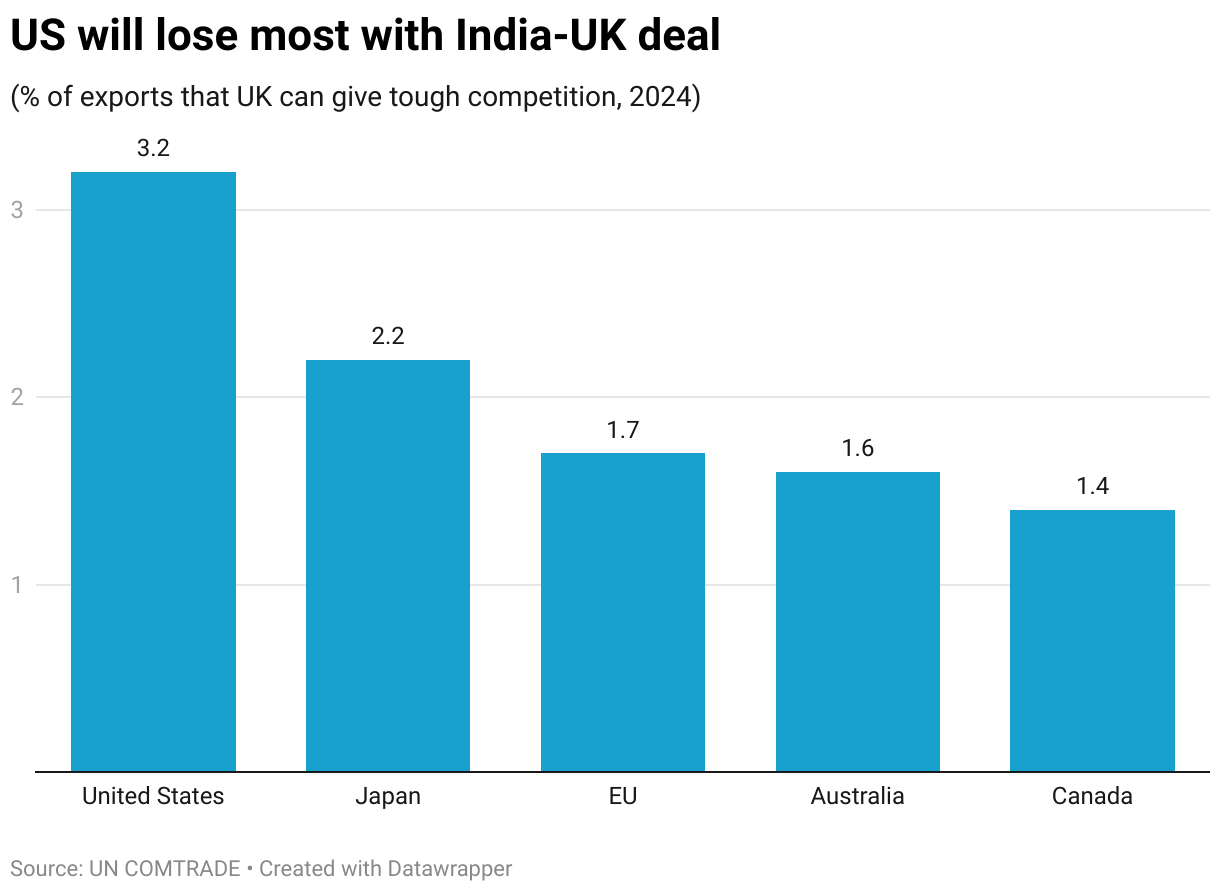
While the bilateral gains are considerable, the deal introduces fresh competition for other major exporters to India. The US, which exported $39 billion worth of goods to India in 2024, is expected to face competition in $1.24 billion worth of its shipments—roughly 3.2 percent of total exports to India.
The most exposed US exports include copper and iron waste and scrap, which account for $703 million, as well as categories such as machinery, vehicle parts, contact lenses, and therapeutic equipment. With UK goods now set to benefit from lower tariffs, US exporters may find themselves at a disadvantage in these sectors.
But the US is not alone. Japan, which exported $19.9 billion to India last year, may face competition in 2.2 percent of its exports, based on UN COMTRADE data. The European Union, with $48.3 billion in goods sold to India in 2024, will see 1.7 percent of its exports competing directly with UK products. Australia and Canada are also exposed, with potential impacts in 1.6 percent and 1.4 percent of their India-bound exports, respectively.
According to a study by the UK’s Department for Business and Trade, the agreement is expected to add $15.7 billion to the UK exports by 2040, boosting the country’s GDP by 0.13 percentage points.
For India, the deal reflects a strategic recalibration of trade alliances, enabling it to access advanced industrial and medical technologies at lower costs while also gaining preferential access in select sectors.
An earlier analysis by Moneycontrol had found that India could give tough competition in over $2 billion in exports from Southeast Asian and South Asian countries if the deal comes into effect.
Clothing, footwear, spices and jewellery are segments where India can start competing with the likes of Bangladesh, Pakistan, China, Indonesia, Thailand and Vietnam.
Indonesia, which signed a strategic partnership agreement with the UK in November 2024, could face tough competition in a tenth of its exports, while India could threaten nearly 5 percent of Bangladesh’s exports and over 2 percent of exports from Pakistan.
Discover the latest Business News, Sensex, and Nifty updates. Obtain Personal Finance insights, tax queries, and expert opinions on Moneycontrol or download the Moneycontrol App to stay updated!
Find the best of Al News in one place, specially curated for you every weekend.
Stay on top of the latest tech trends and biggest startup news.