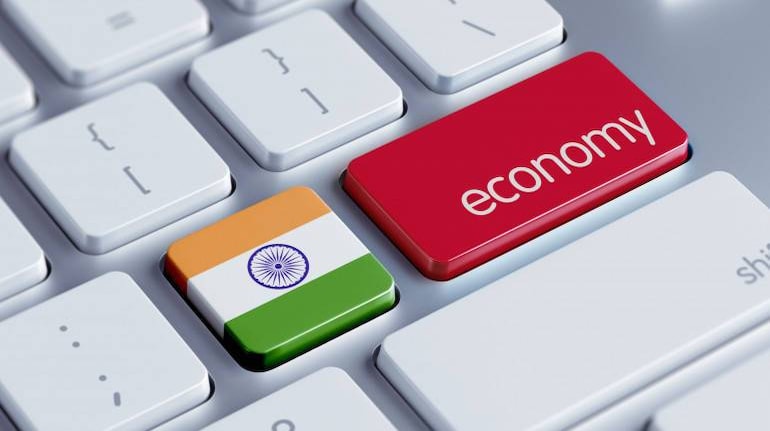
The COVID-19 pandemic has resulted in an unprecedented situation for countries across the world with India being no exception. With a negative growth rate of (-) 4.5 percent in June 2021 predicted for the Indian economy by the International Monetary Fund (IMF), declining tax revenue collections due to demand disruption and higher healthcare expenditure are pointing towards fiscal deficit numbers being higher than the budgeted estimate.
Rather, India's fiscal deficit has already touched a record high of 83.2 percent of the target for the whole of the current financial year in the April-June quarter. This is indicative of the impact of the pandemic on tax collections and front-loading of the government's spending.
Doubts are being raised on India being able to achieve its fiscal deficit target of 3.5 percent of gross domestic product (GDP) for FY21 as specified by the Fiscal Responsibility and Budget Management (FRBM) Act of 2003, and predictions are that fiscal deficit could touch 8 percent of GDP for 2020-21.
The stimulus package announced by the government to the tune of Rs 20 lakh crore (equivalent to 10 percent of GDP) had raised eyebrows. Contrarian thinkers are of the viewpoint that this package amounts to anywhere between 0.8 to 1.5 percent of GDP.
However, the million dollar question is two-fold: Does India have the fiscal space to announce a bigger package? With uncertainty around a second wave of coronavirus hitting many a countries and localised lockdowns being announced in India, is it prudent for the government to announce a demand stimulus package at this point of time or would it be judicious to announce the same closer to the vaccine coming into the market? The announcement of any bigger stimulus will come hand in hand with increased fiscal deficit.
In the Budget speech on February 1, 2020, Finance Minister Nirmala Sitharaman had announced that due to lower revenue collections and higher government expenditure, the fiscal deficit for FY20 was at 3.8 percent as against 3.3 percent announced in last year's Budget, and would be 3.5 percent for FY21 as against the FRBM target of 3 percent (aided by disinvestment).
Rather, the government had already adopted a fiscal expansion path and invoked the 0.5 percent escape clause of Section 4(3) of the FRBM Act. Section 4(2) of the FRBM provides for a trigger option for a deviation from the estimated deficit numbers due to introduced structural reforms.
However, the Centre's fiscal deficit for FY20 came at 4.6 percent (a seven-year high) against the revised estimate of 3.8 percent due to lower than predicted GDP growth and low revenue collections across the board. Thus, with limited fiscal space available, contrarian thinkers are vying for a deteriorating deficit and are of the view that in an unprecedented situation worsening deficit should be permissible. However, keeping the downsides of a widening deficit in mind, we would not recommend that.
Let's trace back history a little. It was seen that in 1991-92, the combined fiscal deficit of the Centre and States was as high as 9.3 percent which came down to 6.3 percent in 1995-96 and then again rose to over 9.0 percent approximately from 1998-2003. Deficit monetisation (the Reserve Bank of India monetised the deficit by issuance of ad-hoc treasury bills) was in vogue in India to manage the high fiscal deficit scenario. With the FRBM Act, whose aim was to bring about fiscal discipline, subscribing to primary issues by the RBI was barred from April 1, 2006. The downside of a widening deficit is that it triggers inflation.
To address the slowing down of the economy, the RBI was already forced to bring down repo rates and pump in money into the financial system by buying bonds leading to increased liquidity. Numbers showed that excess liquidity as of June 1 was to the tune of Rs 4.02 lakh crore. With the economy on the recovery path and consumer demand on the rise, increased liquidity will lead to higher inflation rates. Rather, Consumer Price Index (CPI) inflation for India in July 2020 (with reduced demand) is already at 6.3 percent which has forced the RBI as of August 2020 to keep policy rates unchanged. In such a scenario, a deteriorating deficit will further worsen inflation numbers. Excess money supply will also result in further depreciation of the Indian currency worsening the situation for exporters.
Looking at it from the supply side, a worsening deficit will lead to increased market borrowings by the RBI on behalf of the government which can negatively impact businesses. Increased borrowings by the government will lead to an increase in interest rates and less space available for corporates and industrialists to borrow from the market thereby demotivating businesses to make capital investments. Increased interest rates will result in a rise of cost of production leading to higher product prices for consumers. The Index of Industrial Production (IIP) numbers showed contraction by 16.6 percent in June, an improvement from 33.8 percent in May.
The eight core sector industries, which constitute 40 percent of the IIP, contracted by 17.1 percent in June 2020 as against 38.4 percent in May 2020. In such a situation, increased inflation will result in lower demand for products and services, thereby again negatively disrupting the flow of goods and services in the Indian economy.
Another option available in the hands of the government to cover increasing fiscal deficit is increase of taxes, could be direct or indirect tax. With approximately 4 percent of the population paying income tax, is it fair on the part of the government to increase direct taxes and make these 4 percent bear the extra burden? Tax base has been gradually getting widened from hardly 1 percent a couple of decades back to 4 percent of population now, thanks to tax reforms.
One cannot think of reversing the process under the pressure of fall in revenue collection. The Laffars Curve proved long back that lower the rate, higher is the revenue collection. Moreover, under the current demand constraint situation confronting the Indian economy since the last couple of years, raising tax rate would have an adverse impact. On the flip side assuming that the income tax is raised by the government to increase tax collection and reduce fiscal deficit, higher taxes will result in lesser disposable income in the hands of this section of the society, leading to further reduction in demand. This again will have a negative impact on economic growth and will worsen the anticipated contraction in FY21 for the Indian economy. Rather, further cut in tax rates may be the viable option.
In case the government decides to increase indirect taxes - i.e. the Goods and Services Tax (GST) - it will lead to increased prices of products. Increased prices of products will impact all sections of the economy, thereby making the situation worse for the lower income section of the society. Thus, an additional stimulus package at this point of time will result in an increased burden on fiscal spending which will only worsen the deficit numbers.
Rising fiscal deficit numbers are one of the three main causes for downgrading of India's sovereign credit ratings by international agencies like Moody's, Standard and Poor's, and Fitch Ratings. Agreeably, this is not the time for the government to worry about the ratings, but one must not forget that sovereign credit ratings by international agencies have an influence on the flow of foreign portfolio investments into the country.
In addition to the announcement of structural reforms under the Atmanirbhar Bharat initiative in May 2020, the government is also working on introducing more structural measures in terms of land and labour reforms as announced by Prime Minister Narendra Modi. These land and labour reforms are from the viewpoint of improving the ease of doing business in India and wooing foreign investors into the country, thus making it important for the government to also keep an eye on the sovereign credit ratings of the country.
Higher fiscal deficit has also had other repercussions such as the central government deciding not to pay the increased dearness allowance to its employees. This clearly means lesser spending by government employees.
Last but not the least, it is important to bear in mind that gross market borrowings have increased by 54 percent from Rs 7.8 lakh crore to Rs 12 lakh crore already, and this is debt that our future generations will have to pay in the coming years. Thus, is it advisable that we spend beyond our means and leave the burden for our future generations to bear?
Agreed, a demand stimulus is needed to give the one big push to the Indian economy, but would it not be wiser that it happens closer to the vaccine being launched into the market, thereby once and for all propelling the Indian economy back into the trajectory of economic recovery.
Importantly, the current fiscal crisis should be treated as an exception under the extraordinary condition created by the pandemic as no country has been left unscathed. Earlier the government fiscal health is brought back on track, better it is for the economy. Otherwise, it would mean leaving a scope for an irresponsible political set-up to go for populist measures without a caring economy.
(Dr Jagadish Shettigar is Professor, Economics, and Dr Pooja Misra is Associate Professor, Economics at Birla Institute of Management Technology, Greater Noida)
Follow our coverage of the coronavirus crisis here
Discover the latest Business News, Sensex, and Nifty updates. Obtain Personal Finance insights, tax queries, and expert opinions on Moneycontrol or download the Moneycontrol App to stay updated!

Find the best of Al News in one place, specially curated for you every weekend.
Stay on top of the latest tech trends and biggest startup news.