

Nearly a tenth of India’s exports to the United States, worth about $8.3 billion, will remain vulnerable to tariffs even if the US Supreme Court overturns President Donald Trump’s controversial “reciprocal” tariff regime, a Moneycontrol analysis shows.
While the Supreme Court is examining the legality of Trump’s emergency tariffs imposed under reciprocal and national emergency provisions, duties levied under Section 232 of the Trade Expansion Act of 1962 would remain untouched.
These tariffs are justified on national security grounds and are based on investigations and recommendations rather than presidential emergency powers.
Section 232 measures cover a range of strategically sensitive products, including steel, aluminium, automobiles, timber, copper and certain categories of machinery. According to UN COMTRADE data, India exported about $8.3 billion worth of such goods to the US in 2024. This accounted for 10.4 percent of India’s total exports to the American market, which stood at roughly $80 billion that year. In effect, even a favourable court ruling would still leave around one in every ten export dollars exposed to US tariffs.
This exposure is unevenly distributed across sectors. India’s dependence on the US market is significantly higher in tariff-sensitive categories than in its overall export basket. While the US absorbed about 18.3 percent of India’s total exports in 2024, its share rose to 22.7 percent for products covered under Section 232, underscoring how heavily Indian producers in these industries rely on American demand.
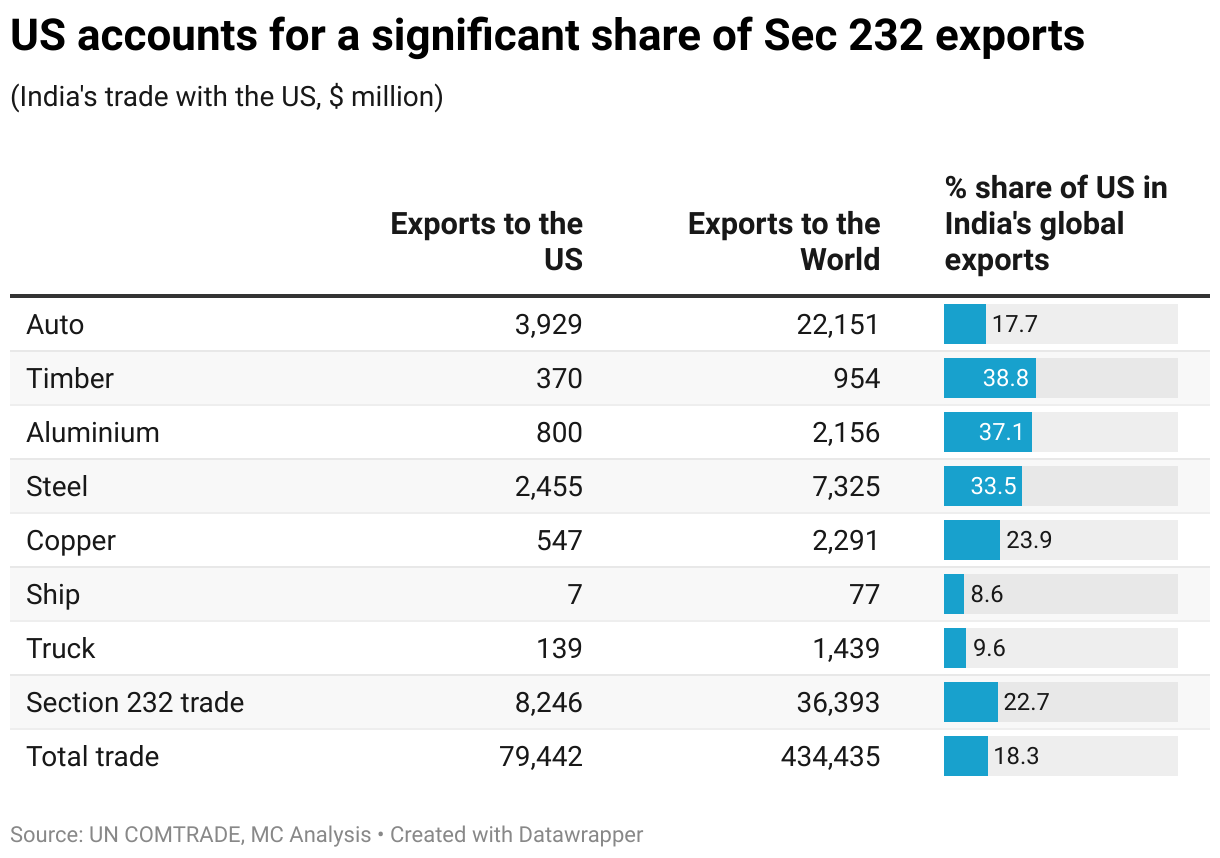
Automobiles form the single largest block of exposure, with shipments worth $3.9 billion falling under the national security lens. Steel exports totalled around $2.5 billion, while aluminium shipments were close to $800 million. Together, these three categories account for more than 85 percent of India’s exports that remain at risk under Section 232 duties. Timber, copper and industrial vehicles add smaller but still meaningful amounts to the tally.
In proportional terms, the concentration is even starker. The US accounted for nearly 39 percent of India’s global timber exports in 2024, about 37 percent of aluminium exports, and roughly 34 percent of steel exports. Such heavy reliance means that even modest tariff barriers can have outsized effects on Indian producers’ margins, competitiveness and investment decisions.
Even if Trump’s emergency tariffs are ultimately struck down, India’s trade exposure to the US will therefore not fully dissipate.
More at risk
The risks could widen further. If the US Congress passes a bipartisan proposal to impose a 500 percent levy on countries that continue to rely on Russian energy, the impact on India could be far larger. Such a move could disadvantage nearly two-thirds of India's exports to the US, worth over $50 billion, with labour-intensive sectors such as textiles and handlooms facing the sharpest blow.
While such tariffs would also hurt Chinese and European Union exporters, India could find itself at a particular disadvantage relative to Asian and Southeast Asian peers. India’s trade-weighted average tariffs are already higher than those of major textile exporters such as Bangladesh, Sri Lanka and Pakistan, and of electronics and electrical goods producers such as Indonesia, Vietnam, the Philippines and Thailand—leaving Indian exporters more exposed if a new layer of punitive duties comes into force.
Discover the latest Business News, Sensex, and Nifty updates. Obtain Personal Finance insights, tax queries, and expert opinions on Moneycontrol or download the Moneycontrol App to stay updated!





Find the best of Al News in one place, specially curated for you every weekend.
Stay on top of the latest tech trends and biggest startup news.