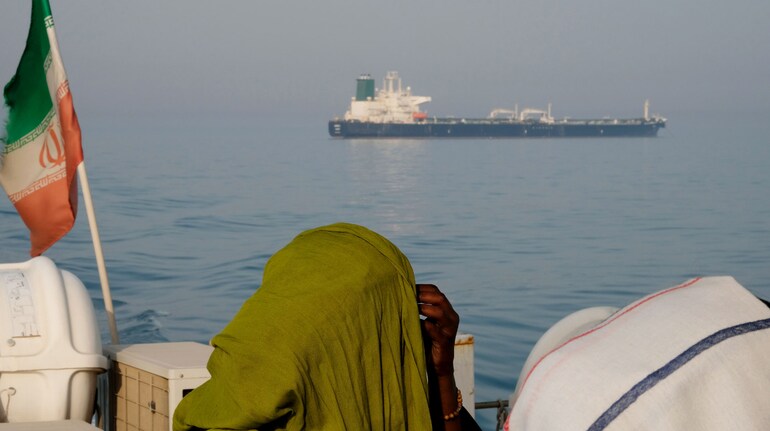

While nearly half of India’s oil supplies face risk of disruption as tensions in the Middle East escalate, the country has enough buffer to meet its energy demands if the conflict is prolonged, analysts say.
In an escalation scenario, the first impact is likely price-driven-higher Brent, freight and insurance costs rather than an immediate volume shock, data and analytics firm Kpler said. “Crude flows can be buffered through strategic petroleum reserve, commercial stocks and Russian optionality,” said Sumit Ritolia, lead research analyst, refining and modelling at Kpler.
Based on Kpler inventory data, commercial crude stocks are around 100 million barrels, including SPR held in strategic reserves at Mangalore, Padur, and Visakhapatnam.
"With imports via the Strait of Hormuz averaging roughly 2.5 million barrels per day — about 50% of India’s ~5 mb/d total crude imports — these combined reserves could theoretically cover close to 40-45 days of imports in a disruption scenario from a crude perspective. In addition, companies also hold refined product inventories, which would extend effective coverage further," Nikhil Dubey, senior research analyst, refining and modeling at Kpler told Moneycontrol.
At the same time, Russian barrels currently floating in the Arabian Sea without clear buyers are likely to be absorbed quickly as Indian and Chinese refiners move to secure supply in the current environment, Dubey noted.
India presently has a reserve capacity of 5.3 million tonnes of crude oil at three locations including Vishakhapatnam (1.33 MMT), Mangaluru (1.5 MMT), and Padur (2.5 MMT) built under phase I of Strategic Petroleum Reserve (SPR) program.
Union Minister for Petroleum and Natural Gas Hardeep Singh Puri had informed the Rajya Sabha on February 9 that the country’s strategic petroleum reserves can last 74 days to meet energy demands in case of geopolitical shocks. The Indian Energy Agency however, estimates that there should be about 90 days of holding as a strategic petroleum reserve.
To further augment the reserve capacity, the government, in July 2021, had also approved the establishment of two additional commercial-cum-strategic petroleum reserve facilities with total storage capacity of 6.5 MMT at Chandikhol (4 MMT) in Odisha and Padur (2.5 MMT) in Karnataka, on a Public Private Partnership mode. However, no major development has been made in this regard yet.
A disruption of the Strait of Hormuz will affect as much as 50% of India’s monthly total oil imports and almost all of its LPG purchases, analysts say.
Roughly 2.5-2.7 million barrels per day of India’s crude imports transit Hormuz, largely from Iraq, Saudi Arabia, UAE, and Kuwait, as per Kpler.
Over the past few days, crude oil prices have risen from ~$65/barrel to $72-73/barrel owing to the buildup of geopolitical tensions in the region. Analysts expect crude oil prices to rise further as markets open on Monday.
“Unless we see clear and credible signs of de-escalation over the weekend, we expect oil markets to open sharply higher. Brent could jump by $15 per barrel on Monday as risk premiums are aggressively repriced,” said Jorge Leon, head of geopolitical analysis at Rystad Energy.
This move would reflect not only potential physical supply disruption, but also extreme uncertainty around maritime flows, retaliation dynamics, and political escalation, Leon said, adding that the effective halt of traffic through the Strait of Hormuz has pushed oil markets into a high-risk scenario.
As per Rystad Energy, around 15 million bpd (nearly 30% of global seaborne crude trade) transits this chokepoint. “Even with Saudi and UAE bypass pipelines fully utilised, the effective disruption could still amount to 8–10 million bpd,” the firm noted.
Discover the latest Business News, Sensex, and Nifty updates. Obtain Personal Finance insights, tax queries, and expert opinions on Moneycontrol or download the Moneycontrol App to stay updated!





Find the best of Al News in one place, specially curated for you every weekend.
Stay on top of the latest tech trends and biggest startup news.