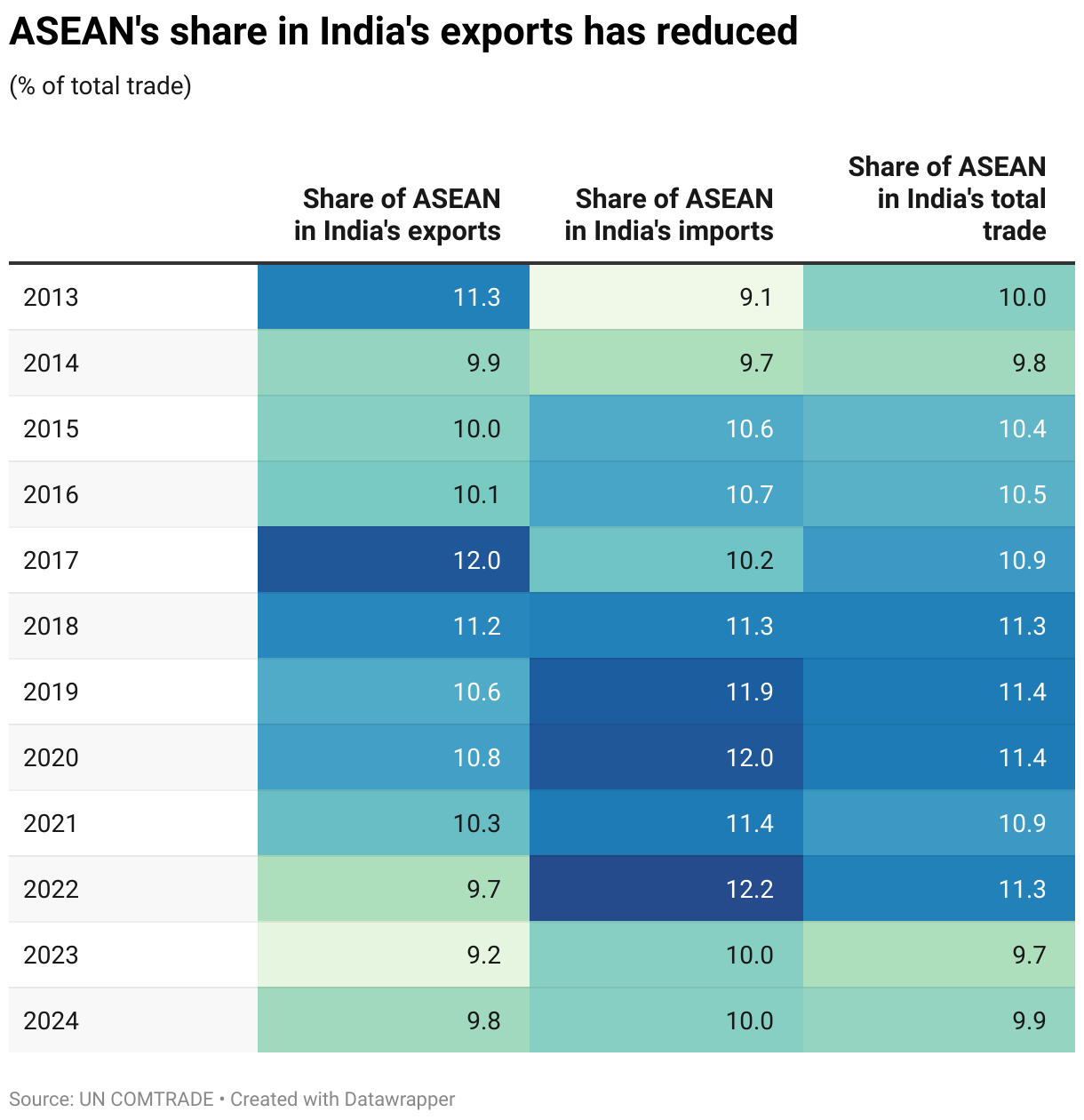
ASEAN’s role in India’s trade has remained broadly steady over the past decade, but the balance has tilted further in favour of imports, with inbound trade from Southeast Asian nations growing faster than India’s exports to the region, a Moneycontrol analysis of official data shows.
“ASEAN is the primary pillar of India's Look East policy. Even in times of uncertainties, India and ASEAN have made progress in their comprehensive strategic partnerships,” Prime Minister Narendra Modi said on October 26 while virtually addressing the ASEAN Summit 2025. He added that an early review of the ASEAN-India FTA (AITIGA) could “unleash the full economic potential of the relationship.”
Trade Share Flat, But Gap Widens
In 2024, ASEAN accounted for 9.8 percent of India’s exports and 10 percent of its imports, keeping its overall trade share around 9.9 percent, nearly the same as 2013, when it stood at 10 percent.
However, in value terms, imports from ASEAN have surged 65 percent since 2016, compared with a 60 percent rise in exports during the same period.
This divergence has translated into a persistent trade deficit, driven largely by electronic goods, metals, and rubber-based products.
Machinery and electrical goods made up 23 percent of India’s imports from ASEAN in 2024, up from 19.5 percent a decade ago, while metals’ share jumped to 11.1 percent from 4.2 percent in 2013.
Exports Shift Toward Higher-Value Goods
On the export side, India’s trade basket with ASEAN remains concentrated in fuels, chemicals, and metals, which together account for over 45 percent of total shipments.
While exports of refined petroleum and chemical intermediates have grown steadily, labour-intensive sectors such as textiles, food products, and leather have lost share, indicating a decline in export competitiveness in these categories.
The bright spot is machinery and electrical equipment, whose share in exports rose from 6.9 percent in 2013 to 13.4 percent in 2024, signalling India’s gradual shift toward higher-value manufacturing.
India’s overall trade dependence on ASEAN has plateaued, even as the deficit has widened.
Discover the latest Business News, Sensex, and Nifty updates. Obtain Personal Finance insights, tax queries, and expert opinions on Moneycontrol or download the Moneycontrol App to stay updated!





Find the best of Al News in one place, specially curated for you every weekend.
Stay on top of the latest tech trends and biggest startup news.