India’s mid- and small-cap indices have fallen sharply from their September 2024 peaks in dollar terms as geopolitical tensions and rising crude prices raise concerns about corporate balance sheets, analysts said.
The BSE MidCap 150 Index has declined about 22 percent in dollar terms from its peak, while the BSE SmallCap 250 Index has dropped around 30.4 percent. Both indices reached their highs in September 2024. In rupee terms, the BSE MidCap 150 Index has fallen about 14 percent, while the BSE SmallCap 250 Index has declined about 22 percent.
Mid-cap valuations have moderated while small-cap stocks continue to trade at relatively elevated levels despite the recent sharp correction. The BSE MidCap 150 Index is currently trading at a one-year forward price-to-earnings multiple of about 25 times, below its 10-year average of 27.3 times. In contrast, the BSE SmallCap 250 Index trades at a one-year forward PE of around 22.2 times, still above its long-term average of 20.9 times.
Akshay Chinchalkar, Managing Partner and Head of Markets Strategy at Wealth Co, said the recent selloff has been driven by several global and domestic headwinds. The ongoing geopolitical conflict has accelerated the recent decline, although the market peak itself formed earlier amid pressures including rising crude oil prices, a stronger dollar due to its safe-haven status, persistent foreign investor selling and higher inflation expectations.
While some technical indicators suggest markets may be approaching key support levels, the risk of further declines remains if crude prices and the dollar continue to strengthen, he added.
The sharp correction has unsettled retail and high-net-worth investors, who hold a significant share of mid- and small-cap stocks. Ambrish Baliga, an independent market analyst, said the current market environment reflects panic selling among investors.
Baliga said investors had become accustomed to buying declines over the past three to four years, when market dips were often followed by quick rebounds. However, fresh investments made in recent months have resulted in losses, prompting many investors to step back from the market.
He said the market has now entered a phase where investors who have already suffered losses are choosing to exit positions and move to cash amid uncertainty about how long geopolitical tensions may persist and how far markets could fall. Some leveraged investors have also been forced to unwind positions as prices declined.
The selloff has erased long-term gains for a large share of stocks in the segment. In the BSE SmallCap 250 Index, about 66 percent of stocks have lost their three-year compound annual growth rate returns, while roughly 50 percent have erased their five-year CAGR returns. In the BSE MidCap 150 Index, about 53 percent of stocks have lost their three-year CAGR returns and 37 percent have erased their five-year CAGR returns.
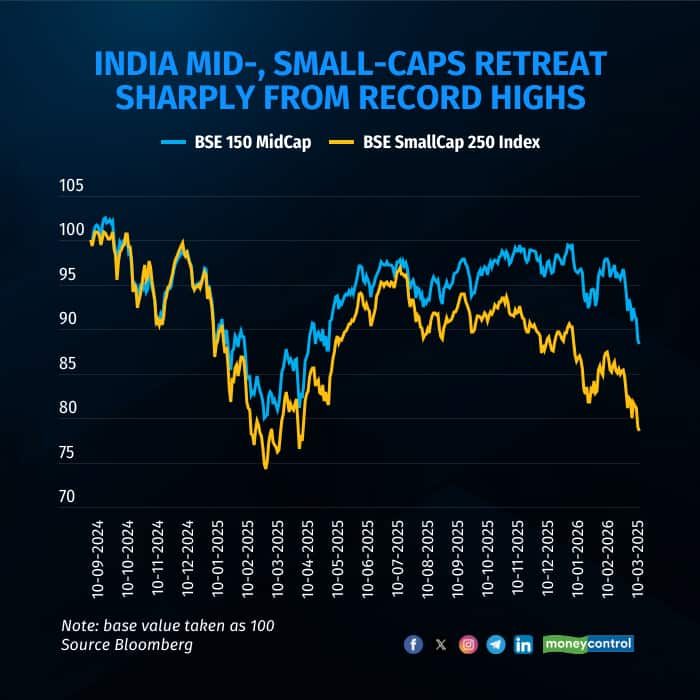
The correction follows a period of stretched valuations in 2024, when strong gains in mid- and small-cap stocks created significant investor enthusiasm. The recent decline reflects a shift from that earlier optimism to caution as global risks increase.
Sunny Agrawal - Head of Fundamental Research at SBI Securities said mid- and small-cap stocks have corrected sharply since the market peak in September 2024, largely due to persistent selling by foreign institutional investors along with a broader slowdown in market momentum. He added that reduced participation from proprietary desks, high-net-worth investors and retail traders, who are typically more active in these segments, has also contributed to the decline.
Among sectors, analysts said auto ancillary companies remain attractive due to premiumisation trends, regulatory changes related to safety standards, export opportunities and product diversification. Consumer discretionary segments such as jewellery and hotels are also being watched, supported by a shift from the unorganised to the organised market and improving demand trends.
Other sectors being tracked include recycling and metal products, structural steel tubes, electronic manufacturing services, hospitals and select non-banking financial companies. Consumer staples, which have underperformed recently, could also see improved growth if inflation moderates toward three to four percent.
Discover the latest Business News, Sensex, and Nifty updates. Obtain Personal Finance insights, tax queries, and expert opinions on Moneycontrol or download the Moneycontrol App to stay updated!
Find the best of Al News in one place, specially curated for you every weekend.
Stay on top of the latest tech trends and biggest startup news.