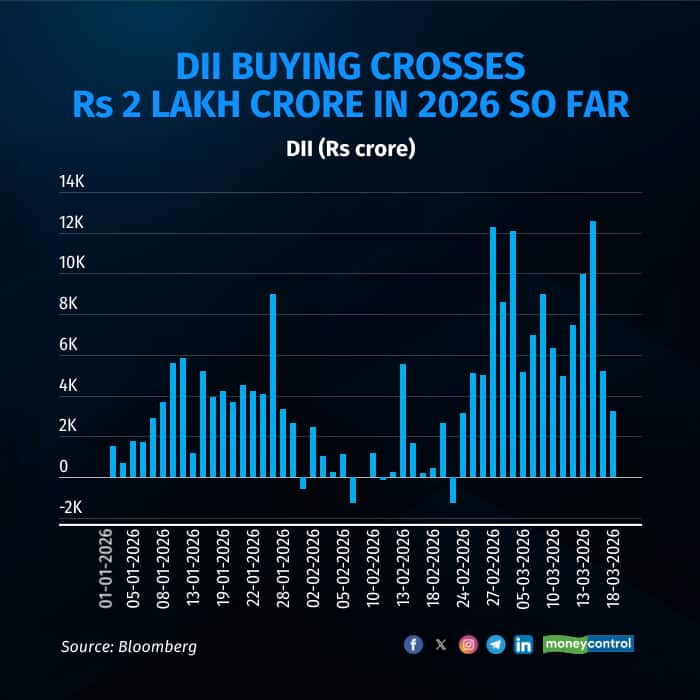
Domestic institutional investors (DIIs) have sharply accelerated their participation in Indian equities in 2026, deploying their second Rs 1 lakh crore in just 12 trading sessions, the fastest pace so far, compared with 39 sessions taken to reach the first Rs 1 lakh crore this year. The surge in buying follows a sharp correction in Indian markets triggered by geopolitical tensions involving Iran, Israel and the US.
So far in 2026, DIIs have invested over Rs 2.03 lakh crore in equities, continuing their strong participation after record inflows of more than Rs 7.75 lakh crore in 2025 and over Rs 5.23 lakh crore in 2024.
Historical trends show a steady acceleration in domestic flows. In 2025, the first Rs 1 lakh crore was achieved in 31 sessions, followed by subsequent tranches in 35, 39, 37, 21, 38 and 26 sessions. In 2024, the first five tranches were completed in 57, 40, 58, 36 and 45 sessions, respectively, while in 2023 it took 158 sessions to cross Rs 1 lakh crore.
The sustained buying has come despite stretched valuations, subdued earnings growth, absence of domestically listed artificial intelligence-related firms, and continued selling pressure from foreign institutional investors (FIIs). The momentum has also persisted even as crude oil prices rose above $100 per barrel, posing risks to India’s macroeconomic stability. With the country importing around 85 percent to 90 percent of its crude requirements, higher oil prices are expected to impact the trade balance, inflation and fiscal position.
Nikunj Saraf, Chief Executive Officer at Choice Wealth, said the recent market correction has largely been driven by global uncertainties, including geopolitical tensions and rising oil prices, while DIIs are viewing the decline as an opportunity rather than a concern. He said that since the correction is not driven by weak domestic fundamentals, domestic investors are using lower valuations to accumulate quality stocks, with recent rebounds also supported by value buying after sharp declines.
Indian benchmark indices witnessed a relief rally in the last two sessions, with the Sensex and Nifty rising about 2 percent during the period. However, broader markets remained volatile, with the BSE MidCap 150 and BSE SmallCap 250 indices continuing to see fluctuations.
A steady flow of domestic capital has supported the market, with inflows from systematic investment plans, mutual funds, insurance and pension funds providing a consistent investment base. These regular inflows have created a pool of capital that is deployed during market dips, further accelerating buying activity.
The trend also reflects a structural shift in Indian markets, which were earlier heavily dependent on foreign investors. Strong domestic liquidity is now helping absorb selling pressure and stabilise markets even during periods of sustained FII outflows.
So far in 2026, the Sensex and Nifty have declined more than 10 percent each, while the BSE MidCap and SmallCap indices have fallen over 9 percent and 12 percent, respectively. FIIs have sold more than $6.89 billion worth of Indian equities during the year.
Saurabh Jain, Head of Fundamental Research at SMC Global Securities, said that while FIIs remain cautious and retail sentiment is mixed, DIIs are acting counter-cyclically by deploying steady domestic liquidity and absorbing selling pressure, thereby stabilising markets and reinforcing the structural shift towards financial assets.
Discover the latest Business News, Sensex, and Nifty updates. Obtain Personal Finance insights, tax queries, and expert opinions on Moneycontrol or download the Moneycontrol App to stay updated!
Find the best of Al News in one place, specially curated for you every weekend.
Stay on top of the latest tech trends and biggest startup news.