

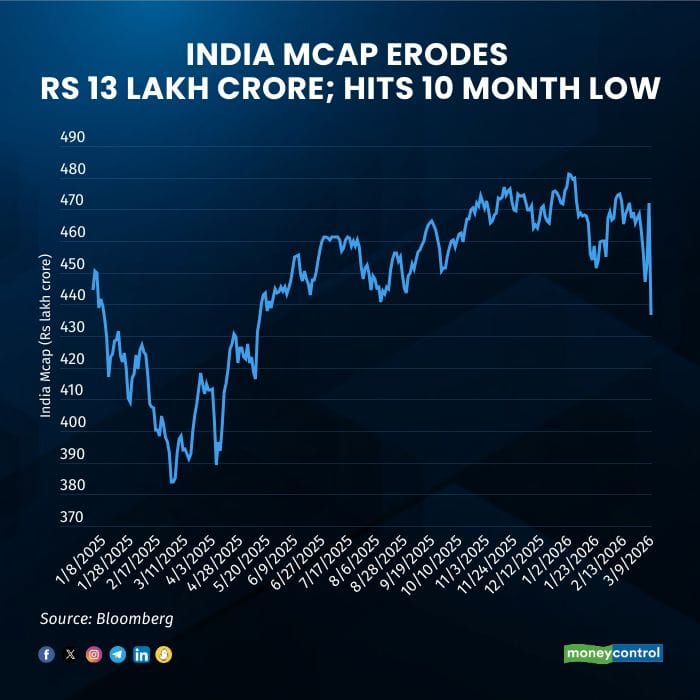
The market capitalisation of all listed firms on the BSE fell by over Rs 13 lakh crore, hitting a 10-month low, after a sharp selloff triggered by surging crude oil prices amid escalating geopolitical tensions in the Middle East.
Brent crude rose above $117 per barrel for the first time since 2022 as the US-Israel conflict with Iran showed no sign of easing, with both sides appearing set to prolong the confrontation. Investors also moved toward the US dollar as a safe-haven asset, adding pressure on risk assets globally.
The total m-cap of all listed companies on the BSE dropped to Rs 436.7 lakh crore, down Rs 13 lakh crore from the previous close, marking its steepest fall since April 7, 2025.
The broader decline has been significant since the latest market correction began. Since February 24, the total market capitalisation of BSE-listed firms has eroded by over Rs 35 lakh crore.
During the same period, the benchmark Sensex and Nifty have fallen about 7.5 percent each, while broader markets have also weakened. The BSE 150 MidCap index declined 5.5 percent, while the BSE 250 SmallCap index dropped 6.5 percent. Foreign institutional investors also turned sellers, offloading over $1 billion worth of equities during the period.
Meanwhile, domestic institutional investors (DIIs) — including mutual funds, insurers, banks and pension funds — stepped in aggressively during the correction, investing over Rs 58000 crore in Indian equities.
According to an ICICI Securities report, crude oil prices above $100 per barrel could trigger a sharp negative correlation with the Nifty50. The brokerage said crude prices currently reflect the “sum of all fears” arising from the significant escalation of the conflict in the Gulf region.
Despite the seriousness of the geopolitical situation, the report noted that oil prices have risen moderately to around $85 per barrel levels earlier, suggesting that markets may be pricing the disruption as temporary. By contrast, crude oil had surged to around $130 per barrel in 2022 within days of the Russia-Ukraine conflict.
Historically, crude oil prices and Nifty50 returns have shown a curvilinear relationship. When oil prices remain below the $90–$100 per barrel range, they tend to move positively with equity markets as higher oil prices can signal stronger global demand. However, once prices move above the $90–$100 range, the relationship reverses as higher crude prices begin to significantly increase India’s import bill and raise the risk of supply shocks linked to geopolitical tensions or broader macroeconomic stress.
Discover the latest Business News, Sensex, and Nifty updates. Obtain Personal Finance insights, tax queries, and expert opinions on Moneycontrol or download the Moneycontrol App to stay updated!
Find the best of Al News in one place, specially curated for you every weekend.
Stay on top of the latest tech trends and biggest startup news.