China is guiding the yuan weaker at a carefully orchestrated pace, as the central bank seeks to blunt some of the economic impact of the trade war without destabilizing financial markets.
The People’s Bank of China weakened the yuan’s daily reference rate for a fifth straight session on Wednesday, but moderated the pace of its adjustment. State banks were seen selling dollars in large amounts to prop up the yuan in the onshore market, according to traders.
The offshore yuan advanced by the most in a month, paring Tuesday’s 1.1% drop that that pushed it to a record low since the creation of the market in 2010. The onshore currency edged lower.
“The authorities want to manage the pace of yuan weakness, and they don’t want a big disorderly move,” said Khoon Goh, head of Asia research at Australia & New Zealand Banking Group. “But the broad direction is for further upside in dollar-yuan if there is no back-down on the US tariffs. I do not see a big one-off devaluation.”
The PBOC’s move came with no resolution in sight for the trade standoff, with President Donald Trump pushing forward with sweeping 104% levies on many Chinese goods. China has vowed earlier this week to “fight to the end” and retaliate against tariff threats.
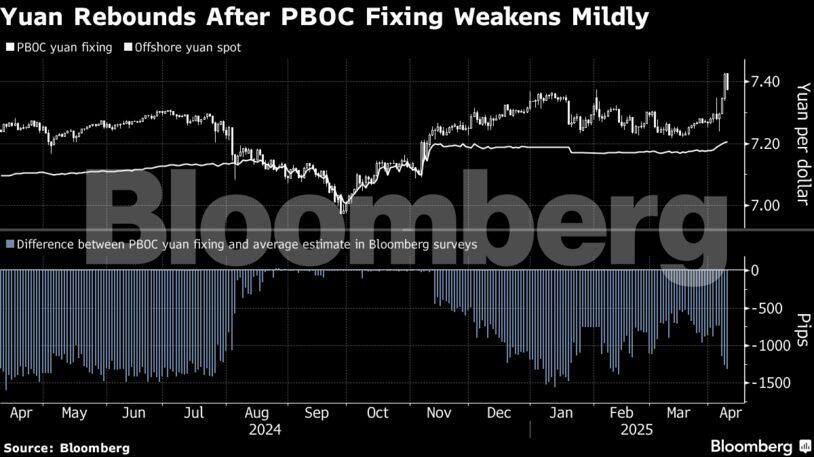
The yuan is weighed by bets that the PBOC will eventually allow some weakness to counter the impact of US tariffs on its economy, the nation’s bleak growth outlook and expectations that Beijing will roll out more monetary easing. But so far, China has stopped short of delivering an aggressive devaluation that some had speculated.
On Tuesday, bearish yuan bets received a boost after the PBOC allowed the so-called fixing to breach 7.20 per dollar, a level seen by investors as a soft-red line for official intentions toward the managed currency since Trump’s election. The onshore yuan, which is confined to a 2% trading range around the fixing and thus within tighter control of the PBOC, slid to the weakest level since September 2023 in response.
However, sharp yuan weakness carries a high cost despite its potential support for exports. It can hurt confidence toward Chinese assets and further agonize the US — Trump already said China is manipulating its currency to offset tariffs.
There are signs China is seeking to control the pace of yuan’s declines. State banks sold a large amount of dollars at around 7.3460 level in onshore trading in the morning to support the yuan, according to traders who asked not to be identified.
The PBOC weakened its fixing by 0.04%, half of the pace seen in the previous session, to 7.2066 on Wednesday. The gap between the fixing and market estimates widened to 1,321 pips, the most since February.
“Policymakers may prefer to maintain some degree of measured yuan stability,” Christopher Wong, strategist at Oversea-Chinese Banking Corp. wrote in a note. “A softer magnitude of increase in the dollar-yuan fix should calm sentiments for yuan, as well as provide a breather for Asian currencies.”
Discover the latest Business News, Sensex, and Nifty updates. Obtain Personal Finance insights, tax queries, and expert opinions on Moneycontrol or download the Moneycontrol App to stay updated!
Find the best of Al News in one place, specially curated for you every weekend.
Stay on top of the latest tech trends and biggest startup news.